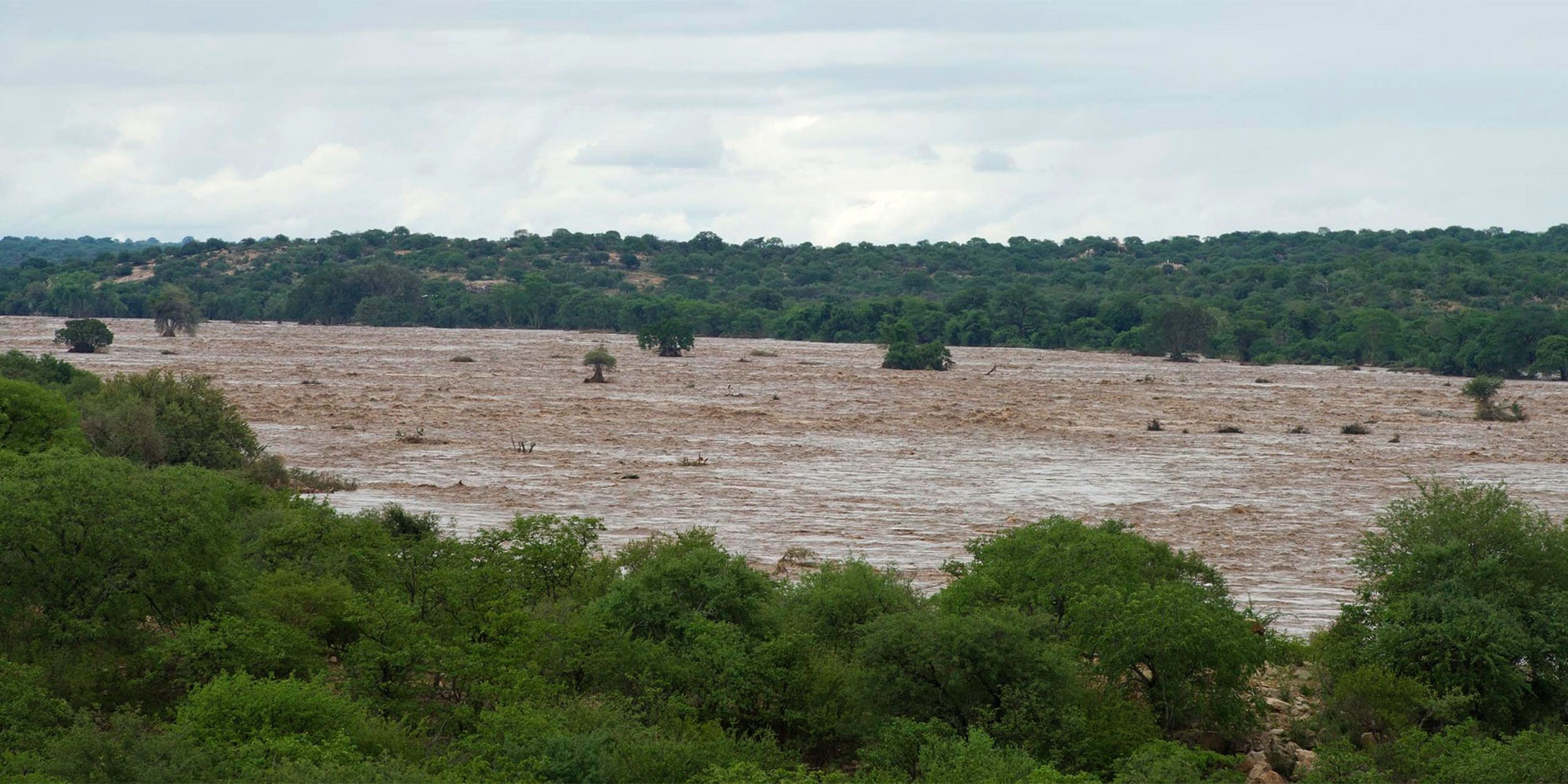
 The Limpopo River on 21 January 2013, when heavy rainfall caused severe floods in parts of Mpumalanga and Limpopo, just like this January. (Photo: Deaan Vivier / Foto24 / Gallo Images)
 In mid-January, South Africa’s northern provinces were gripped by severe flooding, and since then headlines have been numerous, populating newsfeeds daily.
What happened is widely known. The persistent rainfall started in late December during the festive season, and by 15 January the continuous rain had already turned into heavy downpours, the ground had been saturated, decreasing drainage potential, and the rivers had begun to break their banks.
The sheer volume of water was unprecedented. A widely reported attribution study by World Weather Attribution found that a dangerous combination of La Niña conditions, characterised by above-normal rainfall and compounded by human-induced climate change, made the downpours 40% more intense, resulting in the equivalent of six months’ rain falling within about 10 days in Limpopo and Mpumalanga.
However, this was anticipated by the South African Weather Service, which escalated its alerts from a level 9 (orange) warning to level 10 (red), its highest possible alert, signalling life-threatening flood risk. Technologically, the system worked. Socially, it faltered.
Impact-based warnings are designed to trigger behavioural and government responses – evacuations, road closures, the early positioning of emergency services. But in many flood-hit villages, people did not understand the gravity of the warnings.
When Daily Maverick visited Limpopo, the impression we got, in our interactions with residents of some of the worst-affected communities, was that although some of them may have heard about the level 10 weather warning in the lead-up to the disaster, very few had an idea of what this meant. It was assumed it would be a bad storm, just a feature of an average rainy season, and would pass through, as so many storms had done before.
/file/attachments/orphans/6I1A2844_566778.jpg "Sipho Dzambukeri outside a house that was damaged by the recent floods in Mbaula village in Giyani, Limpopo. (Photo: Felix Dlangamandla)")
They were largely unprepared for what followed – violently overflowing rivers, blocked roads and collapsing infrastructure. With many communities already isolated because of their remote and rural location, the sudden emergency was devastating, the immediate response chaotic. “The problem is that early warning is not enough on its own. It must be linked to action at the local level,” said Ephias Mugari, a climate adaptation researcher at the University of Limpopo’s Centre for Global Change.
Mugari explained that early-warning systems are made up of several components: forecasting, communication, interpretation and response. The first two may have functioned, but the latter two collapsed. Although residents were told that flooding was likely, they were not told what to do next, where to go or who was responsible for coordinating evacuations.
The mayor of the Collins Chabane Local Municipality, Shadrack Gezani Maluleke, noted that the municipality communicated warnings from the South African Weather Service through platforms such as social media and local radio stations.
But he acknowledged that things had gone wrong. “Obviously, we need to do things differently from now on, in that we need to strengthen our disaster departments in our local municipalities, as well as in the district, to ensure that things are handled much better compared with this time.”
Disaster management in silos
Beyond community-level gaps, Mugari said fragmented governance created a deeper structural problem. Disaster risk management required coordination across sectors – water, health, housing, transport and social development. However, these departments often operated in isolation.
“What happens in agriculture affects health. What happens in health affects other sectors. Disaster management needs all stakeholders working together, not in silos,” Mugari said.
The researcher, who is also part of the Limpopo Provincial Disaster Management Advisory Forum, proposed that the escalation of weather warnings should automatically trigger the release of resources and personnel across all spheres of government.
Although the government did officially classify the floods as a national disaster, which allows for the type of institutional mobilisation Mugari described, it only did that on 18 January, when most of the flooding had already occurred, after oversight visits to flood-affected areas by President Cyril Ramaphosa and Cooperative Governance and Traditional Affairs Minister Velenkosini Hlabisa.
Mugari added that in situations such as the Limpopo floods, sector-wide resource deployment is often reactive rather than pre-approved, and local leadership structures are frequently not sufficiently capacitated to respond adequately.
/file/attachments/orphans/P7Leratowarmingclimate_708364.jpg "(Graphic: Jocelyn Adamson)")
He argued for the establishment of local disaster management committees, even at the village level, that are trained, equipped with resources and empowered to act immediately when warnings are issued. This, he said, would reduce panic and improve decision-making during crises.
Daily Maverick contacted the Disaster Risk Management Centre about the flood response and South Africa’s early warning system, but had not received a response by the time of publication.
Preparedness in a warming climate
The floods raised urgent questions about South Africa’s climate adaptation strategy. Although policies and frameworks are good on paper, Mugari cautioned that plans without funding are “as good as dead”.
He stressed that climate adaptation should not focus on post-disaster relief, and any investment must prioritise prevention.
This includes stronger drainage systems, flood-resilient infrastructure and land-use maps that consider updated climate risk maps. International mechanisms such as the Loss and Damage Fund and the Adaptation Fund existed, but they must be deployed sooner to support not only recovery, but also resilience-building to prevent future losses.
As extreme weather events become more intense and less predictable, Mugari warned that treating disasters as rare shocks is no longer a viable option. “Preparedness must be embedded in planning and budgeting, before the rain falls,” he said.
The role of NGOs
As is so often the case in South African disasters, nongovernmental organisations were an integral part of the response to the flooding. National groups like Gift of the Givers and local entities such as the Greater Giyani Business Chamber sprang into action, providing relief with food parcels and essentials.
Clifford Mabe, a Gift of the Givers community liaison officer in Limpopo, was on the ground from day one, helping affected communities alongside his team members Rashid Chamissa, Israel Molauzi and Tholang Taudi. Mabe praised the provincial Emergency Medical Services and search-and-rescue teams for their invaluable efforts during the disaster response.
“From the word go, they were leading us where to go. They even flew us [by helicopter] to do assessments because we couldn’t access the villages… Every distribution since day one, they were there. They were guiding our trucks. They were checking the roads before we went,” he said.
Despite facing obstacles such as inaccessible areas, damaged roads and extreme heat, Gift of the Givers has distributed almost 6,000 food hampers since the disaster hit. On 19 February, Mabe spent his birthday on the ground providing aid. “It was raining heavily. We were doing distribution in the rain. We couldn’t stop. Forget about the rain. We are here to help people,” he told Daily Maverick.
Mabe said he was fortunate to work alongside people who had a “real passion” for the job, since it often pushed individuals to their limits. “When you start thinking of other people who don’t have food, don’t have shelter, you need to push to make sure that those people will have support,” he said.
“When you’re on the ground, you don’t just go and throw food parcels at people. We sit with those beneficiaries… We ask them about their challenges. They need to feel important again. They lost everything, but they need to… get that dignity back.” DM
This story first appeared in our weekly DM168 newspaper, available countrywide for R35.
/file/attachments/2988/Frontpage1_855591.jpg)