



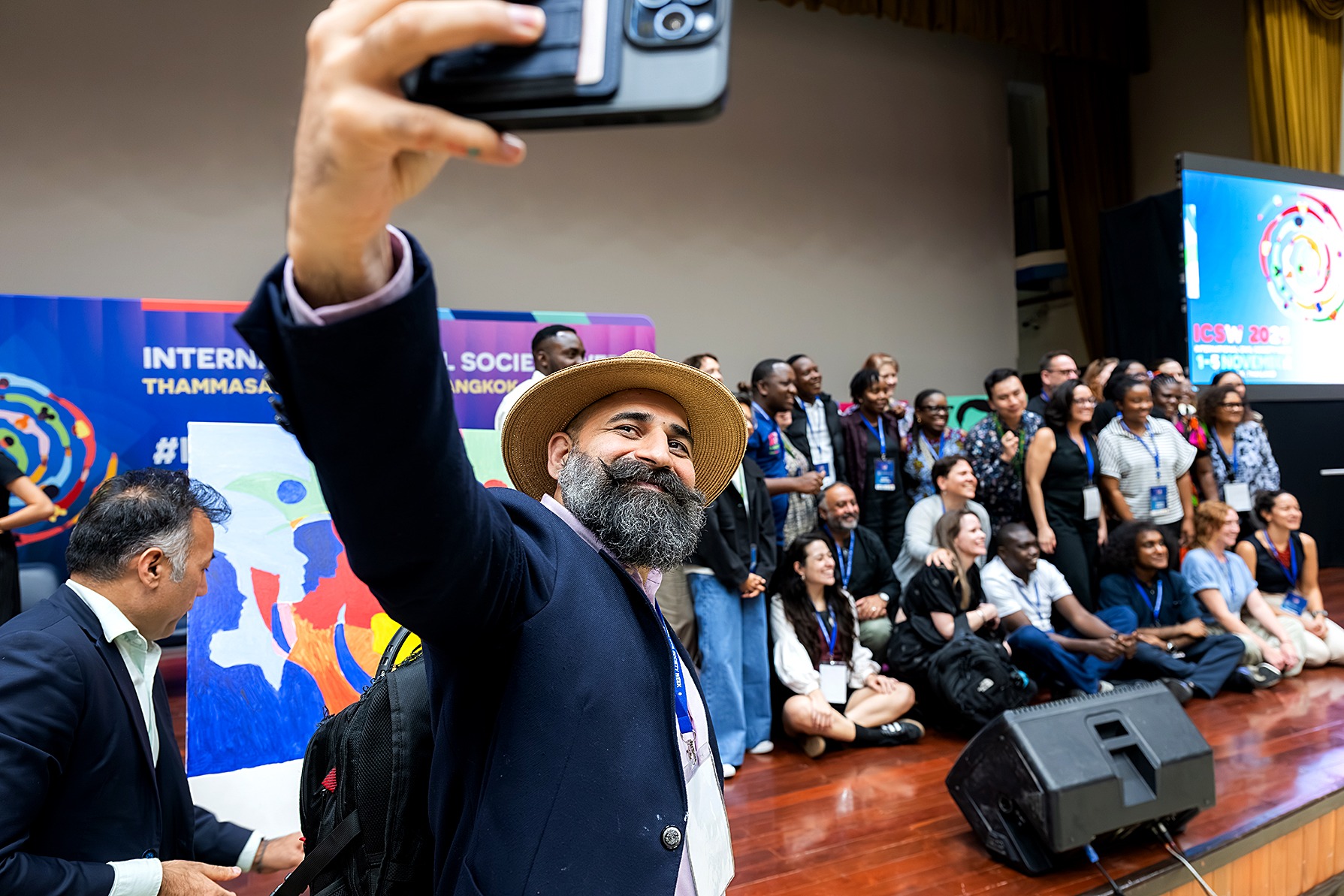
 Sulieman Hedayat, an Afghani calligrapher from the organisation ArtLords, takes a selfie at International Civil Society Week. (Photo: Civicus)
 A continued rise in authoritarianism across the globe, extreme military and economic power concentrated in the hands of elites, and a general degradation of democracy.
These are but some of the issues that hamper democracy and civil liberties in countries across the globe. At times, these problems seem intractable. But Mandeep Tiwana, the secretary-general of Civicus, a global alliance of civil society organisations and activists, is resolutely hopeful for the future.
Daily Maverick spoke to Tiwana on the sidelines of the International Civil Society Week (ICSW) in Bangkok, Thailand. The event, held over five days in November last year, brought together nearly 1,000 civil society leaders, activists and artists from all spheres of the globe to discuss issues around democracy, civil rights and inclusion in today’s fragmented political and economic landscape.
“Civil society believes in internationalism, in an interconnected humanity. Issues like peace, equality, justice and sustainability cannot be solved by one country alone; they transcend borders,” said Tiwana, who hails from India. He is a human rights lawyer by training and worked with the International Committee of the Red Cross and other bodies before joining Civicus. Tiwana took over as the latter’s secretary-general in June, 2025.
According to Tiwana, his organisation has been tracking challenges that fall under two broad categories.
“There is a rise of authoritarianism and a gaining of extreme military and economic power in authoritarian states. At the same time, there is a degradation of democracy in countries that were previously seen to have strong democratic traditions and practices.”
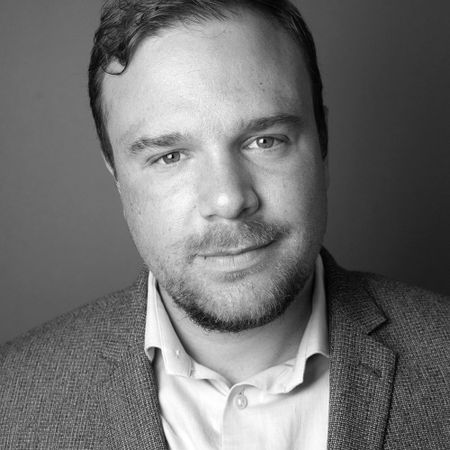
/file/attachments/orphans/MandeepTiwana1_968124.jpg "Civicus Secretary-General Mandeep Tiwana speaks at the International Civil Society Week in Bangkok, Thailand, in November 2025. (Photo: Civicus)")
In the US, where he spends considerable time at the United Nations’ headquarters in New York, Tiwana has witnessed a “high level of corruption, the lack of taking responsibility for anything, a complete lack of any moral compass and the willingness to do anything to stay in power”.
Tiwana was previously stationed at Civicus’ SA headquarters. He says there are parallels between the Trump administration and that of former president Jacob Zuma.
Both Trump and Zuma spearheaded an “erosion of checks and balances” in their respective countries, argues Tiwana.
In countries where authoritarian regimes are already in place, meanwhile, despotic leaders have only strengthened their grip on power. In Rwanda, for instance, president Paul Kagame’s government has solidified its repressive strongman approach under a veneer of supposed service delivery.
“As long as the streets of Kigali are clean it doesn’t matter that you have people in dungeons and families living in poverty,” says Tiwana.
Peaceful protest
He highlights freedom of expression and peaceful protest as vital means to oppose repressive regimes. In countries like Kenya and Serbia, recent protest movements around human rights issues were met by harsh crackdowns from their respective governments.
“Freedom of association, freedom of expression, the right to peaceful assembly… those are fundamental rights. And wherever they are suppressed, you see a high chance of a concentration of power and wealth, and high levels of corruption.”
Also of concern is the manner in which populist leaders have been growing and consolidating their bases by leveraging the power and reach of social media platforms.
According to Tiwana, populist leaders offer “simple solutions to complex problems”, and they exploit people’s fears and biases in the echo chambers that abound on social media platforms. Populist leaders have been especially adept at targeting specific segments of society, such as an increasingly disenfranchised youth.
/file/attachments/orphans/ICSW2025_D2-126_592496.jpg "Delegates at the International Civil Society Week 2025 in Bangkok, Thailand. (Photo: Civicus)")
“The quality of democracy on offer in many countries was actually very poor. And people think in binaries. So they said, ‘Okay, democracy doesn’t work.’ Then you have a charismatic, authoritarian leader in a country with a youth bulge... who then struts around and appeals to them with machismo and patriarchy.”
But it is in the youth that Tiwana pins much of his hope.
“I have two daughters, aged 11 and 12, and when I see them go to school and being so conscious and alive around issues of discrimination, around inclusion, and their kindness and understanding. That gives me hope.”
Tiwana says he also draws courage from the way in which young people stood up for their rights in recent years.
“There were movements against corruption in Kenya, in South Korea young people stood up against military-style rule, in Guatemala it was the youth who led protests when a corrupt cabal was trying to steal the election.”
According to Tiwana, one of Civicus’ biggest achievements is the organisation’s ability to bring together activists with other role-players from countries all over the world to discuss and strategise around issues affecting civil society.
“We’ve created a sense of solidarity between civil society actors around the world, by getting organisations to understand that there are others who care about democratic rights, that there are others who stand with them when they are persecuted.”
Games for change
The 2025 edition of International Civil Society Week, held at the main campus of Bangkok’s Thammasat University, featured keynotes, plenaries and workshops focused on addressing society’s most pressing challenges.
Added to the offering were appearances by artists, musicians and other creatives, all somehow involved in tackling human rights and other issues in their respective countries.
There appears to be a growing trend in the use of interactive games and other creative means to spread awareness around societal issues.
Error 404, a board game showcased at the gathering, seeks to encourage debate and understanding around fake news, disinformation, hate speech and surveillance.
/file/attachments/orphans/Error404boardgame_514818.jpeg "The Error 404 board game takes players through scenarios related to hate speech, disinformation and related issues. (Photo: Pieter-Louis Myburgh)")
Developed by Romanian NGO Station Europe, Error 404 takes players through a range of situations and encourages them to think critically about how they might deal with real-world problems.
One of the game’s cards, for instance, has players reflect on how they would react to conspiracy theories relating to the media. Another focuses on the monitoring of students’ online activities.
Daria Ienea, Station Europe’s representative at the gathering, says Romania is in great need of programmes that might boost civic and political education.
The country’s 2024 presidential elections had to be annulled after a foreign interference scandal. The election’s first-round winner, Călin Georgescu, an ultra-nationalist with pro-Russian leanings, was found to have benefitted from a massive cyber campaign that saw bot accounts sow disinformation aimed at his opponents, among other dubious tactics. It is suspected that Georgescu’s campaign was backed and bankrolled by Russian actors.
“For now, the community in Romania really needs help, specifically on civic and political education,” says Ienea.
/file/attachments/orphans/Daria-FlorentinaIenea_241949.jpg "Daria Ienea from Station Europe, a Romanian NGO that uses board games to help cultivate awareness around societal issues. (Photo: Civicus)")
Ienea and her colleagues have taken Error 404 to high schools and libraries in Romania, where students and other participants got to test the game’s interactive format.
“The goal is to reach and educate as many people as possible,” says Ienea.
Narrating Change, another game presented at International Civil Society Week, aims to help individuals and teams working in the civil society space to craft better communications strategies.
According to Michelene Rama, games are highly effective tools for inspiring ideas and strategies. Rama is from Dakila, a Philippine non-profit that promotes social transformation through art, media and grassroots actions.
“The mechanics of games are easier to grasp than the mechanics of society,” says Rama.
/file/attachments/orphans/NarratingChangegame_507341.jpeg "The Narrating Change board game was conceptualised in the Philippines. (Photo: Pieter-Louis Myburgh)")
The idea is to use the game as a practical tool during workshops for individuals whose work somehow relates to narratives and narrative change, including strategic communications specialists, media practitioners, student leaders and other civil society actors.
“After you’ve played Narrating Change, you actually take the steps you went through in the game to map out an action plan,” explains Rama.
Hope through art
Perhaps the most invigorating moment of the entire International Civil Society Week came when Thai rapper Elevenfinger (birth name Thanayut Na Ayutthaya) took to the stage on the second day.
Hailing from Khlong Toei, Bangkok’s largest slum, Elevenfinger grew up in a very poor household.
“I was at a games café one day when someone came in and began singing rap songs,” the 24-year-old told us through an interpreter. He was instantly taken with the genre and began writing songs of his own. He soon realised that hip-hop could be a powerful means to bring about awareness around important societal issues.
/file/attachments/orphans/Elevenfinger_286938.jpg "Thai rapper Elevenfinger uses his music to address issues affecting the country’s marginalised communities. (Photo: Civicus)")
“Pop music in Thailand is all about glamour and wealthy lifestyles. Nobody was singing about what life in the slums is like. I started using rap music to express myself,” said Elevenfinger.
Eventually, he became a strong voice in favour of constitutional reform, freedom of expression and an overhaul of the country’s justice system. Naturally,Thailand’s authoritarian government didn’t exactly welcome the rapper’s messages.
In 2021, Elevenfinger was sentenced to a year in jail for his involvement in protest action aimed at then prime minister Prayut Chan-o-cha.
He ended up spending two years in jail. This was a setback, but certainly not a waste of time, seeing as Elevenfinger wrote material for two full-length albums during his time behind bars.
Today, Elevenfinger is as resolute as ever about helping to foster change in his country. One lingering problem is the misappropriation of public funds.
“The Thai government needs to spend taxpayers’ money in a way that benefits citizens equally,” he argues.
Another inspiring session at the Bangkok gathering exposed attendees to the powerful work of the ArtLords movement. Founded in Afghanistan in 2014, the ArtLords is a collective of artists and volunteers who use art – think large, provocative murals – to spread messages of peace, hope and social change. Their murals in Kabul and elsewhere in Afghanistan reflect the country’s deep desire for a peaceful and prosperous future.
/file/attachments/orphans/IMG_5688_179594.jpeg "A painting by Sulieman Hedayat and other collaborators at International Civil Society Week. (Photo: Pieter-Louis Myburgh)")
Sulieman Hedayat, an Afghani calligrapher and one of the organisation’s representatives, described how the murals transformed parts of Kabul, bringing colour and inspiration to areas pockmarked by decades of violent conflict.
ArtLords also offers support to women artists in Afghanistan, where the suppression of women is a grim reality under the Taliban’s suffocating rule.
The movement organises painted meditation sessions for women artists, where they’re given safe spaces for processing trauma and encouraging expression.
Tiwana, meanwhile, says it is his hope that events like International Civil Society Week would instil courage in activists who operate in the world’s most troubled regions.
“I want to help form an appreciation that they’re not alone. There are hundreds of millions of people who actually believe in our common humanity, right? So I want delegates to know that their struggle for justice, for rights, for democracy... it is not isolated. There are many others out there who are fighting the same fight,” he said. DM