




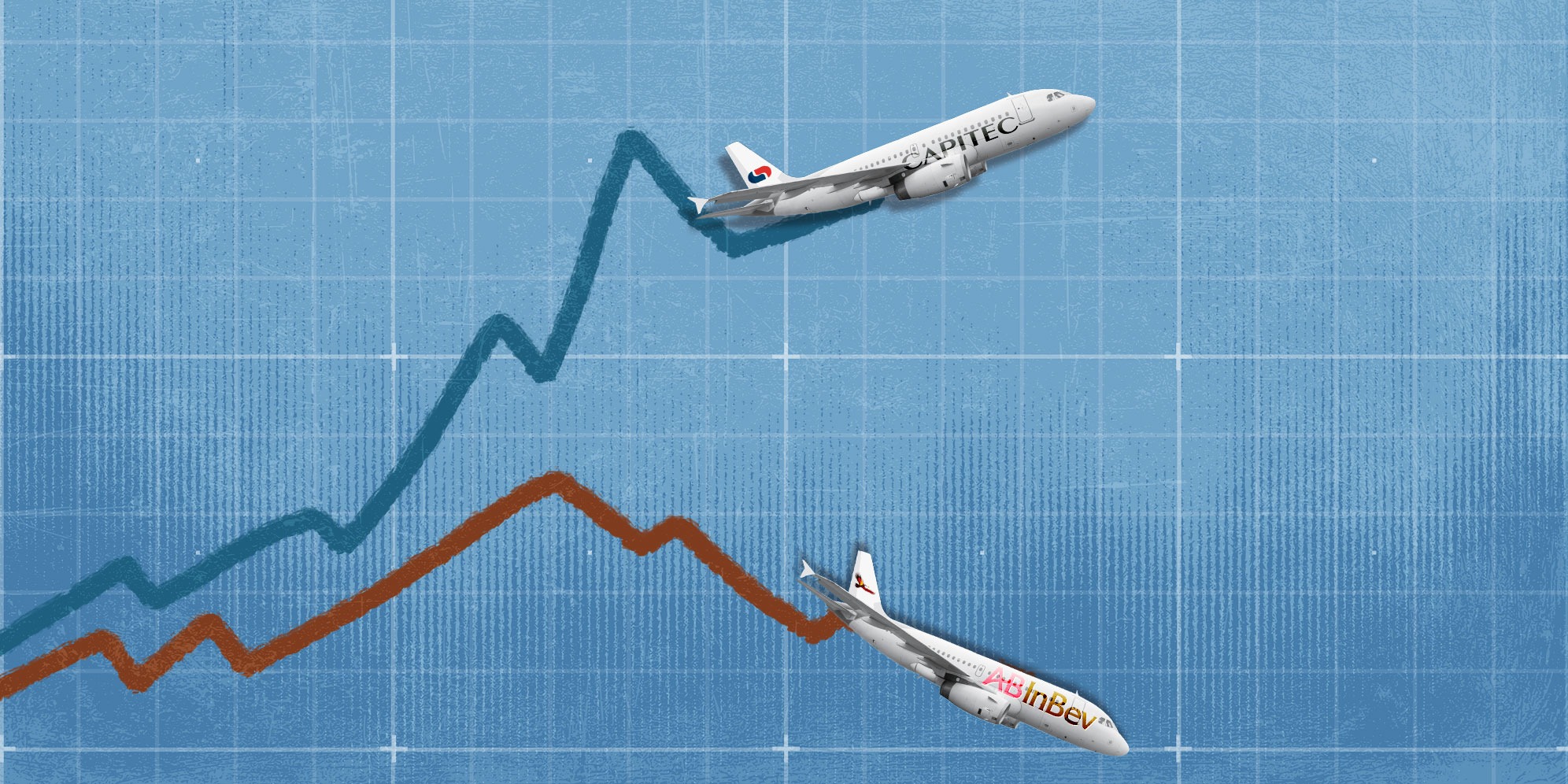
 Illustrative image: Capitec’s impressive growth continues, eclipsing AB InBev’s struggles in a changing market. (Images: Sourced | iStock) | (By Daniella Lee Ming Yesca)
 This seems ridiculous, doesn’t it? The concept of comparing beer and banking – how could these things possibly be related?
Aside from there being a good chance these days of hearing the point-of-sale machine sing the Capitec jingle after you’ve paid for a crisp ale at your local watering hole, there isn’t much else that they have in common.
Unless you’re an investor, of course. Through that lens, you can see them as industries that are competing for your capital.
You don’t need to allocate your capital to industries in the same way that you spend your money each month. Your monthly budget will be spread across numerous consumer products and services, many of which are poor industries to invest in. But with your portfolio, you can entirely avoid specific industries and focus on others. Not only can you do this, but you should be doing this.
In the past week, we saw two market giants come out with earnings updates. At Capitec, there’s still an exceptional growth story that is being driven by multiple flywheels in the group. At AB InBev, the company is trying to do the best it can in a world where people are swapping beer for kombucha.
Over five years, Capitec’s share price is up 230%. AB InBev has managed just 36%. Those are two vastly different outcomes.
Sure, we are comparing an exceptional story of disruption to a mature company here, but the point is that your money doesn’t distinguish between these things when you choose where to invest. All your money knows is whether it went up or down, an outcome that will be a function of what you bought and how much you paid on entry.
The underlying question here is well worth thinking about: even though AB InBev’s price/earnings (p/e) multiple is much lower than Capitec, which one of them is actually expensive relative to the underlying performance?
Let’s dig into the latest numbers to answer it.
Capitec: so much achieved, much more to still do
Capitec makes a song and dance about simplicity. If you’ve researched the history of the group, you’ll know that the journey to get to a market cap of R540-billion has been predicated on providing a focused service offering in a way that genuinely disrupts the market. To disrupt, you need to be materially better than the existing players. This is very hard (arguably impossible) to do, unless you focus on getting only a few things right.
/file/attachments/orphans/20230310_090002_126179.jpg "Capitec has many growth engines, such as Capitec Connect and the insurance businesses. Image: Capitec head office in Stellenbosch. (Photo: Neesa Moodley)")
With a market cap that has now overtaken both FirstRand and Standard Bank, Capitec can feel extremely proud. Gerrie Fourie retired as CEO as mid-2025 and handed the reins to Graham Lee, the exec who previously ran the personal bank division. He’s inherited a company that has more growth levers to pull than any other large bank in South Africa, mainly because the product offering at Capitec still has so many elements that can be added.
Business banking is just one example of a key growth area for the group. I’ve experienced it myself, as I’ve switched to Capitec in one of my businesses and I’m now enjoying considerably lower fees than before. There are many other growth engines, such as Capitec Connect and the insurance businesses.
A trading statement has confirmed that Heps (headline earnings per share) for the year ending February 2026 will be up by between 20% and 25%. Despite Capitec’s impressive scale, it is still growing rapidly.
The p/e multiple is currently around 35x. The market is paying up for Capitec’s growth, but this multiple doesn’t seem ridiculous when you consider the underlying market position and how much more it can still do.
AB InBev: no flywheels detected
Imagine an airport. Capitec is enjoying a long growth runway that allows a huge plane to take off without much risk of something going wrong. Everything is well-lit and you can see miles ahead. Over at AB InBev, the growth runway has turned into one of those jungle airstrips in an action movie, where you aren’t sure whether the small plane will actually manage to get its nose above the tree line.
I don’t know about you, but I prefer boring movies for my money and action movies for my TV screen.
The shrinking runway at AB InBev is thanks to a major consumer health trend: a switch away from beer. Tasty as it may be on a hot day, even the “lite” alternatives are filled with calories. People have become more aware of this and have reduced their consumption accordingly, with AB InBev reporting a 2.6% drop in beer volumes in FY25.
When volumes are dropping, the only way you can increase revenue is through higher prices. Revenue per hectolitre was up 4.4% in FY25. As business strategies go, putting pricing pressure on an ever-reducing number of customers doesn’t seem like a road to success.
For AB InBev to make shareholders happy, it needs to spend money wisely and earn more profit from what it sells. It achieved this in 2025. Its profit margin got a little bigger, reaching 35.8%. The fourth quarter was only 35.2% though, down 10 basis points year-on-year. This is concerning exit velocity for the year.
Heps grew by 19% in FY25 despite these concerns, but this is a rare example of Heps being a poor reflection of the underlying growth story. AB InBev discloses growth in underlying earnings per share to give you a better idea of the performance. With an increase of just 6% in FY25 (and a more impressive 7.5% in the fourth quarter despite the margin pressure), AB InBev is telling a story of mid-single digit growth.
This also ties in with AB InBev’s near-term guidance of Ebitda (earnings before interest, tax and depreciation) growth of between 4% and 8%, with an important additional factor being the extent of debt on the balance sheet and how this affects earnings growth.
So, modest growth and a market that seems to be shrinking. Surely this comes at a low p/e multiple, right? Wrong. Currently trading at 19.7x, the market is paying up for this story and treating it as a defensive business.
For context, you can buy Shoprite on exactly the same multiple. Which one would you rather have? Which one do you believe is truly “defensive” in the modern world?
Glossary
📈 Price/earnings multiple: tells you how many years of a company’s profit you are paying for when you buy its shares.
📈 Headline earnings: Headline earnings are a measurement of a company’s earnings based solely on operational and capital investment activities. It specifically excludes any income that may relate to staff reductions, sales of assets, or accounting write-downs.
Investing isn’t about comparing multiples and always picking the lower one. It’s about understanding what you’re getting for the price that you’re paying for it. This is why Capitec has been such a strong performer for investors, despite trading at a “high” multiple. DM