





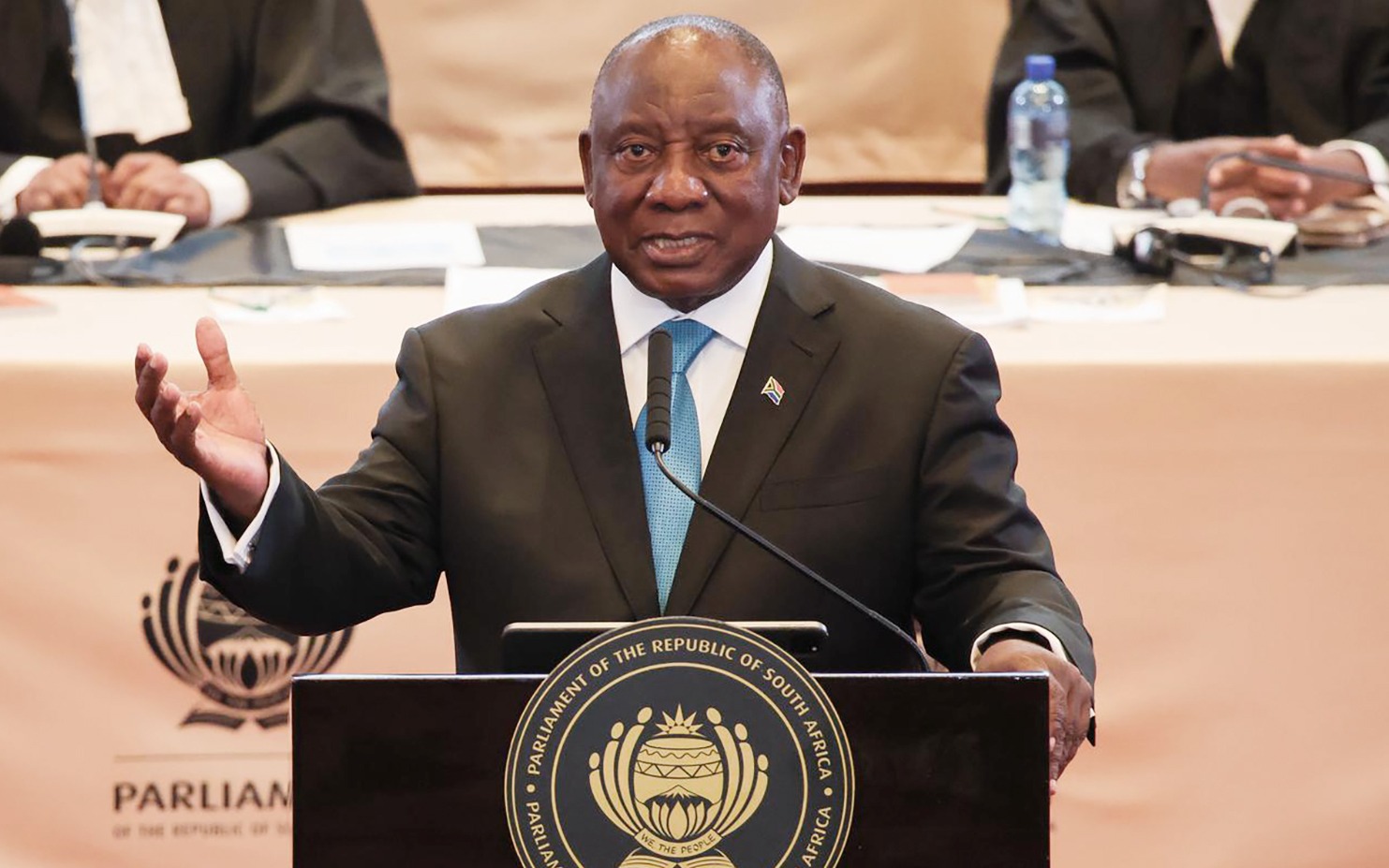
 President Cyril Ramaphosa to delivers the 2026 State of the Nation Address. (Photo: Jairus Mmutle / GCIS)
 In his State of the Nation Address (Sona) on Thursday, 12 February, President Cyril Ramaphosa committed to embarking on a mission to end child stunting by 2030, which has been heralded as a “big win” by civil society partners in the children’s sector. This also aligns with the United Nations’ Sustainable Development Goal 2 which aims to end all forms of malnutrition by 2030.
Stunting – the impaired growth and development that children experience from poor nutrition – is estimated to affect one in four children under five in South Africa. Putting it on the national agenda is seen as a step in the right direction for improving health and development outcomes for young people. Worryingly, South Africa’s stunting rate is ranked higher than the global average.
However, questions remain about the specific interventions the government will be pursuing to bring about an end to stunting and tackle malnutrition in the early years.
Steps to end stunting
In his speech, Ramaphosa said the government would:
- Work to end child stunting and tackle malnutrition among young children in line with the National Strategy to Accelerate Action for Children (NSAAC);
- Focus on the crucial first 1,000 days of a child’s life; and
- Build on existing support such as the Child Support Grant to implement targeted interventions that ensure pregnant women and low-birth weight children get the protein and nutrients they need.
The NSAAC, which was approved by Cabinet in November 2025, lays out 10 national priorities to substantially improve child and adolescent wellbeing, including improving child nutrition.
The Maternal Support Grant (MSG) Advocacy Coalition, a collective of NGOs and researchers, has been campaigning for a nine-month grant for expectant mothers that would provide income support from the second trimester of a confirmed pregnancy until three months after birth. The coalition has argued that babies born to food-insecure mothers are more likely to have low birth weight and experience stunted growth.
Ramaphosa did not explicitly commit to a maternal support grant in his speech.
David Harrison, CEO of the DG Murray Trust (a member of the MSG Advocacy Coalition), said this may indicate the government will be pursuing more progressive interventions in the short term, such as multiple micronutrient supplementation (MMS) during pregnancy. MMS has been shown to be more effective in improving health outcomes for babies than current supplements which only provide two nutrients, iron and folic acid.
Another possible strategy is the scaling of the Khulisa Care programme, a pilot nutrition strategy launched by the Western Cape Department of Health and Wellness and the DG Murray Trust in August 2025, said Harrison. It targets underweight pregnant women and mothers who have already given birth to babies with a low birth weight, providing access to monthly food vouchers for nutritious, protein-rich foods and primary healthcare support through trained community health workers.
/file/attachments/orphans/David-Harrison_400_534027.jpg "David Harrison. (Photo: TRI / Wikipedia)")
Read more: Western Cape to tackle ‘shocking’ stunting stats in ‘targeted’ nutrition scheme for moms, babies
“The key strategies [to end stunting] include better maternal nutrition, and so the commitment to the Khulisa Care programme… is important. This is where we would argue that the maternal support grant is important because targeted strategies don’t seem to be reaching the 20% of babies who are most vulnerable,” said Harrison.
“We know the Child Support Grant has a coverage of only about 63% in the first year of [a baby’s] life. So, getting pregnant women onto a support grant to ensure that they and then their children have got support during pregnancy and right from birth is critical.”
Stunting and ECD centres
Tshepo Mantjé, an early childhood development (ECD) coordinator with the Equality Collective, noted the organisation’s support for the MSG Advocacy Coalition and its call to implement a support grant for pregnant mothers.
He added that the strategies to tackle stunting should include a strong nutrition programme in ECD centres. Currently, 40% of the R24-per-child-per-day ECD subsidy provided to registered centres is ringfenced for nutrition. This amounts to about R9 per child per day – too small an allocation for proper meals, he argued.
/file/dailymaverick/wp-content/uploads/Dougan-Payne-Crags_-MAIN.jpg "A pupil at The Crags Primary School in Kurland, Western Cape collects a meal at the school hall. Most pupils at the school are on the National School Feeding Scheme. A local NGO, Masizakhe: Food4Learning, offers additional support to the school. (Photo: Daily Maverick)")
The push for better access to quality meals at ECD centres is not new. Julika Falconer, CEO of the ECD-focused nonprofit Zero2Five, said that the organisation had long worked with its partners to position ECD centres as “nutrition hubs” within their communities, and argued that early learning sites should be leveraged in the fight against stunting.
“With expanded access to ECD services, early learning programmes are uniquely positioned to support the fight against stunting and malnutrition. Through simple growth monitoring, early identification of children at risk and referral pathways that involve local clinics and community health workers, ECD centres can serve as frontline points of prevention and care,” she said.
Making food more affordable
Harrison highlighted three main frontiers on which to tackle stunting:
- Making protein-rich staples more affordable through interventions such as the “10 best buy strategy”, which seeks to unite government, business and civil society in bringing down the prices of 10 highly nutritious basic foods;
- Reducing the number of babies who are born small; and
- Helping families and communities to grow their own food.
“There’s been an attrition of the value of the Child Support Grant... When it was established, it was about 95% of the food poverty line. Now, it’s down to about 70% of the food poverty line, and probably even lower,” Harrison noted.
“The medium-term budget must try and get the Child Support Grant back to the food poverty line, because we know that has been shown to be probably the single most effective strategy in reducing child vulnerability and reducing stunting.”
/file/dailymaverick/wp-content/uploads/2025/08/Z63_4549.jpg "The cost of an empty stomach: why we must act now with Mark Heywood, activist at Daily Maverick’s The Gathering 2025. (Photo: David Harrison)")
Mark Heywood, human rights activist and spokesperson for the Union Against Hunger, welcomed the Sona 2026 commitment to ending stunting by 2030, and emphasised the importance of civil society involvement in the development of a plan of action.
“Our response is that a commitment that is welcome needs to be rapidly translated into a plan of action that indicates what measures will be taken to end stunting within four years – who will have responsibility and be ultimately accountable in government; what is the budget that is allocated to that; and how will government instigate a social mobilisation so that people who will benefit from this understand and participate in the design of a programme that reaches all vulnerable children,” he said.
Curbing alcohol harms
Ramaphosa flagged excessive alcohol consumption as a “major contributor” to child stunting in his address, with potential to affect children’s development during pregnancy. He committed to:
- Calling on provincial governments to strengthen the regulation of alcohol by limiting the density of liquor outlets, restricting trading hours and ending the sale of alcohol in large containers; and
- Proposing measures to curb excessive alcohol use such as minimum unit pricing or higher excise duties, and greater restrictions on alcohol advertising.
Harrison described the acknowledgement of alcohol harms in relation to many small children as “hugely significant”.
“The biggest obstacle, I think, is the influence, power and far reach of the liquor industry into departments of government,” he said. “We know from studies that have been published that the stalling of the Liquor Amendment Bill is due to pressure from the liquor industry.”
The Liquor Amendment Bill was published for public comment by the Department of Trade and Industry in 2016, but only introduced to Parliament in 2025, almost a decade later.
There was a need to engage with the Department of Trade and Industry to get the bill back on track, said Harrison, as well as with metros and towns on the provincial level to ensure they were handling liquor licence applications with proper consideration and consultation.
The DG Murray Trust is currently litigating against the Northern Cape and North West legislatures for extending liquor trading hours without proper public consultation.
“What we understand about proper consultation is that there’s an opportunity for communities to fully express and understand the harm that alcohol is causing to the community,” said Harrison.
Strengthening early childhood development
Early childhood development got a brief mention in Ramaphosa’s Sona 2026, with assurances that the government was:
- Expanding access to ECD through the Bana Pele mass registration of early learning facilities and an increase in subsidies for ECD pupils; and
- Ensuring children received a “good start” by making Grade R compulsory.
Read more: Compulsory Grade R faces budget constraints and unplaced learners as 2026 academic year begins
Mantjé praised the “major shift” in how the government had spoken about early childhood development in recent years, noting that Ramaphosa's Sona speeches since 2019 showed an “increased understanding of the value of early childhood development, in child outcomes, but also in building the nation and addressing major things like inequality and injustice”.
However, he said there was still a long way to go in realising the objectives of the Bana Pele mass registration drive. Many ECD centres were still struggling to advance from bronze to gold certification under the requirements, a problem Mantjé linked to the lack of participation by local governments in removing barriers to registration.
“National government has set this goal around the Bana Pele mass registration drive, but have not empowered local governments to actually make it possible for practitioners to move through,” said Mantjé.
“For instance, we see major blockages around environmental health certificates, which are given and approved at local government level… We also have a lot of challenges around land use and zoning options, and things like basic services – water, electricity and sanitation… What we would like to see… is express mention of how national government is going to enable local municipalities to play their part in ensuring registration is successful.”
According to Mantjé, strategies to improve local government participation in ECD registration include:
- Ensuring that ECD is within local government integrated development plans, which inform funding allocations;
- Including ECD in spatial planning, allowing early learning centres to be mapped out in expansion plans for communities;
- Educating councillors on the importance of ECD, especially in the lead-up to local government elections in 2026; and
- Strengthening inter-departmental coordination at local government level.
While Mantjé acknowledged the value of increasing the ECD subsidy from R17 to R24 per child per day in 2025, he said the amount still fell short of the baseline needed for good-quality and inclusive early learning services.
“Another thing that we find is that… since the subsidy went up, there have been major delays in payments of the subsidy. In the Eastern Cape, for instance, all quarters of last year were paid late… They’re paying at the end of the quarter, not at the beginning of it,” he added.
This resulted in many ECD practitioners going into debt to cover the costs of running a centre, he said.
In the wake of the Sona, the Legal Resources Centre (LRC) released a statement condemning the failure of the state to pay subsidies to ECD centres in KwaZulu-Natal on time.
“This comes amid persistent national concerns about stunting, and the long-term consequences of inadequate support for early development. Against this backdrop, the Legal Resources Centre has asked the Pietermaritzburg High Court to provide judicial case management and directions over its upcoming challenge to the KwaZulu-Natal Department of Education’s ongoing failure to pay ECD subsidies consistently,” the centre said.
The applicants in the LRC’s case – the Friends of South Africa ECD Forum and the KZN ECD Alliance – are seeking an order to compel the department to file a comprehensive report listing all subsidised ECD centres in the province, detailing the total subsidy amounts owed to each centre and directing that all outstanding subsidies be paid within one week of the report being filed. DM