




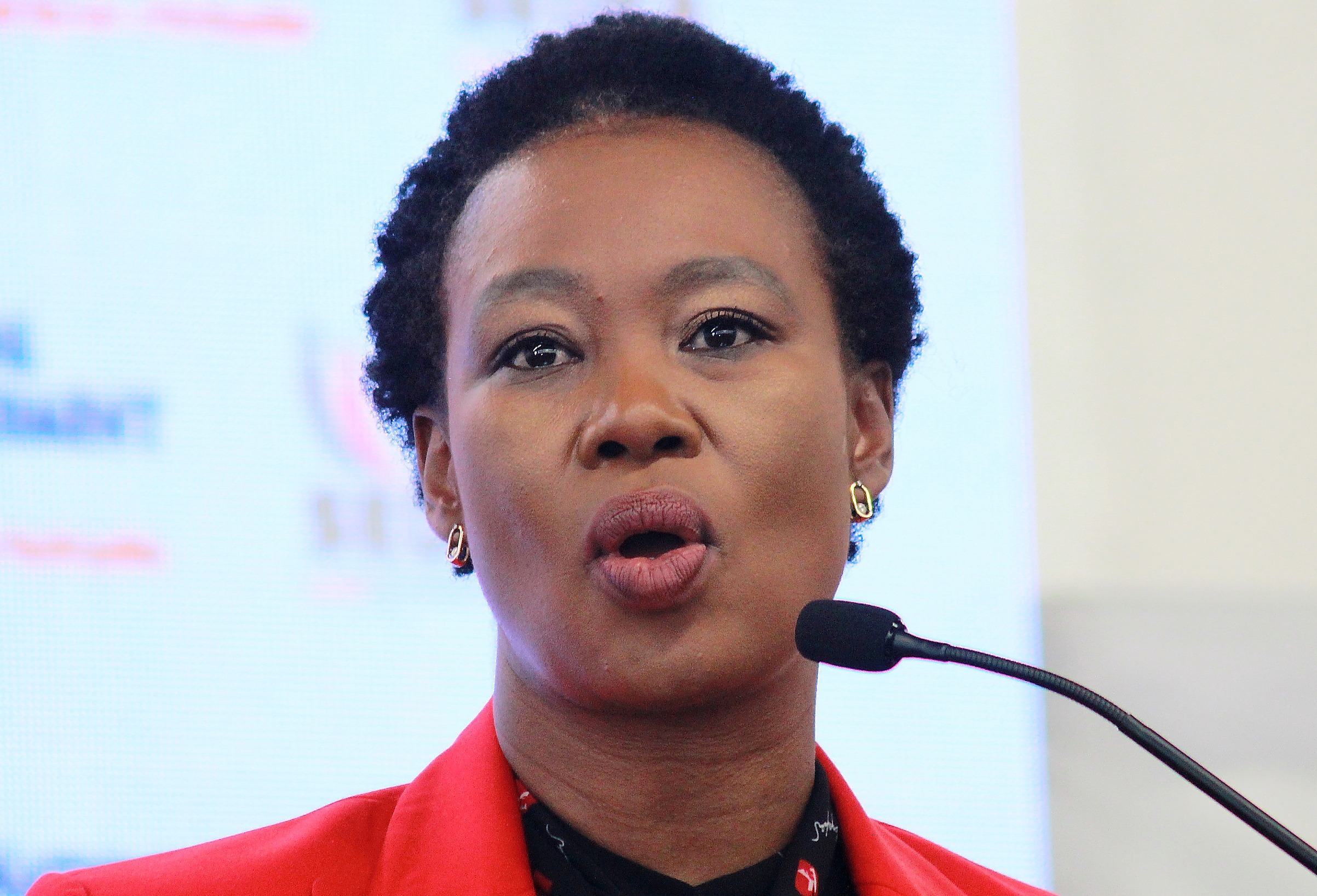
 Minister of Small Business Development Stella Ndabeni has ringfenced a women’s empowerment fund aimed at dragging the mining sector’s gender demographics out of the dark ages. (Photo: Fani Mahuntsi / Gallo Images)
 Minister of Small Business Development Stella Ndabeni reminded the audience at a National Entrepreneurship Strategy engagement session on the sidelines of the Mining Indaba 2026, that her portfolio has a surname.
Although the minister has dropped part of hers (you’ll notice she no longer carries the weight of the double-barrel signature), the key focus for the department is the development of small business capacity.
For years, the mining industry and the state have danced a clumsy tango around empowerment. Now there’s a raft of new collaborations with the Department of Minerals and Petroleum Resources (DMPR) and the Department of Trade, Industry and Competition, with Ndabeni trying to organise the steps into a waltz of small business support in the resource sector.
Her timing is not accidental, as the mining industry faces a legislative overhaul that threatens to scrap the Mining Charter in favour of the B-BBEE Act.
The dance of empowerment
“You will never have successful coordination if you don’t know who your ecosystem player is,” Ndabeni told Daily Maverick, explaining the delay in finalising the National Small Enterprise Act.
Her plan is to target the capital-intensive barriers to entry in mining. Ndabeni confirmed that her department is actively collaborating across the Government of National Unity to plug the funding gaps that commercial banks ignore.
“The department [DMPR] have put about R500-million at the IDC [Industrial Development Corporation] in order to support the junior miners. We were working together on designing that,” Ndabeni said.
But the minister’s focus isn’t just on the junior miners digging holes; it’s on who owns the equipment. She has ringfenced a specific women’s empowerment fund aimed at dragging the sector’s gender demographics out of the dark ages.
“It’s specifically for women and […] we are funding it with R300-million. We are hoping to leverage even more from other mining corporations,” she said, listing Exxaro and Harmony Gold as partners.
The urgency behind these funds goes beyond economics. Ndabeni explicitly linked economic exclusion to the civil unrest of July 2021, framing these interventions as essential instruments to maintain constitutional order and prevent chaotic unregulated activity.
The death of the charter
Behind this funding push lies a more fundamental shift away from the Mining Charter towards direct alignment with the B-BBEE Act.
“Instead of having a charter... [the mining industry] is totally doing away with [it]. Now they’re trying to legislate what empowerment needs to be and [DMPR] is doing that by saying [the mining industry] need to align with the B-BBEE Act,’” Lili Nupen, founder and mining and environmental director at NSDV Law, explained to Daily Maverick.
Under the charter, mines had to source 70% of goods from South African manufacturers. That 70% further breaks down to:
• 44% from B-BBEE compliant companies;
• 21% from companies owned and controlled by historically disadvantaged persons (HDPs) (at least 51% ownership); and
• 5% from women or youth-owned and controlled companies.
The industry’s main concern with this alignment is that the 2018 Mining Charter allowed for a broader definition of transformation (HDPs), whereas the proposed 2026 B-BBEE alignment is much more aggressive in its focus on 100% ownership.
Many mines argue that the supply chain for heavy industrial machinery and specialised mining capital goods simply does not have enough 100% black-owned manufacturers to meet a 25% threshold yet.
Perhaps most controversial is the proposed Transformation Fund where companies could opt to contribute 3% of their net profit after tax to a centralised state fund instead of running their own enterprise and supplier development (ESD) programmes. For a mining major, writing a cheque is administratively simple, but it risks stripping “near-mine” communities of their primary economic lifeline, potentially fuelling the very unrest Ndabeni is trying to prevent.
Anglo gets ahead of the curve
While the lawyers fight over the bill, the industry is already moving. The tick-box compliance of the past is giving way to survival strategies.
Anglo American’s Kumba Iron Ore provides a practical example of this shift. In the Northern Cape, the company has launched an impact fund that is driven by a terrifying reality: the life-of-mine horizon for many operations ends between 2040 and 2050.
“The Northern Cape doesn’t have a diversified economy, and for a long time businesses were very much [part] of mining companies’ pipeline,” Dr Pranill Ramchander, executive head of corporate affairs for Kumba Iron Ore, told Daily Maverick in an interview at the fund’s launch at the Indaba.
When the mines close, the towns usually die. To prevent ghost towns, Anglo is investing in businesses outside the mining value chain.
The Impact Finance Facility launched on the sidelines of the Mining Indaba 2026 aims to address a critical market gap: early and growth-stage businesses that are commercially viable but chronically under-served by traditional investors due to perceived risk and high capital costs. By providing flexible, low-cost repayable loans, the IFF aims to attract at least three times more funding from other investors for every rand invested, adds the company.
The fund (R51.2-million coming from Anglo) has identified 33 investment-ready deals, but critically, according to Ramchander, “it comes with the right mentorship, the technical expertise and the right coaching and we want to ensure that the right businesses come in and are scoped out properly”.
Forget tango, development is a line dance
Ndabeni and Anglo both face inevitable criticism about timing: why only now, after decades of mining policy chaos?
Her answer reveals the bureaucratic reality behind policy ambition: “We needed to make sure that we have a structure for the department because we must have an approved structure for us to make sure that our mandate and vision is carried through.”
“There is no integrated approach towards small businesses. The first thing was to develop that framework.”
She also added that engaging with ecosystem players had revealed, “there is no integrated approach towards small businesses. The first thing was to develop that framework.”
Anglo has belatedly realised that there is a dependence on Kumba in the Northern Cape, and reliance is risky during challenging times when mines cannot absorb as many businesses.
Whether these empowerment bets pays off depends on execution – something South African economic policy has historically struggled with. DM