




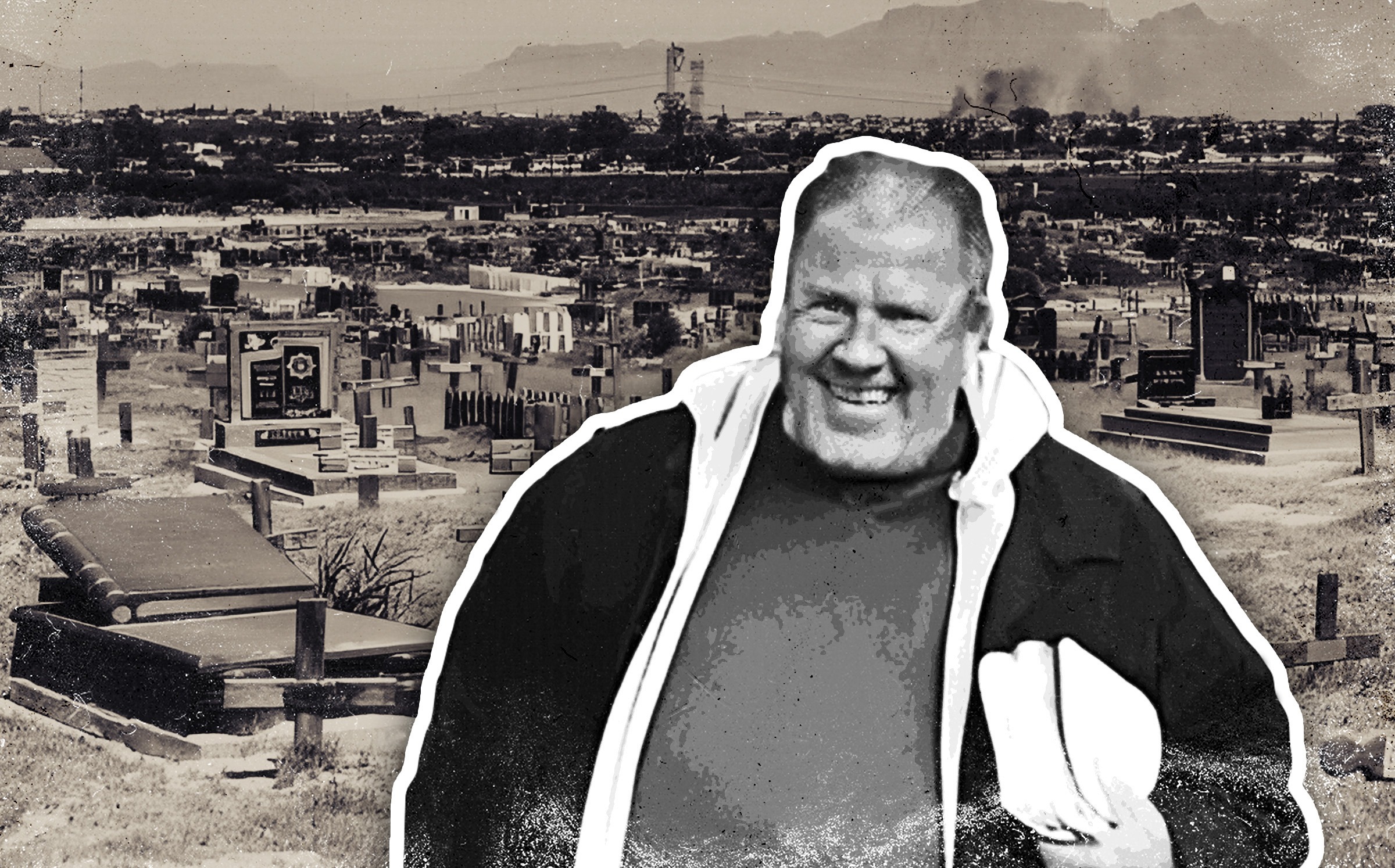
 Illustrative image: Petrus Booysen is accused of defrauding clients by giving their relatives paupers’ burials. (Source: WhatsApp – image enhanced using Adobe Firefly) | Welmoed Cemetery near Kuils River. (Photo: David Harrison )
 This is Part 2 of this investigation. You can find Part 1 here.
In the face of questioning about how at least five families’ beloved mothers could have ended up in paupers’ graves at Welmoed Cemetery, instead of being cremated as the families believed, the City of Cape Town has been noticeably reluctant to share information.
But in a sworn affidavit submitted to SAPS in May 2025, a senior City of Cape Town official admitted that they did not know the location of certain bodies, could not actually confirm whether the bodies given paupers’ burials were those of the loved ones of the affected families, and voiced fear that the rogue undertaker in question may have done this before.
The affidavit, seen by Daily Maverick, is dated 3 May 2025 and signed by the head of compliance for the City of Cape Town’s Recreation and Parks division, Annette van de Wall.
In it, Van de Wall states that at the time of writing the affidavit, “There are two bodies unaccounted for, namely Ms Glenda Amelia Muller [...] and Ms Magdalena Janette Jansen”.
The affidavit also states: “Based on the evidence and mix-up with the documents [...] we cannot confirm if the person listed in our records are [sic] in fact the person buried in our cemetery”.
Van de Wall writes that although Petrus Booysen – the accused undertaker in question – has been banned from the City register, it is impossible to be certain that he is not still doing business using third parties, and laments the potential “reputational risk” this poses to the City.
“The City has over 600 undertakers and over 40 cemeteries, and it is impossible to monitor all the bookings made via a third party (other undertakers). I am extremely concerned that [Booysen] could try and ‘dump’ bodies in our cemeteries that have been in storage at private mortuaries for an extended period,” she writes.
Elsewhere, she notes: “I suspect this will not be [Booysen’s] first or last attempt”.
Daily Maverick sent questions about the contents of the affidavit directly to Van de Wall.
She responded, saying that she was not permitted to answer questions without the approval of her media office, and added: “Can I ask where you got the statement?”
/file/attachments/orphans/Grave2_740841.jpg "Petrus Booysen (centre, blue jacket) is accused of defrauding clients by giving their relatives paupers’ burials. (Photo: WhatsApp)")
Families ‘despondent’ in face of apparent City stonewalling
Once the shock of hearing the news had slightly settled, all Anita Momberg and the other families wanted was answers.
How could an undertaker have given paupers’ burials to their loved ones without their permission? For that matter, how could anyone bury anyone in a City cemetery without written permission from the family?
One family member asked Daily Maverick: “If this can happen, then what’s to stop someone murdering someone and then getting some crooked undertaker to dump the body in a pauper’s grave where it might never be found?”
Given that all five of the paupers’ burials in question had happened within the space of a single two-week period in September 2024, the families also wanted to know how confident the City of Cape Town could be that this had never happened before.
It was possible, they feared, that this could be a much wider issue, potentially drawing in multiple undertakers.
The families had initially had cordial and empathetic engagements with City officials – but it was evident from the start that the only wrongdoing the officials seemed willing to countenance was on the part of the undertaker accused of carrying out the burials, Petrus Booysen.
A letter sent to the affected families, signed by Susan Brice, the head of Cemetery Management for the City, opens: “The Recreation and Parks Department wishes to express our sincere sympathy towards the families who have been affected by the fraudulent and unethical conduct of Mr Petrus Booysen of St Francis Funeral Services”.
The families were, and remain, incandescent with fury at Booysen. But they also felt that the City of Cape Town had a case to answer about how this could have happened in the first place.
What they were met with, to their confusion, was a brick wall.
City officials refused to give Anita Momberg the names of any other affected families with which she could compare experiences, citing Popia laws; the families eventually found each other through social media after media coverage.
City officials also refused to voluntarily provide the families with any documents or records relating to the burials. Each family had to launch at least one Promotion of Access to Information Act (Paia) request to demand these records, and in some cases two – because the families didn’t know exactly what documentation they should be asking for, and the City seemed unwilling to guide them.
Cheron Rudolf, whose late mother Dorothy Beukes was given one of the paupers’ burials, told Daily Maverick that the way in which the City had engaged with the families had been “disheartening”.
Rudolf said: “It has left many of us, myself included, feeling despondent and powerless.”
Daily Maverick’s experience in trying to extract information from the City was similar.
Over the course of several weeks, we sent the Recreation and Parks department’s media office a total of 26 questions, in addition to the separate questions sent to Van de Wall. We received a response to 13. In the interests of transparency, those questions and answers are available to read here:
In answer to the all-important question: “Has there been an attempt to investigate whether this issue affected more than the 11 families mobilised by Anita Momber, and if so, what was the outcome?”, the City responded simply: “Yes, this has been investigated”.
Other answers would seem to be plainly untrue. Asked whether the City was cooperating with the Paja (Promotion of Administrative Justice Act) application launched by the families on 9 December 2025, the response was: “Yes”.
The City was obligated to respond to that application within 20 working days. As of mid-February 2026, the families have received no official response – which is why they are now heading to the courts.
The critical missing affidavits
What motivation could there be for an undertaker to promise families that their loved ones would be cremated, but bury them instead?
The answer to that is almost certainly financial. Daily Maverick has seen invoices sent by Petrus Booysen to the affected families. Booysen charged around R16,500 for his services, of which the vast majority was supposed to go to cremation fees.
Booysen was subsequently allegedly burying the bodies in “public” graves at City cemeteries instead of cremating them.
This is the cheapest option for burial available, at a charge of R950, as a staffer at Maitland Cemetery confirmed to Daily Maverick over the phone.
There’s a reason why these are cheap. A “public grave”, according to the City’s Cemeteries, Crematoria and Funerals by-law, is one where “a second burial of any member of the public may take place after a period of five years and on which the erection of a headstone is not permitted for either the first or second burial”.
The only form of memorial allowed atop such a grave is a wooden cross, for a period of five years only.
These are the graves generally used for paupers’ burials, but also sometimes for situations where a deceased person’s family members have very little money.
/file/attachments/orphans/WelmoedCemeteryKuilsriverTersiaMurrayPaupersGraveDH2541copy_792616.jpg "A City of Cape Town employee at Welmoed Cemetery points out the piece of concrete slab placed as a headstone at the pauper's grave of Tersia Murray in the Welmoed Cemetery in Kuilsriver near Cape Town, 21 January 2026. (Photo: David Harrison)")
Precisely because other bodies may be buried in such a grave, there is a special affidavit which has to be submitted alongside the other documents. In it, the deponent has to swear that they are the “next of kin (closest living relative) to the deceased for whom I/we require a burial”.
The deponent also has to confirm and accept that “this may not be the first burial in the grave”.
It is not just burials in public graves in the City of Cape Town that require an affidavit from the family giving the undertaker permission to bury, however.
It is all burials – because this affidavit is the single most important safeguard designed to prevent a rogue undertaker from violating the wishes of the deceased and their loved ones without their knowledge.
The City’s burial bylaws specify that burial documents must be accompanied by “an affidavit by the next of kin of the deceased, or where not practicable, other close relative, consenting to the disposal of the corpse when such corpse is to be buried in the manner requested”.
Daily Maverick confirmed this by phoning the booking office of Maitland Cemetery and asking what documents an undertaker was required to submit to bury a body.
“Death certificate, ID, Burial Order, Notice of Interment, affidavit from the family,” the woman on the end of the line reeled off immediately.
Burials processed without necessary forms
Thanks to the Paia applications from the families, the City did eventually have to send them the documents on their system relating to the wrongful burials.
For all the burials, at least some records were available, even if often partial. What this means is that these burials did go through the City system, as opposed to some outlandish scenario in which Booysen scaled the fence of Welmoed Cemetery at midnight to bury bodies without approval.
The City has repeatedly blamed what happened on Booysen submitting “fraudulent documents”, effectively absolving officials from much blame.
But what the actual documents suggest is something quite different.
/file/attachments/orphans/2026-02-1114_33_47-Greenshot_125195.jpg "The interment notice form for Tersia Murray appears to have been filled out entirely by Petrus Booysen<br>(Source: Supplied)")
(Source: Supplied)
Daily Maverick has closely studied five sets of these documents relating to five paupers’ burials.
In three out of five cases, the interment notice appears to have been signed off by a cemetery official. This is despite multiple inconsistencies in the documents apparently submitted by Booysen.
In the case of Rachel Trussel, Freda Fortune’s mother, for instance, the interment notice was originally made out for another of the victims, Dorothea Beukes, whose name and date of burial were simply crossed out and replaced with those of Trussel.
On that form, Trussel is recorded as being buried on 18 September 2024. But records from the mortuary at which Trussel’s body was being kept, seen by Daily Maverick, show that Trussel’s body was only “signed out” by Booysen on 26 September.
“So in essence, my mom’s body is missing,” Fortune told Daily Maverick.
Yet worryingly, Trussel was not even one of the two women whose bodies were listed by Van de Wall in her police affidavit as being “unaccounted for”.
In four out of five cases, the documents show that Booysen himself had simply signed the affidavit consenting to burial in a public grave, despite the fact that the form clearly states it must be signed by “next of kin”.
In the case of Tersia Murray, Anita Momberg’s mother, the City confirmed that the record of the affidavit “did not exist”.
In three of the five cases, the documentation appears to have been accepted at Welmoed Cemetery, despite the fact that the relevant Burial Order, signed by a Home Affairs official, clearly states that the place of burial will be “Maitland Crem”, ie crematorium.
How could such inadequate document sets have been accepted by City staffers, with the burials duly recorded on the City cemetery database?
/file/attachments/orphans/WelmoedCemeteryKuilsriverDH2697copy_438880.jpg "A view across the Welmoed Cemetery in Kuils River near Cape Town. (Photo: David Harrison)")
Momberg was also told in her Paia response that “Mrs Brice” – Susan Brice, head of Cemetery Management – told the City’s information officer that “there is only one coffin” in the grave plot number to which Momberg’s mother’s body is linked on the records.
As Van de Wall’s affidavit illustrates, in reality the City has no way of knowing this until exhumation happens.
The investigation with no public findings
For its part, the City says it has carried out a full investigation – but it won’t release the report, or any results, to either Daily Maverick or the affected families.
The families are adamant that they need to see this report: both to get closure on their unanswered questions, and to be more reassured that what they have been through has not affected further families who may not even be aware.
It’s for this reason that they won’t let the matter go – which is why they approached the Public Protector for help towards the end of last year.
The Public Protector’s Western Cape office ended up recommending Alternative Dispute Resolution – effectively mediation – between the families and the City in December 2025. The families declined the offer on the grounds that the City was still refusing to release a number of requested documents.
Since Daily Maverick published its first article on this issue on 10 February, the families were again approached on 13 February for a mediation session – but the date offered was 17 February, which Momberg and others say they cannot make due to the short notice.
The City also asked Momberg – who has been indefatigable in mobilising the families and lobbying for answers – to prove that she had obtained “power of attorney” for all the other family members, even though signed letters giving consent for Momberg to represent them had already been submitted to the Public Protector last year.
The submission the City made to the Public Protector for the investigation in 2025 is significant, however, in that it provides the only sign that the City does accept some degree of culpability in terms of shortcomings among its staff.
Among the “controls” the City says it has effected to avoid this happening again are “Enhanced verification and scrutiny of burial documentation submitted by undertakers”, and “Ongoing training for booking clerks to identify irregularities in burial applications”.
This strikes a different note from the tone of Van de Wall’s 2025 affidavit, in which she acknowledged no wrongdoing or negligence, stating simply: “The City is not required to vet the identity of the deceased or confirm the content in the coffin. For this reason, it is a requirement to make use of a registered undertaker.”
Taking it to court: Families’ last resort
In the coming weeks, the families are lodging a Paja application with the high court.
“We need clarity, accountability and legal certainty,” Momberg says.
They are also frustrated with the circular nature of events, giving rise to the perception that the families are not being taken seriously.
Since Daily Maverick’s reporting on the confusion about which entity has the authority to order the exhumation of the bodies, for instance, the NPA has reached out to clarify that it is SAPS and the City that need to gather the necessary documents to have an exhumation order signed by a judge.
Among these necessary documents are letters of consent from the families – which had already been submitted to SAPS as far back as May 2025.
“The court application is not adversarial for the sake of it,” Momberg says.
“It’s a mechanism to compel full disclosure of the decision-making records.”
She says the family will cooperate with all the relevant authorities to facilitate the exhumations, which they have been demanding for close to a year, but “transparency and accountability cannot be secondary considerations”.
When the long-awaited exhumations eventually happen, some families may experience the relief of giving their loved ones the cremations they asked for.
For others, the exhumation may vindicate their greatest fear: that their mothers’ bodies simply cannot be located, opening up a secondary painful ordeal. DM