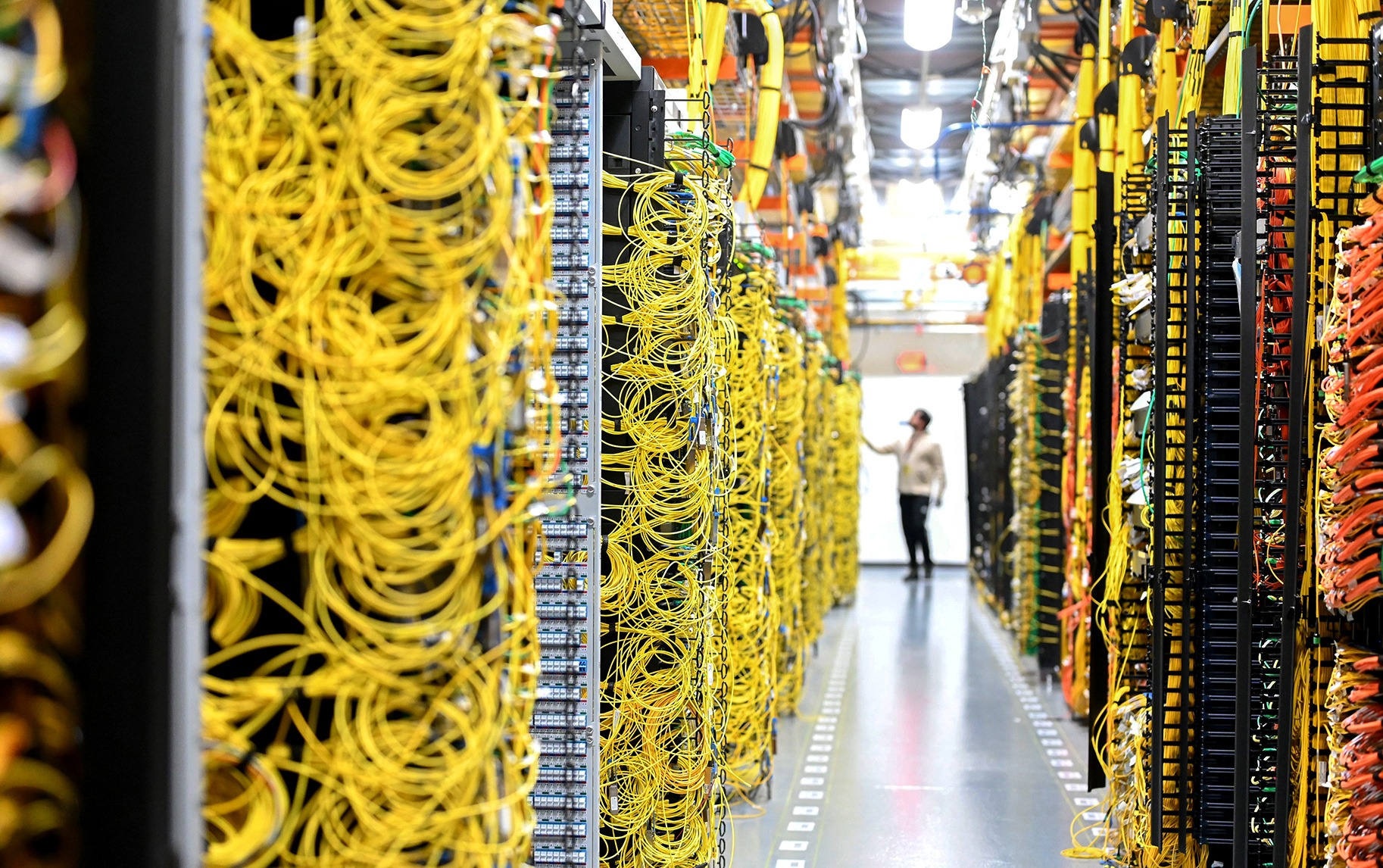
 AWS Data Center Interior.
(Image: AWS)
AWS Data Center Interior.
(Image: AWS) 
Drive past the nondescript, high-security compounds in Isando or Brackenfell, and you wouldn’t guess that inside, the air is freezing, the noise is minimal, and the money is printing faster than a national mint in a debt crisis.
While the average South African factory and ferrochrome smelter is begging Eskom for scraps of power, these data centres have, effectively, privatised their own slice of the national grid.
By building 120MW power stations in the Free State and wheeling (the current electricity industry buzzword) that power to cities where they are based, data centres are solving their own load shedding problem by booking up scarce transmission capacity, turning themselves into energy islands.
/file/attachments/2987/Tonydatapic13_InfographicFIXED_973139.jpg)
AWS started the direct investment in renewable energy trend with a 10MW solar plant near Kathu in the Northern Cape in 2021, powering their Cape Town operations. Teraco upped the ante by building a 120MW solar PV facility in Free State, while other companies chose long-term power purchase agreements.
Vantage Data Centers secured 87MW for Waterfall City from SolarAfrica, while Africa Data Centres (ADC) broke ground on a 12MW solar farm near Bloemfontein with Distributed Power Africa to cover the 6MW expansion on its CPT1 site in Cape Town and future Johannesburg sites.
City of Cape Town spokesperson Luthando Tyhalibongo has confirmed the metro supports wheeling arrangements for such “high-energy consumers to offload demand from the local grid.”
But while data centre operators tout solar credentials through these wheeling deals and on-site solar – rooftop solar is not sufficient to meet the demand of these power-hungry, silent factories. Instead, those panels atop the physical buildings are relegated to aircon, electric fence and interior lighting duty.
The immediate backup to keep the chatbots chatting is fossil fuel. And with the rise of AI, the power thirst is becoming unquenchable.
/file/attachments/orphans/HowModernDataCentresWork_Infographic1_144217.jpg "How Modern Data Centres Work.
<br>(Source: Daily Maverick)")
(Source: Daily Maverick)
“Data centres are no longer just a technology story – they are an energy story,” NJ Ayuk, of African Energy Chamber fame, was quick to point out in a recent press release framing how these AI factories are reshaping Africa’s energy landscape.
There is even serious talk of nuclear. Dr Yves Guenon, chairman of the French South African Chamber of Commerce and Industry, explained how this burgeoning industry is stretching global nuclear capacity thin.
“International investors are hunting for clean, reliable electrons… Solar plus battery storage simply cannot guarantee for 24/7 AI training clusters.”
In the meantime, to guarantee the 99.999% uptime sold to clients, operators rely on vast fleets of diesel generators.
Cutting environmental corners
There is only one publicly available National Environmental Management Act (Nema) filing that reveals how data centre operators sometimes use Section 24G rectification as a way to legalise expansions made without prior environmental authorisation. ADC made the mistake at their Midrand campus on Old Pretoria Road.
The unfortunate poster child for data centre rules skirting
The original ADC infrastructure dates back to before Nema’s requirements. However, as the facility expanded, adding more diesel generators and fuel storage to keep up with increasing demand and reliability standards, these upgrades triggered environmental listing notices that weren’t authorised at the time.
The situation escalated in 2021 when ADC installed four additional 2.5MW generators, pushing their total backup power capacity over the 10MW threshold. This crossed the line set by Listing Notice 1, Activity 37, requiring environmental authorisation for such activities.
Realising this, ADC submitted a Section 24G application to retroactively legalise their expanded operations. The process comes with an administrative fine (potentially up to R5-million under the Nema amendments) though the exact amount paid is rarely disclosed publicly.
This case highlights a regulatory mismatch with the realities of South Africa’s unstable grid.
Data centres often start with modest backup power and fuel storage, but as load shedding worsens and uptime demands rise, incremental upgrades push them over compliance thresholds.
Many operators only discover their non-compliance after the fact, prompting Section 24G applications to regularise their operations and avoid delays to critical infrastructure.
Tyhalibongo confirms that the high volumes of diesel required for backup power trigger mandatory Environmental Authorisations from the National Department of Environmental Affairs, before any storage.
Skipping this step to rush a facility online is a gamble operators may be willing to take, choosing to pay the fine later rather than delay the “go-live” date.
A City whistleblower brought the ADC CPT1 campus expansion in Diep River, Cape Town, to Daily Maverick’s attention. There are no updated plans for the additional cooling infrastructure and backup generators on record.
/file/attachments/orphans/AfricaDataCentresCPT1municipalrecords_675988.jpg "Infographic produced from City of Cape Town whistleblower communications. (Infographic: Lindsey Schutters)")
We asked the company for comment, but it had not responded at the time of publication.
The algorithmic displacement
The most uncomfortable question is what these buildings do to the South African worker. Proponents argue they are GDP multipliers. “If we can guarantee that they will have electricity... they will create job[s] not in nuclear, they create job[s] in the data centre,” argues Guenon.
But walk into a modern data centre and you will be struck by how empty it is. Once the construction crews from WBHO or Stefanutti Stocks leave, the facility runs on automation. Remote services allow a technician in Seattle to reboot a server in Cape Town without a local engineer ever touching it.
The real threat, however, isn’t inside the data centre, it’s what comes out of it.
These AI factories are being built to host the very algorithms designed to replace human labour in call centres, banks and creative industries. The high-performance compute (HPC) clusters, powered by Nvidia chips renting for a premium $10 per hour in SA, are training models to automate the service sector, one of the few sectors where South Africa still creates jobs.
South Africa has successfully positioned itself as the digital gateway to Africa. The subsea cables landing all along our coastline have plugged us into the global main vein. The investment numbers are intoxicating for a government desperate for good news.
/file/attachments/orphans/Tonydatapic8AfricasubmarinecablenetworkSourcesubmarinecablemapcom_FINAL_444964.jpg "Apart from land-based data centres, the global flow of information is also supported by an extensive network of submarine data cables stretching across the world. (Source: submarinecablemap.com)")
As one industry insider told us, it’s the perfect business. “The tenants never sleep, they never complain, and they never move out. You just have to keep feeding the beast.” T
he question is whether we are the masters of this beast, or just its food source.
Like with most things, it’s a real estate play
To understand who benefits, you first have to understand the business model. Companies like Teraco (majority-owned by US giant Digital Realty), Vantage Data Centres, and ADC are not really ICT companies. They are specialised landlords.
The industry jargon is colocation. In English: they build a fortress, secure a massive grid connection from Eskom (or the City), install military-grade cooling, and then rent out white space to whoever can pay.
Metropol bylaws – specifically in the City of Cape Town – inadvertently confirm this unglamorous reality. Tyhalibongo gave a written response to Daily Maverick, explaining that the city classifies these hi-tech facilities merely as business premises or even warehouses; “buildings used primarily for the storage of goods”.
Whether those goods are pallets of car parts or endless racks processing petabytes of data, the zoning logic is the same. This regulatory loophole allows these power-hungry giants to spring up anywhere a warehouse is permitted, from heavy industrial zones to the urban development edge, often bordering residential areas.
But the real estate market is not confined to rent per square metre. There are markets built on top of the assets in the power arbitrage and the ecosystem.
/file/attachments/orphans/AWS_Data_Center_Interior_2_501354.jpg "AWS Data Centre Interior. (Image: AWS)")
“We are in the business of providing space and power,” ADC CEO Adil El Youssefi said in response to Daily Maverick questions about the underlying business model following the announcement of thousands of Nvidia chips coming to the continent in ADC facilities.
The Cassava Technologies subsidiary operates as the continent’s largest network of interconnected, neutral facilities, effectively serving as the infrastructure backbone for Africa’s digital economy.
But the Nvidia deal shifts the goalposts of neutrality somewhat for the data centre provider, with the related incentive to sell hardware capacity as a service.
But as AI demands soar, that model is shifting. His big boss, Strive Masiyiwa (chairman of Cassava Technologies, which is ADC’s holding company), calls the new breed of facilities “AI Factories” (to be fair, Nvidia CEO Jensen Huang started calling them that last year).
“It costs a lot of money to buy a GPU and it takes more than a GPU to build an AI factory,” Masiyiwa said when announcing the new deals with Nvidia, Google and OpenAI on the opening morning of Africa Tech Festival 2025. “We have to build cooling systems of the type we haven’t seen before.”
While traditional property yields struggle, data centre investors are eyeing internal rates of return (IRR) of between 25% and 40%. Digital Reality’s 2022 purchase of Teraco was priced so high that it implies a tiny annual yield of just 3.5%. Decoded into normal English, it means the market doesn’t see Teraco as a simple landlord, but as a dominant, utility-like monopoly that is essential to the economy – like Eskom.
So, who gets rich?
If you check your pension statement, the answer might be you, but only slightly. The lion’s share is heading offshore.
The market has two main players. On one end, you have the hyperscalers like Amazon Web Services (AWS), Microsoft (the Azure cloud business, to be exact), and Google. They build their own cloud compute regions, or, as is more frequently the case, lease massive halls. On the other hand, you have operators like Teraco and Vantage.
Teraco, the dominant player, is 55% owned by Digital Realty, a New York-listed Real Estate Investment Trust (REIT) valued at over $40-billion. When you pay your cloud subscription, a fraction of that flows back to Manhattan.
/file/attachments/orphans/Tonydatapic3howmanydatracentressourceVisualCapitalistWorldEconomicForum_FINAL_892507.jpg "A chart of global data centre distribution emphasises the dominance of the US. (Source: Visual Capitalist / World Economic Forum)")
Local capital is desperate for a slice of the pie. With South Africa’s traditional infrastructure (rail and ports) collapsing, data centres have emerged as one of the few investable infrastructure asset classes left.
The latest evidence of this shift came at the end of January, when the Competition Commission recommended the unconditional approval of Stanlib Infrastructure Fund II’s acquisition of a major stake in Cassava’s Africa Data Centres. The deal sees Stanlib, a heavyweight in local asset management, taking joint control of the South African operations of the ADC network, with the option of full control in the future.
This acquisition is the practical application of a philosophy outlined by Andy Louw, co-head at Stanlib Infrastructure Investments. Louw told Daily Maverick in a media roundtable when the deal was first announced at the end of 2025 that their investors have a “very long-term mindset mandate”.”
“Our base case is that we never sell,” Louw explained.
Pension funds are pouring billions into these concrete boxes because they view them as modern toll roads. Just as Sanral collects fees for every truck on the N1, these funds collect rent for every bit of data passing through the big grey buildings. They are banking on what Louw described as a “hockey stick growth curve” that will eventually flatten out into a steady, utility-like dividend yield.
The only problem is that nobody knows exactly where on that curve we currently are. DM