




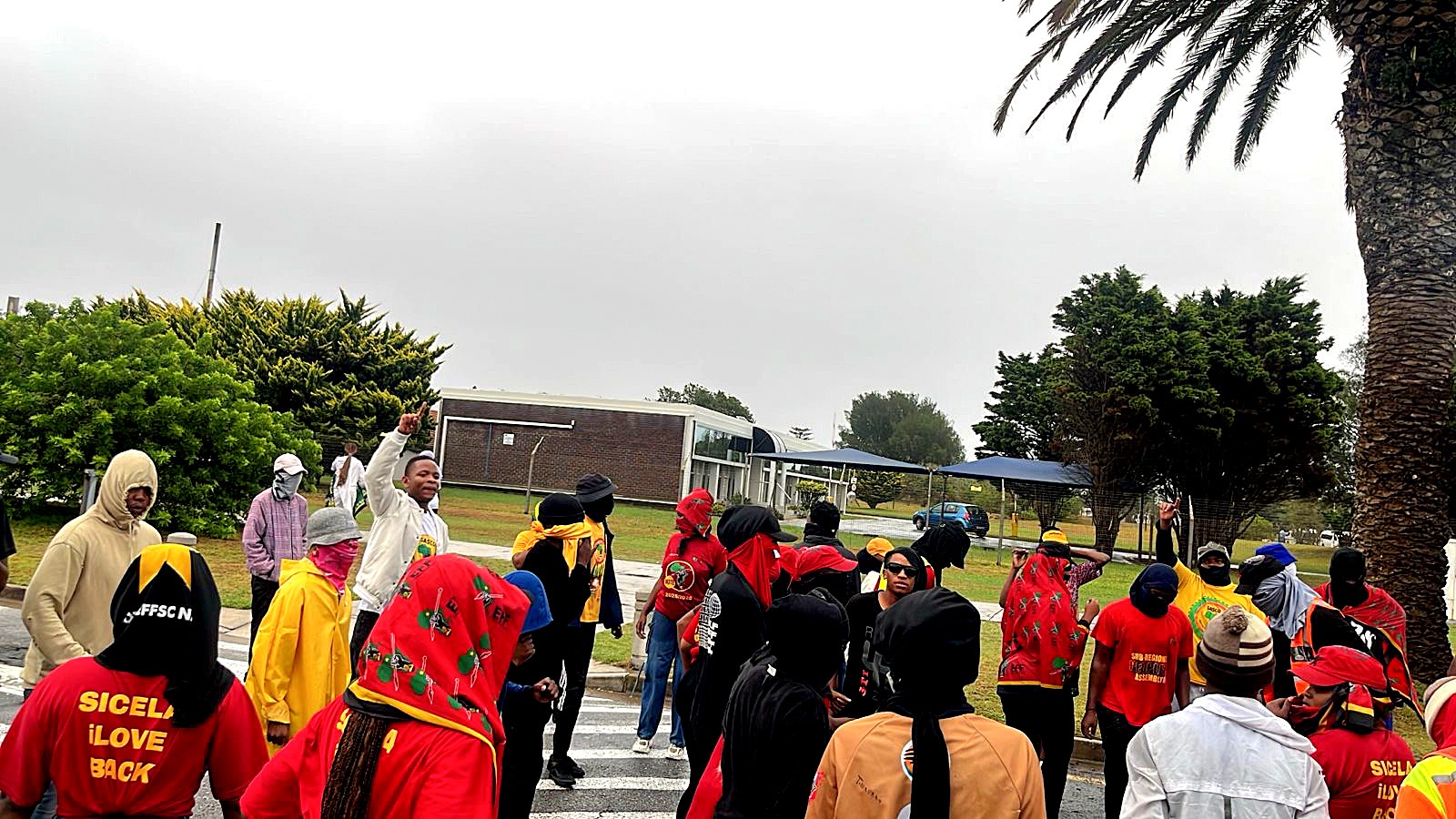
 Nelson Mandela University students gather during a protest on 12 February. (Photo: Supplied / Meluleki Ncane)
 Following the protest that broke out on 12 February 2025 at Nelson Mandela University (NMU), after private security and members of the South African Police Service (SAPS) fired rubber bullets at students at the North Campus during a protest over accommodation, registration and transport issues, the university went to the Eastern Cape Division of the High Court in Gqeberha on Friday, 13 February 2026, and successfully applied for an urgent interim interdict to stop further disruptions.
The interdict specifically prohibits students from:
- Barricading Roads: Blocking entrances to any of the NMU campuses (South, North, Second Avenue, Ocean Sciences, etc.).
- Entering Premises for Protests: Students are only allowed on campus for “bona fide” academic reasons (attending class, studying). They are forbidden from entering the campus just to interfere with university business.
- Interfering with Operations: Damaging property or “obstructing/destroying” academic and administrative processes.
Despite the interdict to stop the disruption, the protest continued for three days.
The student organisations (the “Respondents”), including the NMU Student Representative Council, Economic Freedom Fighters Youth Command, South African Student Congress, uMkhonto Wesizwe Movement, Pan Africanist Student Movement of Azania, Democratic Alliance Student Organisation, Action SA Student Forum, and the general body of NMU students have until Tuesday, 3 March 2026, to go to court and explain why this order should not be made permanent.
If they don’t, the order will stay in place indefinitely.
The protest on 12 February centred on accommodation shortages, transport challenges and registration delays. It came just days after Parliament’s Portfolio Committee on Higher Education conducted an oversight visit to the institution.
Tensions escalated when members of the SA Police Service and private security fired rubber bullets at protesting students, injuring several. Students responded by throwing stones at police and security officers.
/file/attachments/2988/nmu-news-1770900659124511_315070.jpeg "Police and student protestors clashed at Nelson Mandela University on 12 February. (Photo / Algoa FM)")
Students told Daily Maverick that the protest followed multiple attempts to engage with the university over unresolved concerns, including a shortage of student accommodation, delays in funding decisions, registration backlogs and transport services.
Videos and images seen by Daily Maverick show students burning tyres and singing while members of the SAPS and private security fire rubber bullets. In the footage, students can be seen retaliating by throwing stones.
A student leader, Olwethu Gwelana, said: “We woke up in the morning, and the students burnt tyres. The police said they don’t mind us protesting, but when we burn tyres, it’s going to be a strike, and it’s violence. So the students switched off the [fire] in these tyres. Students sat down and lifted their hands to show that we are not fighting. They sprayed students with brown water.”
One video captures the moment a student is removed from a police van after being fired at with a rubber bullet and locked inside until fellow students demanded that he be released.
Gwelana said the university had taken too long to respond to students’ concerns, adding that academic activities could not proceed smoothly if students were unable to register.
“What has transpired here is a build-up of issues. These issues have been raised with the university, and all procedures have been followed. The first issue that was raised around the 12th of January was that the admission process is exclusionary to people coming from Quintile 1 to Quintile 3, particularly people coming from rural areas.”
Economic Freedom Fighters chairperson at the Second Avenue campus, Meluleki Ncane, said students were struggling with accommodation and transport.
“There are issues of accommodation for unfunded students. There is no plan for them. The majority of first years have not registered. We wanted the registration process to be extended until April,” said Ncane.
/file/attachments/orphans/NelsonMandelaUniversitystudentsfacingpoliceafteraprotestederuptedduetoissuesofexclusionandlackofproperaccommodation12February2026ImagesuppliedbyMelul_716936.jpg "Nelson Mandela University students protest on 12 February. (Photo: Supplied / Meluleki Ncane)")
The university confirmed that the entrances to the North and South campuses were blocked by about 30 students.
“The group obstructed access with burning tyres and barricades, seeking to prevent students and staff from attending classes and reporting for duty. Reports of intimidation directed at members of the university community have also been received. Such actions are unacceptable and inconsistent with the university’s values and principles,” said the university.
It added that management had been actively engaging with the Students’ Representative Council (SRC). “Matters previously raised as demands have been addressed, and outstanding issues remain under consideration through established engagement processes involving the SRC,” said the university.
Daily Maverick sent questions and received the below answers from NMU spokesperson Zandile Ngwendu:
- Students told Daily Maverick that many first-years are experiencing challenges with registration due to financial clearance delays and a lack of accommodation. Is NMU working on clearing students, and on what grounds are students excluded? Nelson Mandela University has long availed a relief mechanism in the form of institutional financial concessions. This is not funding, but affords qualifying students who have been successful in their applications an exemption from paying the upfront down-payment in order to register. The students are then required to sign an acknowledgment of debt form. The institutional concessions can no longer be extended to first-time entering students as the National Students’ Financial Aid Scheme (NSFAS) has introduced provision for loan funding to students who fall within the “missing middle” – those whose combined household income does not exceed R600 000. The arrangement avails appropriate funding for qualifying students in this category.
- Is there enough accommodation at NMU, as students are said to have been sleeping in halls on campus? For the 2026 academic year, the University received 22 763 residence applications. On-campus bed capacity is 5 238, and off-campus bed capacity at residences accredited by the University (6 033) and NSFAS (17 876) exceeds 23 000. Those who were sleeping in common spaces are portion of students who are still finalising their funding for tuition and accommodation. This small group of students has since been provided with temporary on-campus accommodation solutions while they work to resolve funding matters.
- There is high-visibility security, and rubber bullets have been fired. What necessitated the call for this security? During the two days of isolated protests, a group of about 30 individuals obstructed access to the North and South campuses with burning tyres and barricades, seeking to prevent students and staff from attending classes and reporting for duty. Reports of intimidation directed at members of the University community were also been received. Such actions are unacceptable and inconsistent with the University’s values and principles. While the University fully respects and upholds the constitutionally protected right to protest, this right may not be exercised in a manner that infringes on the rights, safety and academic activities of others.
- Students have reported issues with shuttle services. What is NMU’s take on this, and is the institution considering increasing the shuttle services? The University is actively exploring workable solutions to strengthen the shuttle system, with a focus on ensuring that the service safely and efficiently serves those for whom it is intended. DM
This article was updated on 16 February.