




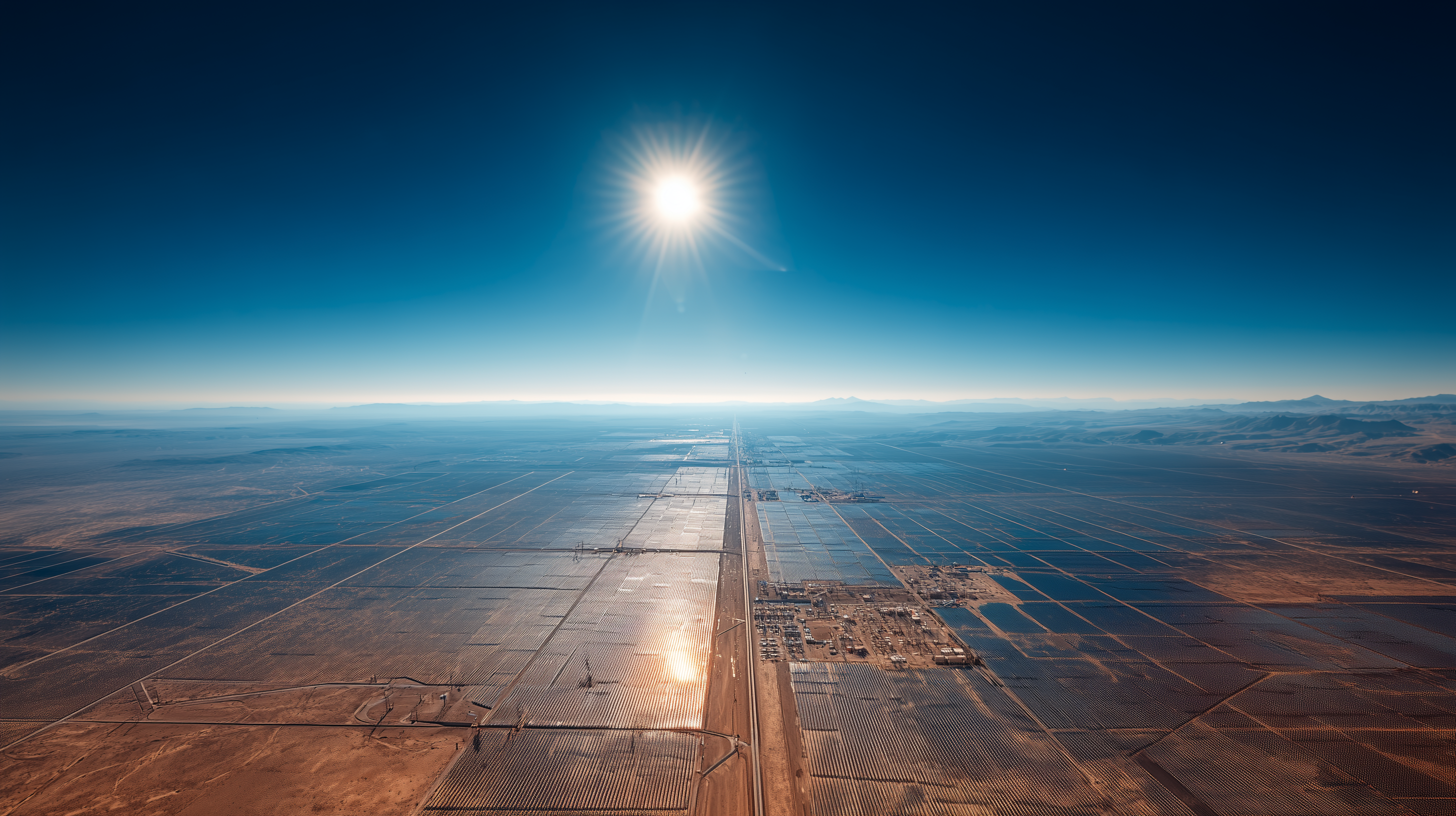
 At full scale, the
platform will comprise up to 20GW of hybrid solar and wind generation, supported by large-scale
electrolysis and integrated industrial infrastructure. (Image: Supplied)
At full scale, the
platform will comprise up to 20GW of hybrid solar and wind generation, supported by large-scale
electrolysis and integrated industrial infrastructure. (Image: Supplied) Perched between the Atlantic Seaboard and Lion’s Head on Bantry Bay’s Ocean View Drive, it really does feel like one is on the top of the world, lookin’ down on creation and, as Western Cape Premier Alan Winde joked, that the map might finally be the right way around.
In his view, the Northern Hemisphere has spent centuries hanging the world map upside down; at this house, South Africa is no longer at the bottom, but firmly on top.
At this Bantry Bay venue, on Wednesday, 11 February, as the final deals of the Cape Town Mining Indaba were being inked nearby, the Kahre Renewable Energy Group pulled back the curtain on a brand new integrated net-zero industrial corridor.
The sprawling infrastructure plan intends to succeed where the South African state has historically faltered. It seeks to link the Northern Cape’s solar and wind abundance directly to the Western Cape’s industrial and shipping hubs via a 450km private transmission pipeline.
According to a statement by the Kahre group, this “desert-to-port” plan is a fully integrated system that combines power generation, transmission, green fuel production and water desalination into one coordinated platform.
The corridor is expected to generate about 40,000 direct jobs and 120,000 indirect jobs across construction, operations, manufacturing and logistics.
The group is proposing a private investment ranging between R794-billion ($50-billion) and R2.3-trillion ($150-billion) over the next 15 years. This mirrors a growing national trend where failing state-led monopolies, like Transnet, are forced to solicit private partners to fix their crumbling infrastructure and management.
Eskom remains hamstrung by a debt-heavy balance sheet and an ageing coal fleet. Kahre’s investment represents a move toward private-led development of essential national infrastructure, this time in the green energy space.
The gridlock and Greenlink
One of the more pronounced problems facing South Africa’s Just Energy Transition (JET) is a geographical mismatch. Some of the best renewable resources sit in the remote Northern Cape, while the grid’s capacity to carry that power to cities is exhausted.
Read more: SA’s energy future — study finds green industrialisation the least cost path to net zero
“We don’t have enough grid capacity in South Africa to enable this kind of investment,” Premier Alan Winde told Daily Maverick at the launch event. “You can build solar plants in the Northern Cape, which is where you need to build them, but how do you get the power to Gauteng and how do you get the power to the Western Cape?”
Kahre’s solution is Greenlink, a private transmission line and pipeline running alongside the existing Sishen-Saldanha railway line. By using this existing corridor, the project hopes to bypass the bureaucratic nightmare of new environmental impact assessments and land access disputes.
“Transmission until now is not really possible to get it accelerated in the private sector, but therefore regulation needs to change,” Dominic Kahre, founder and CEO of Kahre Renewable Energy Group, said. “And when this is in place, the investors are waiting globally to find proper projects where they can invest…”
The math of ‘almost nothing’
The project’s economic hook is the promise of energy so cheap it borders on surreal. According to Kahre, the combination of Northern Cape solar and wind can produce power at a fraction of current costs.
“In the Northern Cape, we will produce a kilowatt-hour out of a PV plant for less than one-and-a-half US cents,” Kahre said. “This is almost nothing.”
Read more: New SAESIR model shows why decarbonisation is SA’s cheapest energy path
He explained that generating electricity was not an economic hurdle any more, as hybrid renewable energy could be produced for about four US cents per kilowatt-hour compared with the plus-minus 50c that South African households already pay.
While the technology is financially viable, this cheap energy remains inaccessible to consumers because the transmission infrastructure required to transport it from the remote Northern Cape deserts to urban centres does not yet exist.
Water and eco vision
The project functions as a four-part value chain designed to bypass national infrastructure bottlenecks.
KTE Energy: Located on 85,000 hectares in the Northern Cape, this hub leverages extreme sun and night-time winds to aim for 20GW of near-baseload power. Kahre claims it can produce solar at 1.5 US cents per kWh — significantly lower than current domestic rates.
/file/attachments/2988/KAHRERenewableEnergyGroup8_827145.jpeg "KTE Energy will see photovoltaic and wind power plants with an initial generation capacity of up to 6 gigawatts (GW) and 3.5 GW of electrolysis capacity by 2030 are being built on an area of 85,000 hectares.")
Greenlink: A 450km private transmission and pipeline corridor will run alongside the existing Sishen-Saldanha railway. By using this established route, the project aims to avoid land-right delays and bypass Eskom’s congested national grid.
Production: At the coast, the power will drive a desalination plant in Velddrif, scaling to 150 million litres of water daily. This water is split to create green hydrogen, ammonia and aviation fuels for export through Saldanha Bay.
EcoVision: To house a projected 150,000 people by 2039, a new “15-minute city” is planned near Velddrif. Powered entirely by renewables, it aims to support 40,000 direct workers and new green industries.
Read more: The future of green hydrogen in South Africa — opportunities, challenges and a path forward
The project represents a hedge against climate instability for the Western Cape. “Quite frankly, if you say still today, what are the biggest risks in South Africa? Water and electricity,” Winde said. “What happens when you have risks? Entrepreneurs find solutions. Here, we have a solution for those risks.”
How this affects you
🔋 The entry of private infrastructure moves the monopoly further away from Eskom, potentially forcing more competitive energy pricing.
🔋 The development of a new industrial hub near Velddrif could draw job seekers to the West Coast.
🔋 Using the Sishen-Saldanha line for power transmission could affect how regional rail corridors are managed and maintained.
🔋 Large-scale wind, solar and desalination plants change the physical landscape and require rigorous impact monitoring.
🔋 A focus on green hydrogen for international markets means local benefits depend on how much revenue stays within South African borders.
🔋 The success of the project could determine whether private-led energy shifts actually create broad prosperity or only serve specific industrial zones.
A ‘just’ transition or a private island?
The government’s Just Energy Transition Implementation Plan (JET IP) 2023-2027 estimates the country needs R1.5-trillion to transition fairly away from fossil fuels.
The JET IP document states that “higher levels of international grant funding will be needed to ensure that South Africa’s energy transition is just”, particularly for coal-dependent regions such as Mpumalanga.
Read more: The just energy transition in Africa — game changer or pipe dream?
By contrast, Kahre’s project is a distinct private sector initiative that appears designed to bypass the slow pace of state machinery. Premier Alan Winde highlighted this independent approach, noting that rather than waiting for political permission or asking what the government wanted, the developers secured the necessary land and resources first, only approaching the state for partnership once the groundwork had already been laid.
However, the project cannot entirely escape the state’s orbit. It must navigate a regulatory environment that has historically protected Eskom’s monopoly on the grid. While the National Transmission Company of South Africa (NTCSA) is moving toward an independent operating model, the private Greenlink transmission corridor tests the limits of how much strategic infrastructure the state is willing to cede to private control to solve its energy crisis.
The long game
While the project claims it could move faster (Kahre cited China’s ability to install 262 gigawatts of solar in just six months), the current roadmap for the full EcoVision city and export capacity targets 2039.
Winde seems to believe that this project is an excellent alignment of international capital and local potential. He likened the partnership between the German-led Kahre group and South African stakeholders to a Hollywood blockbuster score. “I think of this as a Hans Zimmer and Lebo M moment,” Winde quipped, drawing a parallel between the German composer and the South African producer who created The Lion King’s iconic soundtrack.
“It was Hans Zimmer who partnered with a South African and took the sound of Africa to the world. And here we are with a German commitment that’s going to help us take South Africa again to a competitive space,” he said.
“True progress is measured not only in megawatt and investments but in jobs, skills and shared prosperity,” said Kahre. Whether this massive private corridor can truly coexist with the national grid, or whether it becomes a gated community for industrial energy, remains the R2.3-trillion question. DM