
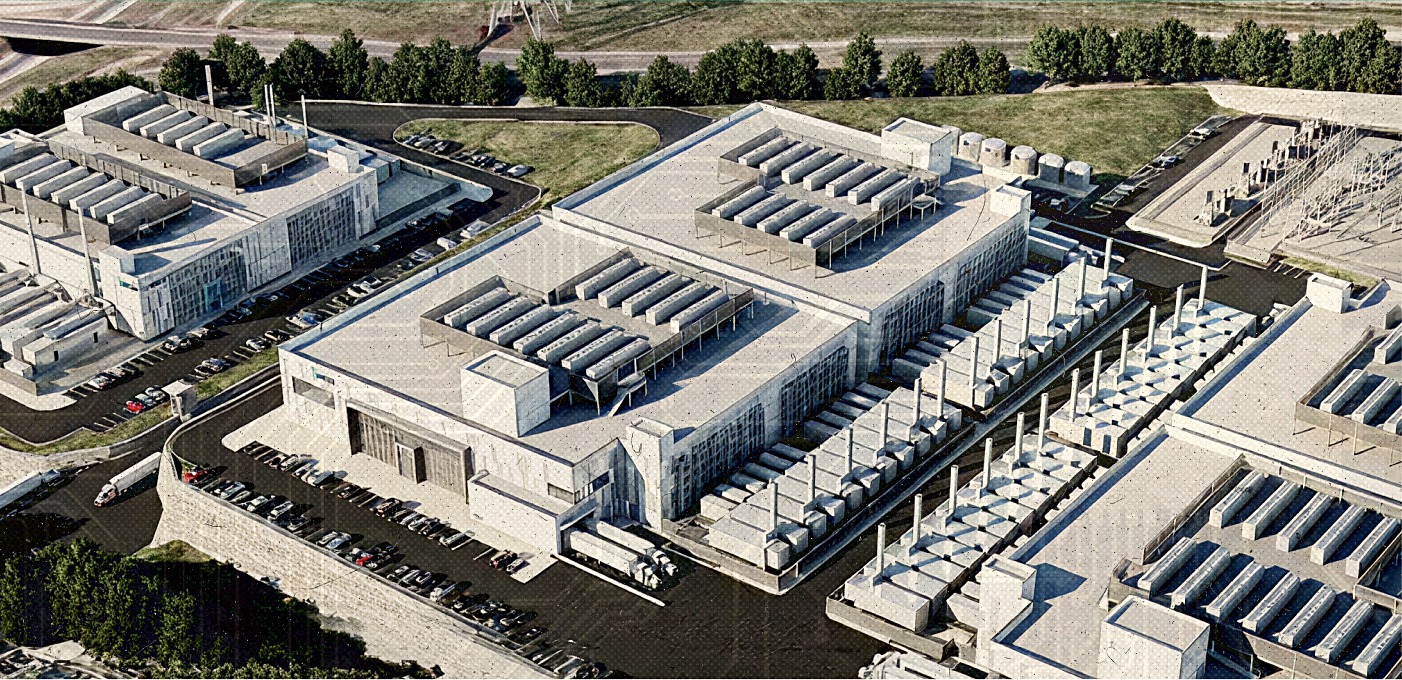
 Several data centre operators, including the Vantage group, are planning expansion or new centres across South Africa. (Image: Vantage website)
 Harnessing the world’s data through machine learning is a game of light, electrons and nanoscale processing. In the AI era, the whoosh-whoosh of cooling fans and water racing through kilometres of pipes has replaced the screech of dial-up.
For most of the cloud era, data moved North-South: a user (North) requested a file and a server (South) delivered it.
In the AI era, traffic moves East-West. When training a model, thousands of graphics processing units (GPUs) work together simultaneously, sharing massive amounts of information with each other to ensure synchronised learning.
White heat of digital thought
The byproduct of AI processing is intense heat. A single Nvidia H100 GPU requires 700W of cooling capacity just to function. When these are stacked into IT racks, you suddenly need to dissipate 40-120kW of heat in a space the size of a fridge. In water-scarce South Africa, this has forced a shift towards closed-loop systems where water never evaporates, keeping environmental losses negligible.
/file/attachments/orphans/HowModernDataCentresWork_Infographic1_144217.jpg "(Source: Daily Maverick)")
The power paradox
A common myth suggests data centres can run on rooftop solar. In reality, on-site panels barely cover office lights. To power the actual IT load sustainably, South African operators use electricity wheeling. They invest in utility-scale wind and solar farms in the hinterlands, feed that energy into the national grid, and off-take an equivalent amount at the facility.
Leading the charge, Teraco has committed a massive R2-billion to build its own 120MW utility-scale solar farm in the Free State, while competitors like ADC and Vantage are securing long-term power purchase agreements to buy diverse renewable supply.
However, the renewables arithmetic is unforgiving. A 120MW solar plant does not equal 100% green power because the sun doesn’t always shine. Even massive utility-scale projects currently only cover roughly 30% to 50% of a facility’s total critical load. The paradox remains: while the industry is frantically building renewable capacity to offset its carbon footprint, the always-on demands of AI mean they must still balance these new green electrons with the steady, fossil-fuelled baseload of the national grid to ensure reliability.
/file/attachments/orphans/HowModernDataCentresWork_Infographic2_547798.jpg "(Source: Daily Maverick)")
Industrial evolution
Because the national grid can be unreliable, local infrastructure must be a customised blend of solar, batteries and huge back-up generators to keep to the uptime commitments. This brownfield strategy of gutting and converting existing industrial warehouses has turned specialised real estate into a high-stakes game, with single plots in Cape Town now fetching upwards of R550-million (what Africa Data Centres paid for its CPT-1 facility).
As South Africa hosts more of these AI factories, the economics are shifting. Individual components like network switches are becoming 30% more efficient, but our demand for AI processing keeps total energy consumption climbing. The goal is a delicate balance: securing permits, wheeling renewable power to offset coal and managing water with clinical obsession. DM