
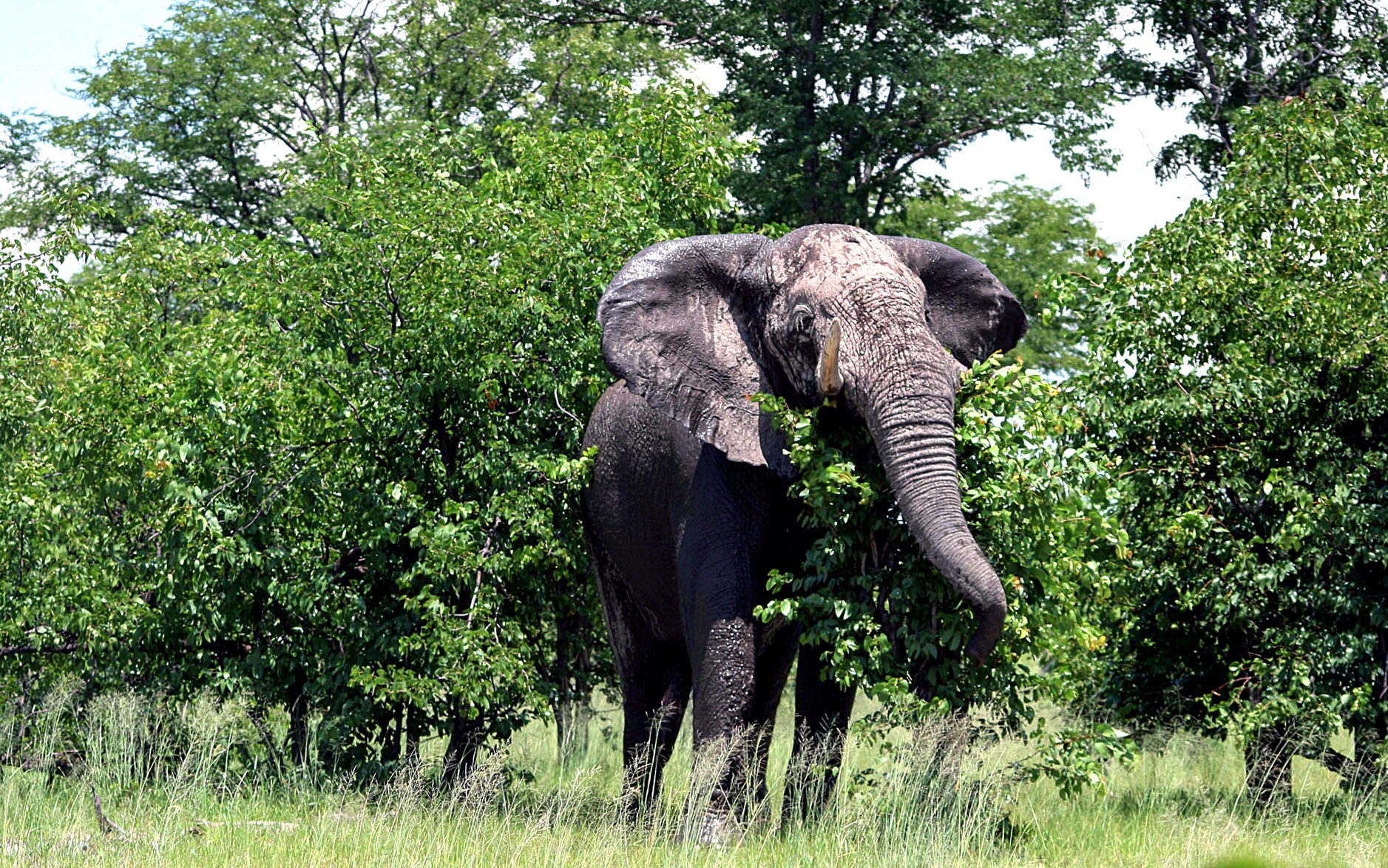
 The impact of browsing elephants is a continual source of controversy. (Photo: Gabriella Teren )
For as long as elephants have shared landscapes with people, they’ve also carried the weight of controversy. In southern Africa in particular, images of toppled trees and stripped bark often spark alarmist claims: too many elephants, woodlands collapsing, something must be done.
These conversations frequently circle back to ideas of carrying capacity and population control. But according to Dr Gabriella Teren — ecologist, founder of the Biodiversity Footprint Company and author of a detailed doctoral study on elephant impacts in Botswana — the reality is far more complex, and considerably less bleak.
“Elephants absolutely change woodlands,” she says. “But change isn’t the same as damage, and it certainly isn’t the same as ecological collapse.”
/file/attachments/orphans/Don-LinyantiGabriellaTeren_356346.jpg "The kind of scene that gets tourists frothed up about elephant damage but is perfectly normal.
<br>(Photo: Gabriella Teren )")
(Photo: Gabriella Teren )
A long view of elephants and trees
Teren’s PhD research focused on the Linyanti riparian woodlands of northern Botswana, which support some of the highest elephant densities in Africa during the dry season. What makes her work unusual is its time-depth and scale.
Using detailed field surveys combined with aerial photography taken over nearly two decades, she was able to track not only whether trees were dying, but which species, where, and how the woodland structure itself was shifting over time.
“This kind of long-term, species-level data is very rare,” she explains. “Most studies either look at huge areas from satellites, which can’t tell tree species apart, or they focus on very small plots. The Linyanti dataset allowed us to connect individual trees to landscape-scale patterns.”
The result is a far more nuanced picture of elephant–woodland relationships than the simple narrative of destruction often implies.
Not the whole story
One of the most visible impacts of elephants is their effect on large canopy trees, particularly acacias. In the Linyanti, tall trees declined significantly over the study period, and several acacia species became rare in the upper canopy. It’s this loss of big trees that often triggers concern, since they provide shade, nesting sites for birds and important food resources.
/file/attachments/orphans/Don-LinyantiGabriellaTeren-1_336297.jpg "Linyanti woodland in a wet season. (Photo: Gabriella Teren )")
However, Teren points out that tree mortality rates were not dramatically higher than natural background levels seen in savannas elsewhere. “What surprised us,” she says, “was that trees weren’t dying at an extreme rate. The bigger issue was that young trees weren’t making it through the ‘teenage’ stage.”
Seedlings of most canopy species, including acacias, were still present. What was missing were saplings — trees tall enough to escape fire, but still within reach of elephants. Repeated browsing and breakage meant that many species couldn’t graduate into the canopy under current conditions. Aside from elephants, impala also take out seedlings.
“That’s a bottleneck, not a dead end,” she emphasises. “It means regeneration is paused, not impossible.” With many of these species being long-lived, a tree only needs one seedling to survive for 100 years to replace itself.
Winners, losers, unexpected beneficiaries
While some tree species struggled, others thrived. Mopane trees, for example, proved highly resilient. When pushed over by elephants, mopane often coppices rather than dies, resprouting as dense, multistemmed shrubs. This growth form actually increases browse availability for smaller herbivores and produces nutrient-rich leaves earlier in the dry season.
In effect, she found, elephants were reshaping the woodland rather than erasing it — lowering the browse line and redistributing food across the ecosystem.
At the same time, shrub species increased dramatically. One species in particular, the native Combretum mossambicense, expanded to dominate much of the understorey. Shrub encroachment is often viewed negatively, but Teren urges caution.
“From a biodiversity perspective, the biggest concern isn’t fewer tall trees,” she says. “It’s when one species takes over completely. In the Linyanti, we did see strong shrub dominance — and we can’t rule out climate change effects — but we also saw signs that these shrubs might be playing a protective role.”
Elephants don’t eat this particular Combretum, and dense shrub patches could shelter tree seedlings from elephant browsing, effectively acting as nurse plants. This opens the possibility that woodland and shrubland may cycle over longer timescales, rather than representing a permanent shift to a degraded state.
In fact, the acacia woodland that was being removed may be caused by artificially low numbers of elephants in the 18th and 19th centuries resulting from European ivory demand.
Landscapes not wastelands
Another key insight from Teren’s work is that elephant impact is not uniform. Using spatial analysis techniques, she mapped clusters of dead trees across the landscape and tracked how these patches changed over time.
“What we found was a very dynamic system,” she explains. “Some patches grew, some merged, some shrank, and others disappeared entirely.”
Even as disturbed areas expanded overall, large sections of intact woodland persisted. Importantly, the landscape did not become a single homogenous scrubland. Instead, elephants created a shifting mosaic of disturbance and recovery — precisely the kind of heterogeneity that supports biodiversity and doesn’t destroy it.
“In savannas, variability is a good thing,” says Teren. “Different species benefit from different structures at different times.”
/file/attachments/orphans/Don-LinyantiGabriellaTeren_688592.jpg "Hedged mopani in Linyanti, Botswana, regrowing through trees downed by elephants. (Photo: Gabriella Teren )</p>
<p>")
So is this a crisis?
According to Teren, the short answer is no — at least not in the way it’s often portrayed.
“There’s no evidence from the Linyanti at the time of my study that elephants were causing irreversible biodiversity loss,” she says. “There have been changes in structure and species dominance, but no tree species were driven locally extinct, and key ecosystem functions are still operating.”
This doesn’t mean biodiversity within the system should be ignored. Dense shrub encroachment, reduced spatial connectivity, and the long-term absence of canopy recruitment all warrant continued monitoring. But framing the issue as an emergency requiring drastic intervention, such as culling, risks misunderstanding how savanna systems actually work.
“These are non-equilibrium ecosystems,” she notes. “They don’t sit at a stable ‘ideal’ state. They fluctuate with rainfall, fire, herbivory and time. But managers don’t like change”
Living with elephants
The implications for management are significant. In large systems like northern Botswana and Kruger, population reduction through culling is neither practical nor ecologically desirable. Instead, Teren argues that allowing elephants to move across broader landscapes — through functioning wildlife corridors and transboundary conservation areas — is the most effective way to moderate local impacts.
Hydrological changes offer another reminder of nature’s own balancing mechanisms. When the Savuti Channel began flowing again in 2008, elephant pressure in parts of the Linyanti eased and opportunities for regeneration increased.
“Elephants need space,” she says. “When they have it, ecosystems have time to breathe. And humans can play an important role by protecting large trees in fenced camps, providing a seed source.”
/file/attachments/orphans/Don-LinyantiGabriellaTeren-3_550893.jpg "A seasonal pan in Linyanti. (Photo: Gabriella Teren)")
Rethinking the narrative
For Dr Gabriella Teren, the takeaway from her PhD research is not that elephants are blameless, but that they are often misunderstood.
“They’re powerful, disruptive and sometimes inconvenient,” she says. “But they’re also part of the machinery that keeps savannas dynamic and alive.”
Perhaps it’s time, she suggests, to move away from asking how to stop elephants from changing landscapes — and instead ask how to live with the changes they bring. DM