



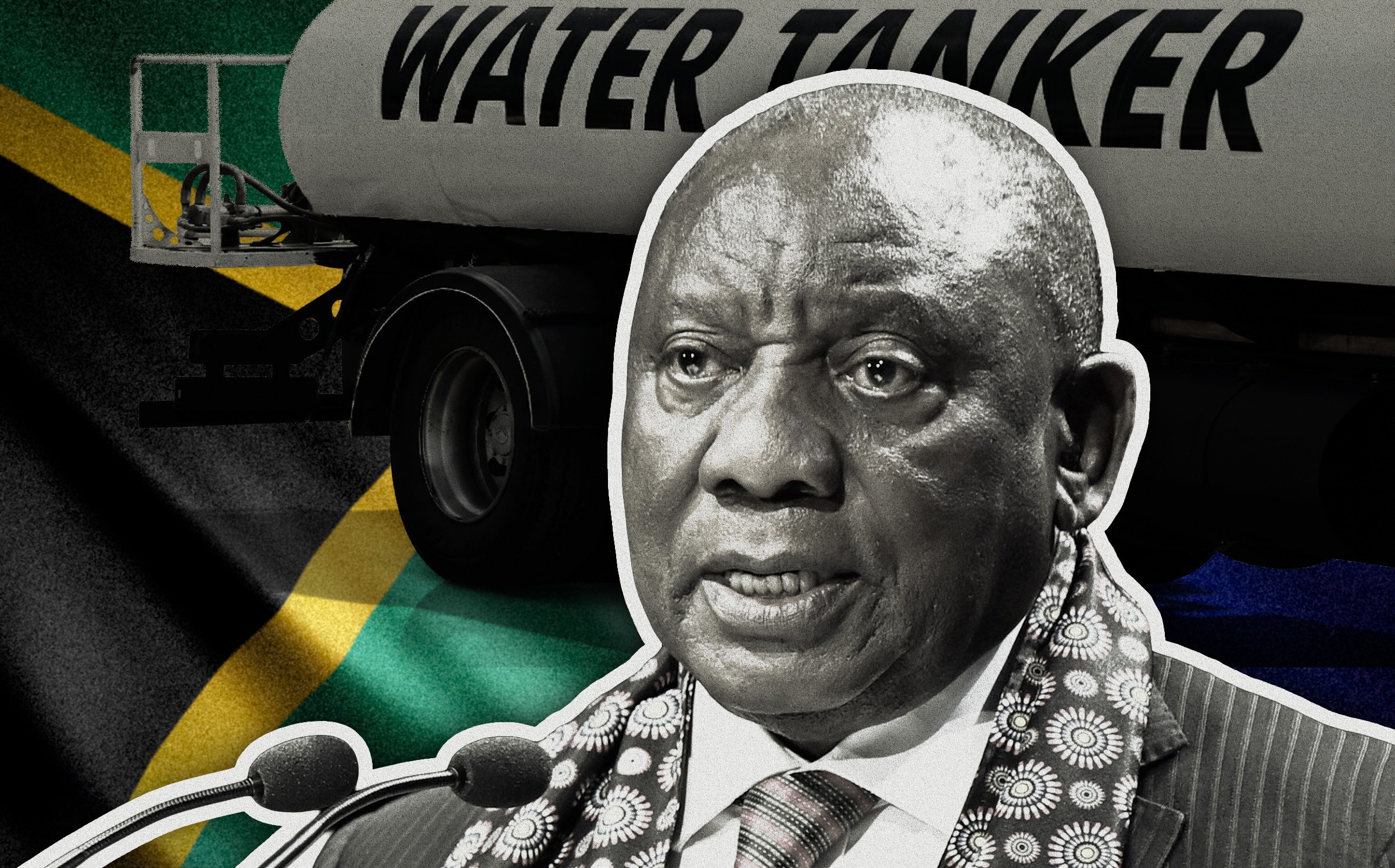
 llustrative image: In 2025 President Cyril Ramaphosa promised to take ‘decisive action’ to resolve the water crisis, but a year later water tankers are still a common sight in many communities. (Photos: Leon Neal / Getty Images | Lefty Shivambu / Gallo Images | iStock)
Anything President Cyril Ramaphosa says in his State of the Nation Address on Thursday evening, 12 February, will be overshadowed by the new national symbol: the water tanker.
Johannesburg, the country’s economic heartland, faces a near system collapse, denied by the City’s leaders but clear to its people, who took to the streets to protest this week. It’s a big city, so it attracts big attention, but its water story is repeated across the country. The water protests and the water tankers defined the state of the nation this week.
/file/attachments/orphans/ED_591910_257804.jpg "Residents fill up water from water tankers in Dube, Soweto, on 7 January 2026. (Photo: Fani Mahuntsi / Gallo Images)")
/file/attachments/orphans/WaterMarshalltown-25_475002.jpeg "Residents collect water outside the One Eloff building in Marshalltown, Johannesburg, on 6 October 2025, after being without water for two months. (Photo: Ihsaan Haffejee / Our City News)")
The ANC’s biggest post-apartheid gain, extending running water to people’s homes or yards, is being rolled back by patronage and wasteful spending, which has funnelled infrastructure funds into salaries or tenderpreneur pockets.
In 2025, Ramaphosa said: “Many people in our cities, towns and villages are experiencing more and more frequent water shortages as a result of failing water infrastructure. It is impossible to live without water, and it is impossible for the economy to grow without water. We are therefore taking a series of decisive actions to resolve the water crisis, to enable our people to get water where they live, whether in townships or rural areas.”
A year on, the actions were not decisive enough.
Ministers in the spotlight
Ramaphosa failed on two fundamentals in 2025: water and safety. This puts two ministers in the spotlight: Minister of Water and Sanitation Pemmy Majodina and acting Minister of Police Firoz Cachalia. A successful year in 2026 rides on their shoulders.
/file/attachments/orphans/FirozCachaliaandPemmyMajodina_661423.jpg "Illustrative image: South Africa’s success in 2026 rides on the shoulders of Minister of Water and Sanitation Pemmy Majodina (left) and acting Minister of Police Firoz Cachalia. (Photos: Misha Jordaan / Gallo Images | Brenton Geach / Gallo Images | iStock)")
Majodina can’t run water through the pipes and into the taps. This is because metros, district councils and councils deliver water through bulk suppliers (such as Rand Water) and municipal utilities. Because local government is in crisis, so is water, and it is becoming as serious an issue as load shedding used to be.
What Majodina and her director-general, Dr Sean Phillips, can do is speed up reform, which they have started, but it is taking too long to make an impact. (For details, see here.)
Cachalia was brought in to steady a corruption-addled South African Police Service (SAPS) after Senzo Mchunu was put on gardening leave. While some analysts differ, he is not working fast enough, given the political space his independence and temporary seat gives him.
He could clean up the police, put in place the best bureaucrats and leave a service that serves people. He is a measured scholar, but there is a place for leadership through action and statement to address the nation’s fears and sentiments about crime and corruption. He has not yet found his full voice, even after 213 days.
But Associate Professor of Criminology at UCT, Irvin Kinnes, says Cachalia is doing well under the circumstances. He has not blandly accepted the picture of crime painted by the SAPS generals. He is questioning the answers and interacting with communities to ensure he has sufficient information to make policy changes.
The fact that police officers named in the Madlanga Commission are already facing disciplinary sanctions and suspension shows that he is not prepared to wait for the commission’s outcome, according to Kinnes. Whether Cachalia can address both police criminality and political criminals once the final reports land will be his litmus test – and his poisoned chalice.
Last Friday, Police Commissioner General Fannie Masemola announced that four police officers had been served with notices of intended suspension in relation to the revelations of the Madlanga Commission, reported News24. He said an additional two officers had already been suspended.
This is after President Cyril Ramaphosa ordered Masemola and Cachalia to establish a special task team to probe at least 14 officials implicated in the policing scandal. The leader of the task team, Ramaphosa said, will report to Masemola. According to a report from the Sowetan, Masemola said this team has been given three months to finalise its work.
Three women make Ramaphosa look good
There is good work being done in the Cabinet. Three women ministers have been top performers and have helped tell a good story for Ramaphosa. They are Minister of Transport Barbara Creecy, Minister of Basic Education Siviwe Gwarube and Minister of Tourism Patricia de Lille. Here’s why.
/file/attachments/orphans/GwarubeDeLilleCreecy_749826.jpg "Illustrative image: The three ministers who are bringing shine to President Ramaphosa’s Cabinet are: Siviwe Gwarube (left), Patricia de Lille (centre) and Barbara Creecy (right). (Photos: Fani Mahuntsi / Gallo Images | OJ Koloti / Gallo Images | Bernard Chiguvare | iStock)")
Creecy is an energetic minister rising to the challenge posed by the many burning platforms she has inherited. She is overseeing the biggest change to logistics as the oversight minister of Transnet, the state’s rail, port and freight utility company. Eleven companies have been selected to bid for rail routes – the state is opening up the freight rail system to private operators to crowd in investment. It’s a shift with great potential for logistics, the second-largest factor holding back significant economic growth.
Creecy makes political space for the essential reforms at Transnet. Passenger rail is slowly being fixed after decades of decline – the blue passenger lines are running again. She faced down the team who nearly ran the Road Accident Fund into the ground and has put in place a new board while continuing to crack down on scholar transport owners who do not adhere to safety regulations. In her hard hat and yellow jacket, Creecy is often on the roads or trains.
Gwarube is a star. The matric results showed why, as Takudzwa Pongweni reported here. Confident and gregarious, Gwarube has quickly mastered her role as a Cabinet minister. She accepts help where she can and occupies her position with confidence. There is still a way to go.
Last year was the first time Grade 4 learners wrote nationally set end-of-year assessments for Maths, Natural Science and Technology in their mother tongue. A total of 11,948 schools across all nine provinces are implementing mother tongue-based bilingual education. It’s a positive step, though visible improvements in literacy rates will take time.
While signed into law, implementation of the Bela Act is lagging. Gwarube only gazetted key regulations for public comment in August 2025, and friction over admissions and language policies continues to stall progress.
In September 2025, the Department of Basic Education announced that the Bana Pele Early Childhood Development (ECD) mass registration drive had registered and approved 10,000 ECD centres, three months ahead of the 31 December 2025 deadline set by Gwarube. While this is a significant achievement, many ECD centres remain either informal or unable to meet the requirements for full registration, so the work is by no means done.
In the 2025 Budget, R10-billion was allocated to the ECD subsidy, increasing the per-child allocation from R17 to R24 per day. However, Grace Matlhape, CEO of Smartstart, has noted that only 41% of ECD centres registered are eligible for this subsidy, and of those, only 33% are reported to be receiving it.
De Lille has had a torrid year after she fired the talented board of SA Tourism, which fought back. That battle is ongoing after the members lost the first round in their bid for an urgent interdict. Travel to any of our hotspots, and it’s clear that South Africa’s natural beauty, plus the fact that Johannesburg’s inner-city is a shopping mecca for the rest of Africa, has meant surging numbers. De Lille can take the credit.
SA welcomed 10.48 million visitors last year, outstripping targets and taking us back to pre-Covid visitor levels. European demand was strong, and visitor numbers from the rest of Africa are growing – tourism is at 3.3% of GDP, and while Cape Town may risk over-touristification, that figure can still go up if De Lille continues to do a good job.
The successful reformers
The Government of National Unity (GNU) is, by necessity, a reform government as it has had to implement deep changes to reverse State Capture. These three ministers are the successful reformers. Here’s why.
/file/attachments/orphans/SchreiberGodongwanaRamokgopa_145554.jpg "Illustrative image: Leon Schreiber (left), Kgosientsho Ramokgopa (centre) and Enoch Godongwana are the reformers in the Government of National Unity.<br>(Photos: Luba Lesolle / Gallo Images | Lindsey Schutters | Jairus Mmutle / GCIS | iStock)")
(Photos: Luba Lesolle / Gallo Images | Lindsey Schutters | Jairus Mmutle / GCIS | iStock)
Minister of Home Affairs Leon Schreiber is re-engineering the department that South Africans depend on from birth to death and in-between at every life stage. By taking people out of Home Affairs department queues and into banks for basics such as ID and passport applications, he has changed the experience, offering an important example of how to work with the private sector for the public good.
The number of delayed visa applications has decreased, and his department issued 4 million smart ID cards in 2024.
The E-visa is finally working, enabling higher tourism numbers, especially for group tours from India and China (important feeder markets). He has published a White Paper on Citizenship, Immigration and Refugee Protection and clamped down on rampant corruption in the department he oversees. The critique is that he is a migration hawk rather than a progressive.
Minister of Finance Enoch Godongwana has recovered from the VAT debacle, which saw budget negotiations in the GNU go to the wall, and he has learnt the art of inter-party negotiation with the help of his deputy, Ashor Sarupen, from the Democratic Alliance (DA).
Debt levels have stabilised, and growth projections are good, and tax collection under South African Revenue Services (SARS) Commissioner Edward Kieswetter is higher than projected. During a recent visit to the new SARS command centre, Ramaphosa praised SARS for successfully implementing all the recommendations of the Nugent Commission, which investigated the capture of the revenue service.
Minister of Electricity Kgosientsho Ramokgopa has all the swagger of someone who stopped load shedding. Which he did – with help from the business-led Energy Council and the post-capture Eskom executive and board. SA’s energy mix has changed substantially, and even as its coal fleet still struggles, the reforms have ensured there is no load shedding. (See amaBhungane’s Susan Comrie here.)
But business is not happy, as it fears that Eskom’s monopoly is trying to backtrack on important energy reforms to unbundle its ownership of the transmission company, as Business Unity SA CEO Busi Mavuso wrote here. And electricity prices are going through the roof. A botch-up by the regulator, Nersa, means South Africans will pay an average of 8.76% more for power come April, rather than the 5% initially pencilled in. Many people are returning to paraffin and wood fires for their energy needs because electricity is too expensive.
Rising stars
The Cabinet reflects a welcome shift – generational change. Two rising stars are Minister of Public Works Dean McPherson and Minister of International Relations and Cooperation Ronald Lamola.
/file/attachments/orphans/macphersonLamola_227569.jpg "Illustrative image: Ministers Dean Macpherson (left) and Ronald Lamola represent the new generation in the government. (Photos: Darren Stewart / Gallo Images | Leon Sadiki / Bloomberg via Getty Images | iStock)")
At 41, Macpherson is among the youngest Cabinet members. From Durban, he is a protegé of outgoing party leader John Steenhuisen. Public Works is not a sexy portfolio, but he has been a workhorse since being appointed to the role as part of the GNU negotiations.
“We build, we maintain, we manage public assets. We turn plans into bricks, pipes, cables, roofs, classrooms, clinics, police stations and offices that work,” he said on 6 February, addressing the National Press Club in Cape Town before delivering the most excoriating exposé of why the state does not work.
He blew the whistle on why government property leases are often at the heart of corruption, how the investigation into the R800-million oxygen tank leasing scandal was obstructed and on how difficult it has been for him to crack down on the construction mafia.
Across the country, local business forums enter private or public construction sites and demand a cut under the guise of local empowerment. In reality, it is still a mass extortion scheme.
Macpherson has been an energetic anti-corruption figure. The final years of his term will see him turn to a massive infrastructure budget to make the country a building site. Bloomberg reported that Ramaphosa could announce the creation of a public property holding company to manage the country’s property portfolio.
Lamola has led South Africa’s international relations in a polarised world of global turmoil.
Before he was appointed minister of the Department of International Relations and Cooperation (Dirco) in July 2024, Lamola served as justice and correctional services minister. He has risen through the ranks of the ANC, after first joining the ANC Youth League at 13, and is a member of both its National Executive Committee and National Working Committee.
Lamola, together with President Cyril Ramaphosa, led a successful Group of 20 (G20) Presidency – the first on African soil – which saw the passing of a Leaders’ Declaration at the Johannesburg Summit in November 2025. This was achieved during a year in which South Africa had to fend off unprecedented attacks from US President Donald Trump, ranging from its G20 priorities to its affirmative action and land redistribution policies. Trump’s eventual G20 stayaway, however, turned out to be a net positive for South Africa and the middle power bloc.
Lamola is also well-known for leading SA’s top legal team to The Hague in January 2024, to argue before the International Court of Justice that Israel violated the Genocide Convention in its military action in the Gaza Strip. South Africa’s genocide case is ongoing before the court.
Meanwhile, Lamola and Dirco have also received sharp criticism from other political parties in the GNU, in particular the DA and the Freedom Front Plus, for “monopolising” SA’s foreign policy, which mostly mirrors that of the ANC.
The traders
Both Minister of Trade, Industry and Competition Parks Tau and Minister of Agriculture John Steenhuisen come in for a lot of flak. But in a year when South Africa faced 20 attacks from Trump, both deserve kudos for diversifying South Africa’s trade markets.
/file/attachments/orphans/SteenhuisenTau_440827.jpg "Illustrative image: John Steenhuisen (left) and Parks Tau have come in for some flak but have diversified South Africa’s trade markets. (Photos: Xabiso Mkhabela | OJ Koloti / Gallo Images | iStock)")
With exports to the US now facing 30% tariffs, which have neutralised the benefits of the Agoa free trade deal (extended for a limited period) and affected both agricultural and motor car exports, SA has had to find new markets rapidly. Steenhuisen’s department has announced a deal to sell table grapes to South Korea and stoned fruit (apricots, peaches, nectarines, plums and prunes) to China. There are opportunities to sell avocados to China, Japan and India.
Last week, Tau signed a trade framework agreement with China, which could further expand access to one of the world’s largest and fastest-growing markets. The aim is to get to a free trade agreement with China in 2026, reports say. DM
Additional reporting by Tamsin Metelerkamp, Siyabonga Goni and Takudzwa Pongweni.