



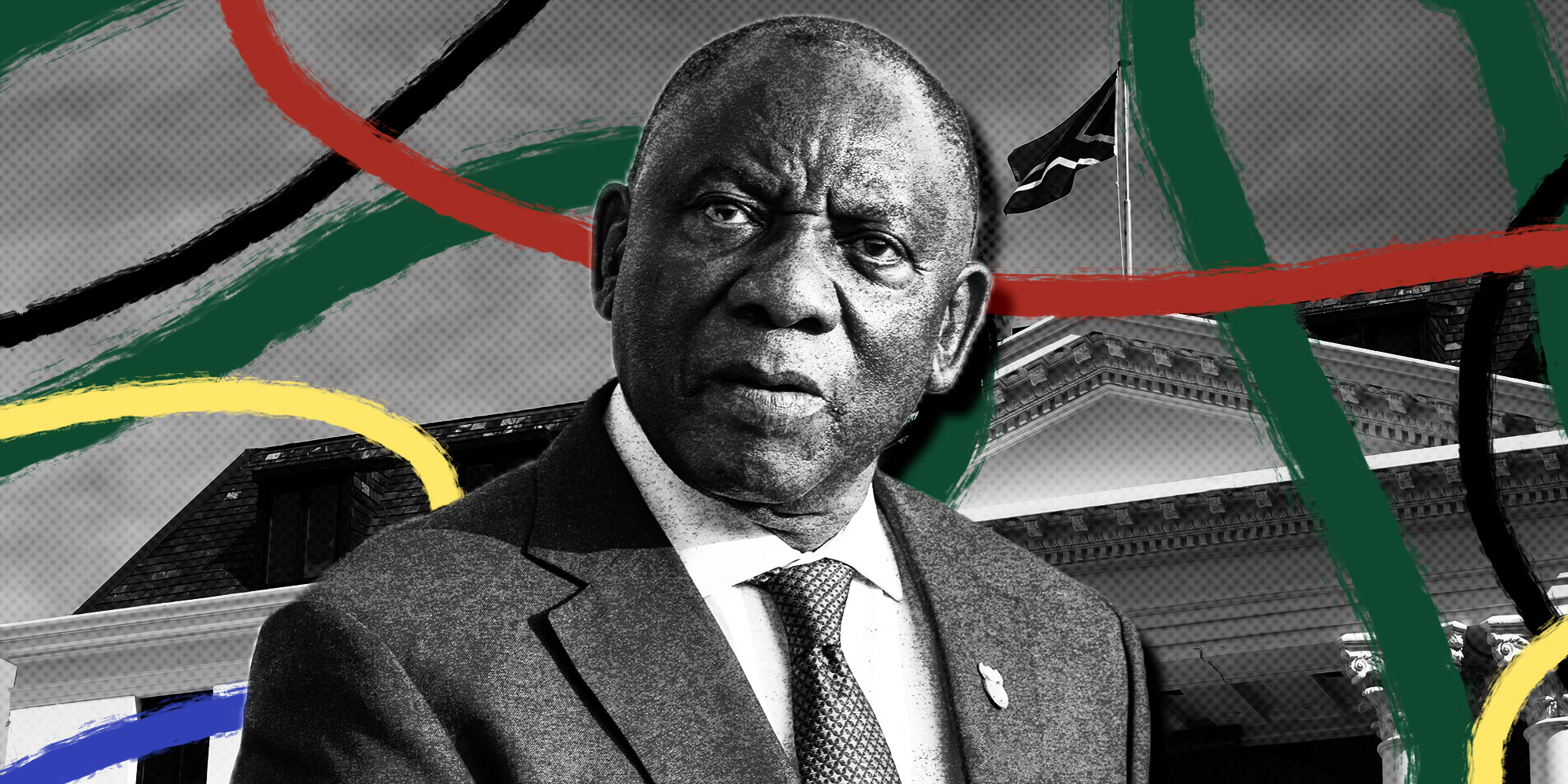
 Illustrative Image: President Cyril Ramaphosa. (Photo: Per-Anders Pettersson / Gallo Images) | Parliament. (Photo: Daily Maverick)
/file/dailymaverick/wp-content/uploads/2025/10/label-analysis-2.jpg)
When President Cyril Ramaphosa takes to the podium in Cape Town on Thursday night to deliver his State of the Nation Address (Sona), he will do so from a relatively strong position.
Inside the ANC, he appears to face no challengers brave enough to stick their necks out in public.
In the government, he has shown himself to be almost indispensable to the coalition. His apparent lack of interest in the Budget last year nearly led to the coalition falling, but his intervention with other leaders after the Budget heralded a new era for his government.
Read more: Most GNU parties hail coalition’s stability in lead-up to big ‘test’ at local polls
South Africa’s economy is now in a better position than at any time in the last decade.
Despite serious problems at some power stations, Eskom has put an end to load shedding. S&P Global has upgraded our rating. We were taken off the Financial Action Task Force grey list in record time. Our economy is growing. Interest rates have been cut and, perhaps most important of all, inflation is still coming down.
All of this could allow Ramaphosa to survey the scene around him and tell the millions of people who will watch the Sona on TikTok in a minibus on Friday morning that things are moving in the right direction.
He will be able to talk up his government’s very real recent achievements and suggest there is real momentum.
/file/attachments/2987/ED_546615_991752.jpg "President Cyril Ramaphosa at the podium for his response to the Sona debate in 2025. (Photo: Gallo Images/Jeffrey Abrahams)")
The reality
However, for almost everyone in South Africa, very little has changed — and there is little prospect of it changing.
This week, residents of Joburg and Tshwane were again without water.
While it appears the end of load shedding has helped to reduce the murder rate significantly, many people still live in the very real fear of violent crime.
Much of our government is still failing. Anyone going into a government building is likely to tell you, with some horror, what they have seen.
And in Gauteng, the health MEC claims, apparently with a straight face, that some patients “prefer to sleep on the floor”.
In recent days, one of the most cogent explanations of our situation has come from the chief economist at the Standard Bank Group, Goolam Ballim.
While highlighting the economy’s upward trajectory, he also raised several critical points regarding the challenges that remain. Perhaps the most important was that there were nearly as many service delivery protests last year as there were eight years ago.
However, he also mentioned two key factors which show that there are changes afoot.
The first is that formal employment in South Africa has increased, with recent figures indicating the country has added one million formal jobs since the pandemic.
And fixed investment, investment in infrastructure, is increasing.
As has been stated many times, more than anything else, this economy needs more jobs.
Of course, any real understanding of our economy must include the informal economy, where millions of people create incomes.
This means any conversation about our economy should focus not just on the “creation of formal jobs”, but also “increasing incomes” for everyone in both the formal and informal economies.
At set-piece events like the State of the Nation Address, ANC politicians tend to focus on the formal numbers and the formal economy.
Considering the size of their potential constituency in the informal economy, they would be well-advised to focus on improving the lives of everyone, on helping informal businesses, rather than dwelling on the official figures.
Recognition and a plan
While a single address cannot act as a panacea for all our problems, the value lies elsewhere: in the President recognising what actually needs to be done.
It is not enough for him to claim that he “feels the pain” of those without water or an income.
Rather, he needs to set out solutions — for the water crisis in so many municipalities, for crime, for dysfunctional government services. And this is where his speech is likely to be vulnerable to attack.
For example, given the inept response of the Joburg mayor and the Joburg region of the ANC to the water crisis, it is obvious that all involved must be removed.
That will not happen.
/file/attachments/orphans/IMG_2065_640837.jpg "Johannesburg residents protest about water outages in the city. (Photo: Reitumetse Pilane)")
The rot in the police, which plays an important role in allowing and enabling the pandemic of violent crime, necessitates the removal of all involved, including the National Police Commissioner, Fannie Masemola.
Again, that will not happen.
Even in the SANDF, where it appears Ramaphosa could, and should, remove the current leadership with virtually no political pushback, he appears paralysed.
Any comment he might make about improving the health system is likely to run straight into the divisive argument about the National Health Insurance.
He is likely to follow the example of all our previous presidents and ignore the dire conditions at Chris Hani Baragwanath Hospital and so many other institutions.
Sense of disbelief
There is a key reason this has happened, and why Ramaphosa is unlikely to break with this tradition: the political ritual of Sona relies on a sense of disbelief.
Surrounded by police officers so conspicuously absent from our streets, soldiers who are often left undefended and sometimes without proper food and in a room full of the political elite, why invite lived reality to join you?
Politically, Ramaphosa could break with much of this in his speech.
As the head of a coalition, he could easily play one party off against another, telling each he had to take this action because of the other.
That would leave him free to speak about the lives people live, and what his government is going to do to improve them.
He could say he is removing from his Cabinet people implicated by the Zondo Commission, or that the Presidency is intervening in Joburg, or placing the Gauteng Department of Health under national administration, or dealing with the rot in the SANDF.
But, based on experience, there is a greater chance that Jacob Zuma will plead guilty. DM