



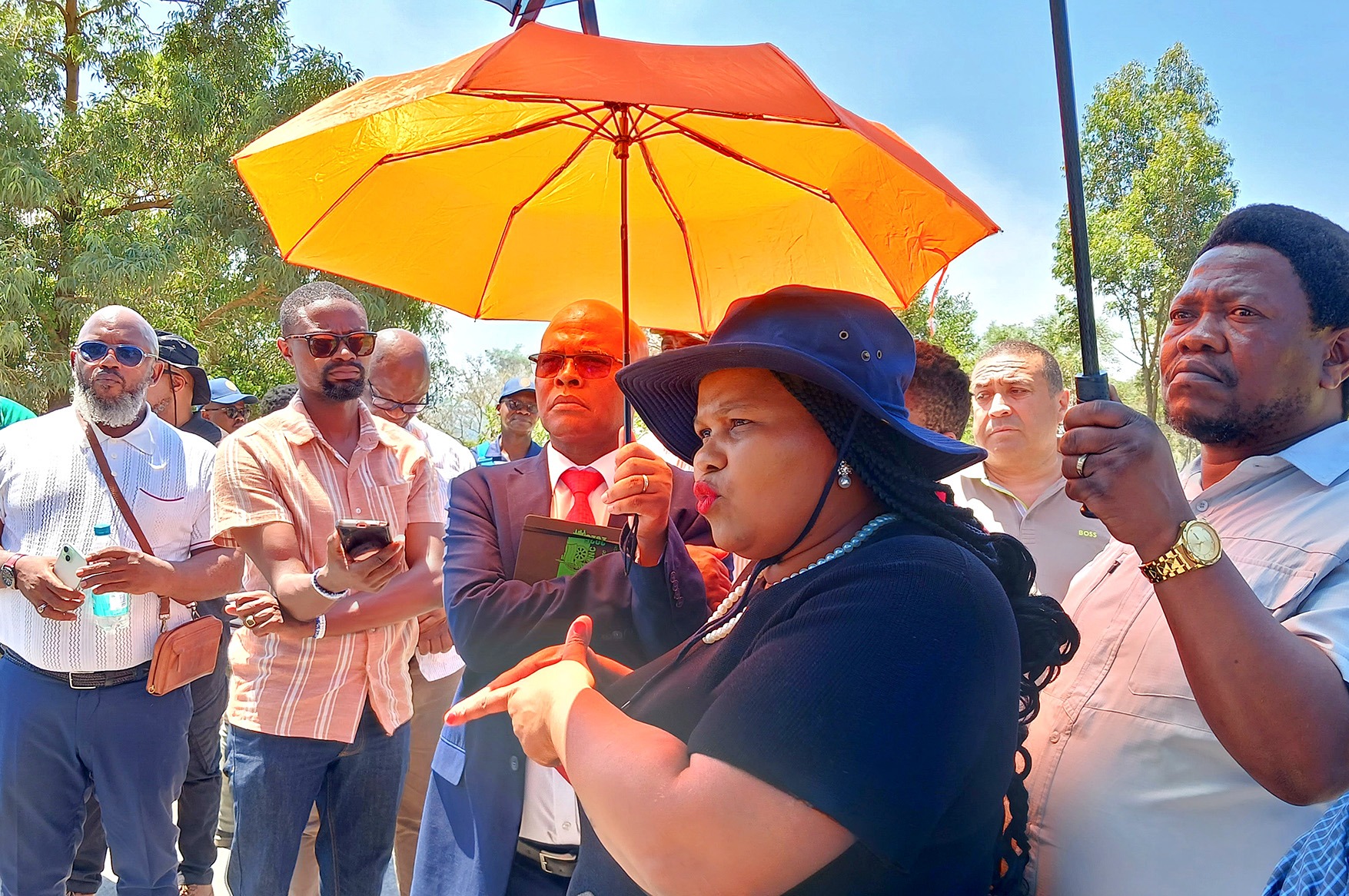
 Nelson Mandela Bay Mayor Babalwa Lobishe and several high-ranking city officials met with the Grogro community on Wednesday after protesters blocked the Kragga Kamma Road. (Photo: Riaan Marais)
Smoke hung in the air as heat radiated from smouldering tree trunks blocking one of Nelson Mandela Bay’s arterial routes on Wednesday morning.
A few metres away, shotgun shells littered Kragga Kamma Road where members of the Public Order Policing Unit fired at surging protesters.
On the side of the road, 25-year-old Ncebazi Jamjam lay on the grass, whimpering in agony, her face bloody and her eyes swollen shut.
She had allegedly been struck in the face by a rubber bullet.
Jamjam was one of the dozens of residents from the Grogro informal settlement who took to the streets early on Wednesday to show their dissatisfaction with the empty promises made to them by municipal officials.
/file/attachments/orphans/GrogroMayor4_850444.jpg "Ncebazi Jamjam (25) was taken to hospital after she was allegedly struck in the face by a rubber bullet during clashes between protesters and the police on Wednesday. (Photo: Riaan Marais)")
The community first took to the streets in October, demanding basic services after municipal contractors removed the illegal electricity connections that powered the settlement. Commitments were made, but never honoured, and on Wednesday residents demanded a meeting with Nelson Mandela Bay Mayor Babalwa Lobishe.
While the Grogro saga dates back more than 40 years, when the first people moved to the vacant plot of land, the community began bumping heads with the municipality in October last year when disruptive protests brought their concerns into the spotlight.
Read more: After decades in the dark, Gqeberha informal settlement is promised R7m electricity lifeline
Temporary electricity
The mayor initially assigned her deputy, Gary van Niekerk, to engage with the community leaders of Grogro. Negotiations included a commitment to install a transformer to provide the community with temporary electricity.
However, it later emerged that this would be illegal, and the only options were to buy the land on which they lived or to relocate the residents to a new site, N2 North, on the outskirts of Gqeberha.
Read more: NMB politicians warn R7m electricity promise to informal settlement could break rules
Four months down the line, and after the city failed to attend several meetings to keep the community informed of developments, the residents of Grogro grew tired of waiting.
/file/attachments/orphans/GrogroMayor3_477116.jpg "Protesters at the intersection of Kragga Kamma Road and the entrance to the Grogro informal settlement on Wednesday. (Photo: Riaan Marais)")
“Promises were made, and they were not kept,” said community leader Zukile Futa. “Even the agreements to meet with us every two weeks with updates grew quiet. They started cancelling meetings, and since November we have not heard anything back. To be honest, the municipality is lucky that we did not return to the streets sooner.”
The earliest reports of protest action started shortly after 6am on Wednesday, when protesters dragged burning logs onto the road, disrupting traffic for residents and several businesses that operate in and around Kragga Kamma Road.
After a petrol bomb was tossed into the street, and a quick exchange of stones being thrown and rubber bullets being fired, protesters moved away from Kragga Kamma Road to another part of the settlement.
/file/attachments/orphans/GrogroMayor7_418799.jpg "Firefighters were called to the scene after burning debris, used by protesters to block Kragga Kamma Road, set nearby bushes on fire. (Photo: Riaan Marais)")
Other than Jamjam’s injuries, no other serious incidents were reported.
Her younger sister, Inganathi, claimed that Jamjam was caught in the middle between protesters throwing stones and police returning fire with non-lethal rounds when she was shot in the head.
“She was shot in the back of the head and went down. Then the same police officer fired at her again, hitting her in the face,” said Inganathi.
However, there were also conflicting reports from people on the scene that she could have been struck by a wayward rock thrown at police officials.
/file/attachments/orphans/GrogroMayor5_529630.jpg "Cartridges from rubber bullets were strewn around Kragga Kamma Road after the police clashed with protesters. (Photo: Riaan Marais)")
Futa said he could not confirm the incident, as he was not present when Jamjam was injured, but said it was unfortunate that someone was injured.
“It was never our intention for anyone to get hurt. All we want is for the mayor to meet with us, but for someone to be hurt that badly was never part of the plan,” he said.
Lobishe eventually arrived on the scene at about 12.30pm, together with the human settlements MMC, Thembinkosi Mafana, the department’s executive director, Tabiso Mfeya, and several other high-ranking officials.
/file/attachments/orphans/GrogroMayor2_532766.jpg "Grogro community leader Zukile Futa told the mayor that she and her officials were living ‘soft lives’ while the people of Grogro struggled without water and electricity. (Photo: Riaan Marais)")
Lobishe apologised to the community about the broken promises to provide a transformer for temporary electricity.
She said negotiations with the landowner, Dr Albert van Rooyen, were still ongoing, but that he had demanded an exorbitant amount of money to buy the land.
According to the officials at the meeting, when negotiations to buy the land started years ago, the figure of R24-million was discussed. This increased to R56-million, and the latest figure was in the region of R80-million.
Lobishe said the city would employ an independent valuator to determine a more reasonable price.
“Our estimates are that the land cannot be worth more than R6-million, but we will continue our discussions with the land owner and see if we can come to an agreement,” said Lobishe.
No response
Van Rooyen said he was eager to continue discussions with the municipality, but had received no response to his requests for meetings.
“I last met with officials on 8 December. Since the start of this year I have emailed them twice, but received no response.
/file/attachments/orphans/GrogroMayor6_982385.jpg "Remnants of a petrol bomb thrown at the police during Wednesday’s protest. (Photo: Riaan Marais)")
“This morning, after the community started protesting again, I got a call to reopen discussions.”
Van Rooyen said he had assessments done on the value of the 85-hectare piece of land.
“I am open to discussing prices with the municipality. I want this deal to move forward,” he said.
Meanwhile, at the scene of the protest, members of the community did not mince their words.
“This municipality and its processes have been failing us for more than 30 years. It is very clear that you do not have a plan,” said resident Monde Mbezu.
He said officials had done nothing but make empty promises, and the mayor should not be surprised by the people’s anger at her and the municipality.
Futa said it was easy for Lobishe to make empty promises as she did not understand the hardships of their community.
“You officials are living soft lives. You do not know what it is like to live in darkness or to carry bottles and buckets of water to your home because there are no taps. This municipality is failing dismally,” said Futa.
Speaking after the engagement with the community, Lobishe reaffirmed that the city apologised for disappointing the community of Grogro.
“We have a long way to walk with these people before we can build a relationship of trust with them,” said Lobishe. DM