




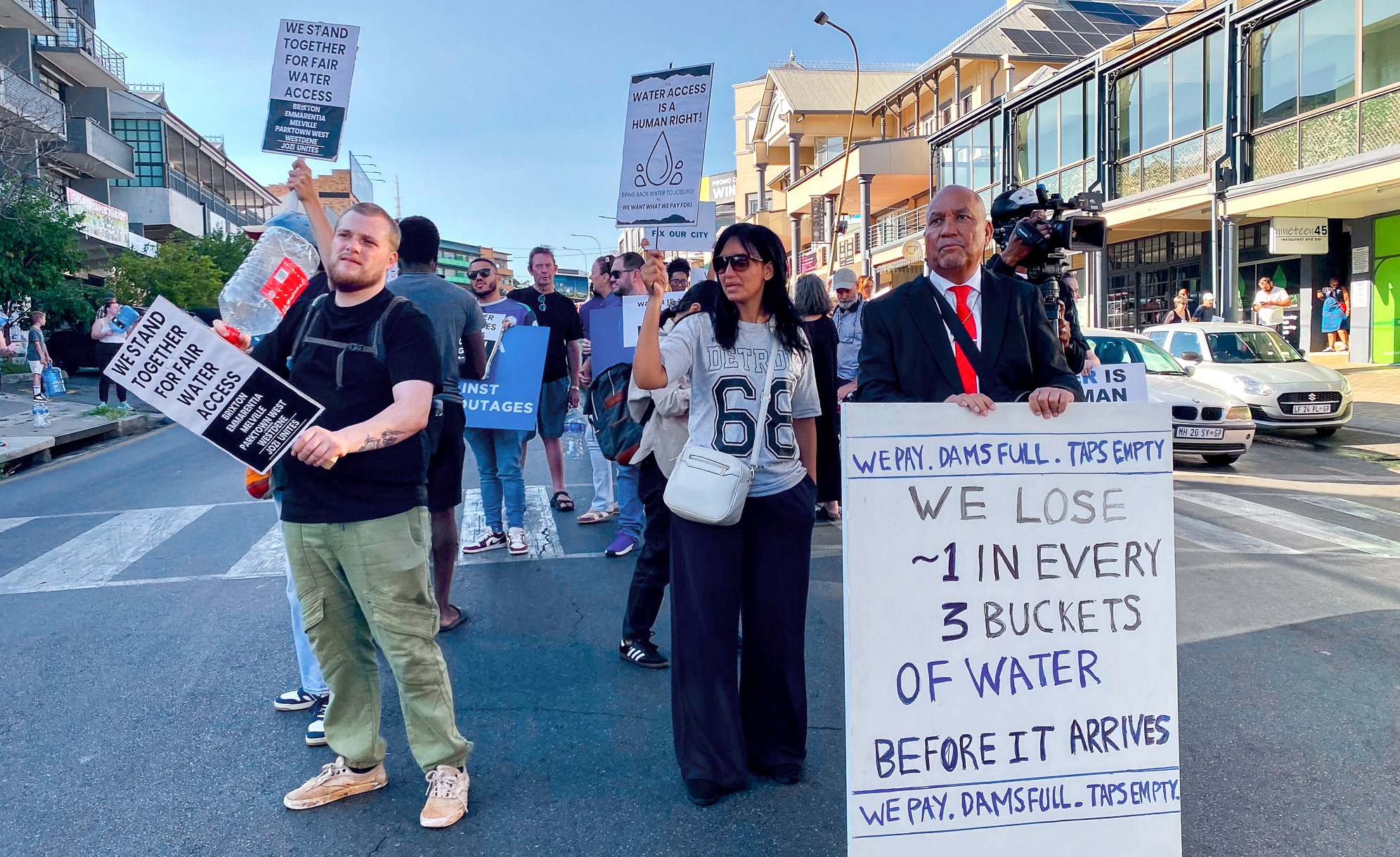
 Johannesburg residents protesting against the ongoing water outages in the city say that even if their protests do not lead to a big change, they will raise awareness. (Photo: Reitumetse Pilane)
 The Democratic Alliance (DA) will be taking the City of Johannesburg to court over the ongoing water crisis, which has been exacerbated by high demand, a multi-system failure and an unprotected strike at Johannesburg Water. The DA was unable to provide an exact timeline, but stated that it has instructed its legal team to pursue the matter on an urgent basis.
The official opposition held a press conference on the state of Gauteng’s water crisis on Wednesday, 11 February, at its headquarters in Bruma, Johannesburg.
In his own briefing on Wednesday, Johannesburg Mayor Dada Morero said: “I do not think that we have reached national disaster stage.”
He said the City had deployed 60 water tankers to affected areas and progress was being made in addressing issues in Selby, Melville, Emmarentia and Brixton.
/file/attachments/orphans/IMG_2114_397246.jpg "Johannesburg Mayor Dada Morero says the City is making progress in addressing water supply in Selby, Melville, Emmarentia and Brixton. (Photo: Reitumetse Pilane)")
The DA’s briefing was attended by its Gauteng leader, Solly Msimanga; its mayoral candidate for Johannesburg, Helen Zille; its mayoral candidate for Tshwane, Cilliers Brink; and its spokesperson for water and sanitation, Stephen Moore. The party pointed to gross mismanagement of the water system, including failing infrastructure, delays in the Lesotho Highlands Water Project and the increasing reliance on water tankers.
The party said that the use of tankers has quadrupled in recent years, and indicated that it is being alleged that tanker suppliers are unduly benefiting from tenders by deliberately sabotaging water infrastructure, referring to claims in areas of the City of Tshwane such as Hammanskraal. This has diverted money towards supplying tankers that could otherwise be spent on infrastructure.
Read more: While Joburg battles for water tankers, they’ve been failing at informal settlements for years
“Joburg has the worst water crisis. There are 22 critically endangered water systems and four that are on their last legs. And those four are the places where we are seeing most of the current outages,” Zille said, adding that access to water is a constitutional right.
The DA said the City has adopted a turnaround plan to address the issues but that it has not been implemented. The party wants the courts to force the City to act on it.
/file/attachments/orphans/IMG_8393_497128.jpg "The DA mayoral candidate for Johannesburg, Helen Zille (right), and Gauteng party leader Solly Msimanga (left) announced on 11 February that the party is taking the City of Johannesburg to court over the escalating water crisis in Johannesburg. (Photo: Naledi Mashishi)")
Zille said that Johannesburg’s crisis has been exacerbated by underspending on maintenance, causing a maintenance backlog stretching back to the early 2000s.
“We’ve done a calculation on the maintenance backlog, not new infrastructure, the maintenance backlog in Joburg, and it is an estimated R200-billion, which is more than twice the entire budget of the City of Joburg,” she said.
She added that the number of businesses and high-end ratepayers that the City has lost in recent years has created a “perfect storm” that has resulted in the crisis the City faces today.
The DA also revealed its strategy for curbing the crisis. Its more immediate proposals included streamlining communication from Rand Water to residents. Moore indicated that the Vaal Dam is currently over capacity, and indicated that water could be used by Rand Water for additional supply during high demand.
“We need to use the water we already have more intelligently when the dams are full. Right now, the Vaal Dam is sitting at 101.6% full. It is over capacity and water is pouring over the dam wall,” Moore said.
“We are going to call on the Department of Water and Sanitation to allow Rand Water to pump more water from the Vaal Dam, only when it is over 100% capacity. And the amount of water with the additional capacity Rand Water has, they could produce 280 megalitres of additional water,” Moore said.
While the DA has called for emergency funding to be made available, it stated that it is not calling for the President to declare a state of disaster, as such periods have limited oversight, making them vulnerable to corruption.
Read more: Civil society body calls for Joburg’s water crisis to be declared a national disaster
Residents protest over lack of water
The DA briefing was held in response to the City’s worsening water crisis, which has seen areas without access to consistent water supplies for weeks.
At the time of the briefing, hundreds of Johannesburg residents took to the streets to express their frustration over the ongoing water crisis affecting a growing number of areas throughout the city. Sixty-three-year-old Susan Jobson was protesting with her cane from her chair in the middle of 4th Avenue in Melville.
/file/attachments/orphans/IMG_2085_875881.jpg "Johannesburg residents took to the streets on 11 February to protest against the ongoing water outages in various areas around the city. (Photo: Reitumetse Pilane)")
/file/attachments/orphans/IMG_2065_640837.jpg "Johannesburg residents express their frustration at the ongoing water outages in various areas around the city. (Photo: Reitumetse Pilane)")
/file/attachments/orphans/IMG_2071_256336.jpg "Some areas of Johannesburg have been without consistent water supply for weeks. (Photo: Reitumetse Pilane)")
“Because I’m living on my own, I can’t pick up the heavy buckets of water, and I struggle to do basic things like flushing the toilet,” she said.
When asked what they hoped to achieve by protesting, demonstrators said that even if the protest did not lead to a big change, it would certainly raise awareness.
The protest was not just attended by Melville residents. It also drew other residents from affected areas of the city, such as Brixton.
Brixton resident Tamsin Botha (35) said she was on day 14 without water. She added that her neighbourhood started experiencing random water outages last summer. Brixton is one of the most affected areas in the city.
Morero confronted
On Tuesday, 10 February, Johannesburg Water denied claims that the city is at Day Zero.
“Day Zero refers to a complete system failure where water cannot be supplied. Johannesburg continues to receive and distribute water across the city. However, the system remains under significant pressure due to high demand, infrastructure constraints and ongoing supply challenges,” it said.
On Wednesday, Mayor Dada Morero briefed the media at Brixton Reservoir with an update on the City’s current water supply challenges, ongoing interventions and measures being implemented to stabilise water supply.
During the briefing, a furious resident confronted Morero, telling the mayor that he had not had water at night for a year.
“If it was your suburb, would it be acceptable not to have water at night for a year?” the resident said.
“You came for a photo opportunity, but I don’t have water at night. I want my opportunity now” he said, as Morero tried to pacify him.
“I am smelling. I haven’t showered.”
Zille was quick to post the confrontation on social media.
Morero later said that the city’s water challenges are being compounded by consumers having “no sense of responsibility for consumption” and illegal and unauthorised water structures being built along the existing infrastructure, adding further strain to the system.
Morero said four reservoirs and three towers are under construction, with one tower nearing completion, and that the Brixton Reservoir should be completed by the end of February.
However, he warned that there is still a severe funding backlog. Morero said the City will seek grants from National Treasury, which would help achieve water objectives. The current budget for this financial year to address water issues is R1.7-billion. Morero revealed a R27-billion backlog and a need for over R32.5-billion in infrastructure investment over the next decade. DM