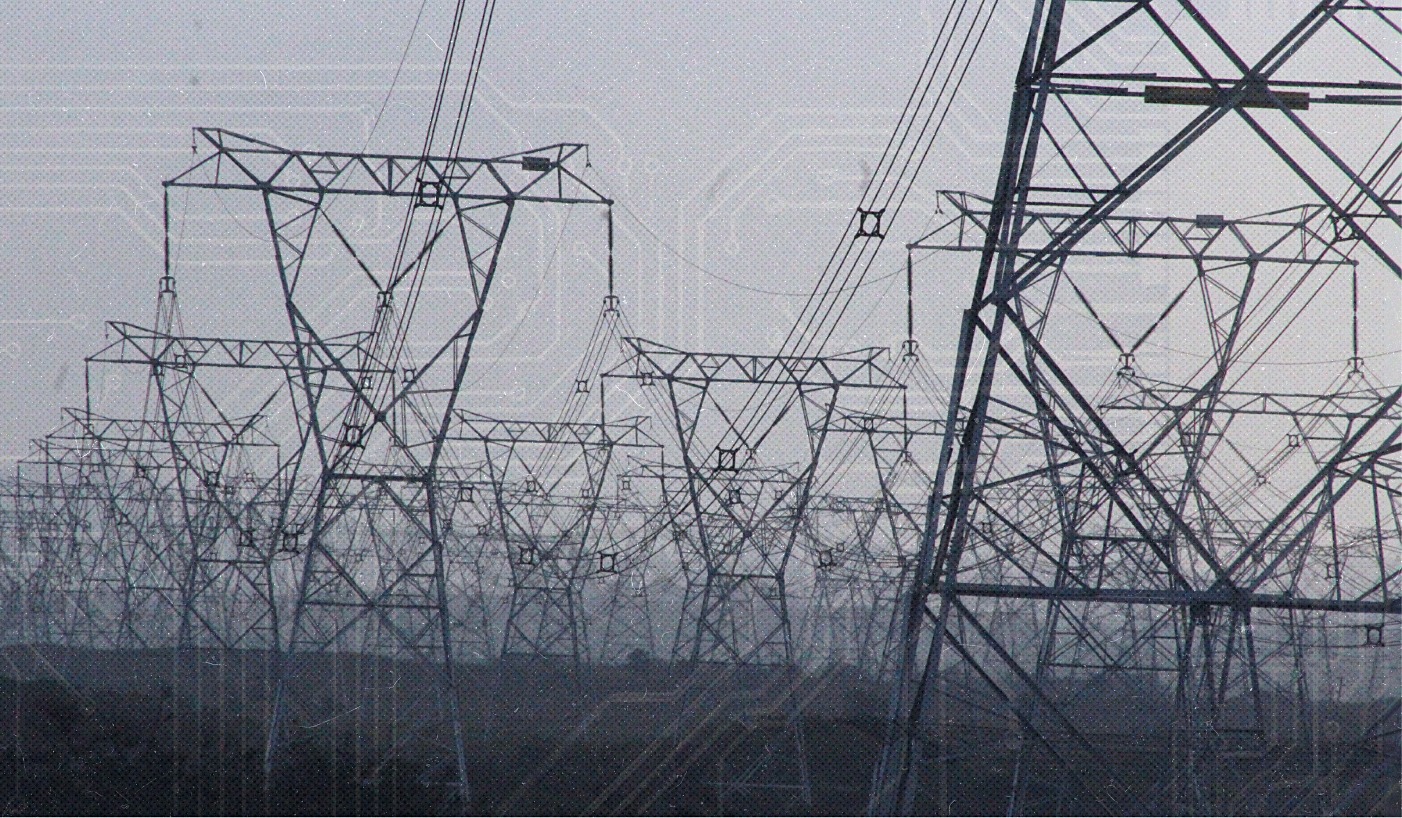
 A forest of power pylons outside the port of Richards Bay, KwaZulu-Natal. Questions are emerging on whether sufficient electricity will be available to power and to cool down digital data centres. (Image: Tony Carnie)
 To protect computer chips and other sensitive equipment from overheating, large volumes of water and cold air are pumped through data centres across the world.
But the water used for cooling purposes is just one part of a bigger story.
Unless they are powered by low-carbon or renewable energy sources, data centres indirectly use even larger volumes of water during the process of coal mining and burning fossil fuels to generate power.
Yet, at both a global and South African level, there is still relatively little information available about the full impacts of the data centre explosion on the world’s diminishing freshwater resources or human-driven climate change.
/file/dailymaverick/wp-content/uploads/2025/11/11411248.jpg "Powerlines lead from Eskom's Lethabo coal-fired power station in the Free State on 13 April 2023. (Photo: EPA / Kim Ludbrook)")
Former Imperial College London researcher David Mytton reported in 2021 that data centres used relatively little water in the US compared with farming, power generation and other uses. However, less than a third of data centre operators were even measuring water consumption at that time, and the sector has since expanded rapidly.
More crucially, says Mytton, it is essential to measure and monitor the full water demand on a location-specific scale – especially with hyperscale projects such as the xAI “Colossus” data centre in Memphis.
A more recent report by the US-based Environmental and Energy Study Institute notes that the water consumption of about 5,426 data centres in the US is already affecting local communities.
Northern Virginia, considered the world capital for data centres, has more than 300 operational data centres, collectively consuming nearly 7.5 billion litres of water in 2023, a 63% increase from 2019.
/file/attachments/orphans/Tonydatapic6VaaldamwaterimageDWS_FINAL_658869.jpg "Water pours from the Vaal Dam in Gauteng during a controlled release in April 2025. Concern is growing about the impact of data centres on water security. (Image: Department of Water and Sanitation)")
The institute suggests that some of the larger data centres can consume up to 19 million litres per day, equivalent to the water use of a town of 10,000 to 50,000 people.
One example comes from the town of Bessemer in Alabama, site of a proposed hyperscale data centre. Inside Climate News reported last year that it could consume more than seven million litres of water per day – equivalent to a third of the available water supplied by the local water utility company.
Water use by a Google data centre in The Dalles, Oregon, has nearly tripled in the past five years, and the company’s data centres are now reported to consume more than a quarter of all the water used in this city.
Read more: Growth spurt of data centres could threaten SA’s electricity and water supply
Research by Dutch data scientist Alex de Vries-Gao suggests that global AI systems could have a carbon footprint comparable to a major city such as New York and consume as much water as all bottled water drunk worldwide in a year.
Officials at the International Monetary Fund believe electricity use by the global data centre sector already equals that of Germany or France (see graph), suggesting that indirect water use by the sector is even more substantial.
/file/attachments/orphans/Tonydatapic22USdatacentreelectrictyusescenariosSource2024UnitedStatesDataCenterEnergyUsageReport_FINAL_198669.jpg "Electricity consumption by data centres in the United States is climbing rapidly. (Source: 2024 United States Data Center Energy Usage Report)")
Where does the water go?
The International Energy Agency (IEA) estimates that the total water consumption of data centres in 2023 was about 560 billion litres. Of this, roughly two-thirds (373 billion litres) was due to indirect water consumption (energy generation) and only a quarter (140 billion litres) from direct consumption (mainly for cooling data centres). The remainder of the water (about 8%) was used in the manufacture of computer chips and other hardware.
In his study – based on sustainability reports from major tech companies, scientific data on carbon emissions and water use per kilowatt-hour of electricity – De Vries-Gao concluded that previous water consumption estimates by the IEA significantly underestimate indirect water use by data centres and is probably a factor of three to four higher than the official estimate.
He also says that several major tech companies currently do not publish AI-specific figures on the energy and water use of their systems. Therefore, stricter reporting requirements are needed to ensure full transparency.
Similar concerns over transparency have been raised by Alyse Coakley, a policy research assistant at Tulane University in Louisiana. This was partly because water consumption within data centres is often reported using the Water Use Effectiveness metric, often excluding the much larger volumes from electricity generation.
/file/attachments/orphans/Tonydatapic9teraco-jb4-data-centre-rooftop-imageTeraco_FINAL_617992.jpg "Part of the extensive network of water- and air-cooling pipes on the roof of the Teraco JB4 data centre campus in Isando, Johannesburg. (Image: Teraco)")
Yet sections of the AI and data sector industry have sought to play down such impacts and also resist moves towards tougher monitoring and regulation.
Last year, OpenAI chief Sam Altman asserted that the average ChatGPT query uses the equivalent of one-fifteenth of a teaspoon of water – in sharp contrast to research cited in a Washington Post investigation that generating a 100-word email with GPT-4 required water equivalent to “a little more than one bottle”.
Responding to pressure from European Commission regulators to tighten control on data centres, a major industry group has also criticised plans for new minimum performance standards to conserve energy and water.
The Climate Neutral Data Centre Pact argues that the new standards would focus mainly on the largest operators, excluding smaller facilities. Another industry body, Cloud Infrastructure Service Providers in Europe, recently warned the commission that “burdensome” water use regulations might push operators into other regions.
Closer to home, several South African based data centres are also facing closer scrutiny over their increasing consumption of both water and electricity.
Read more: Major SA data centre expansion plans emerge, set to more than double current power demand
While coal mining and power generation consumed about 7% of water at a national level in 2013, the impacts are more pronounced at a local level. In 2018, power accounted for up to 37% of water use in the Upper Olifants catchment and the largest share of water in the coal-rich Waterberg region.
More nukes, price hikes and ‘beautiful’ coal
An International Monetary Fund working paper last year suggests that electricity prices in the US alone could rise by 8.6% if companies do not adopt renewable sources to power their data centres. Carbon emissions from AI-driven data centre growth could also lead to a 5.5% rise in US carbon emissions over the next five years.
However, any significant switch to renewable energy – in the US at any rate – seems unlikely given that President Donald Trump has signed an executive order titled “Reinvigorating America’s Beautiful Clean Coal Industry” and a second order to “streamline” permit approvals for big data centres.
/file/attachments/orphans/Tonydatapic11TrumpsbeautifulcleancoalorderSourceTheWhiteHouse_FINAL_984139.jpg "When it comes to powering data centres, coal-burning is ‘beautiful’, according to Donald Trump. (Source: The White House)")
These pressures from corporate America and other developed nations are likely to ripple outwards into the Global South, according to Lydia Powell and Akhilesh Sati, researchers at the Observer Research Foundation in New Delhi.
Powell and Sati doubt that AI will create a utopian world that is wealthy, environmentally sustainable and equal – nor a converse scenario of a mostly poor, dirty and unequal world
However, they caution that developing nations should be cautious about passively consuming optimistic narratives about the data economy generated by the Global North.
“Companies, rather than countries, have a greater influence on locating data centres, as control of the data economy is almost entirely in private hands.”
Due to increasing pressure to reduce carbon emissions, they suggest data centre expansion could lead to a new form of “climatalogical imperialism” in which developing countries provide the Global North with more land, energy and greenhouse gas emission space to support the data economy.
/file/attachments/orphans/Tonydatapic10energy-data-centers-chart-of-the-weeksourceIMF_FINAL_645366.jpg "Researchers from the International Monetary Fund and other groups project that electricity consumption by data centres could equal the current power use of large countries such as Russia by 2030. (Source: IMF)")
They note that the Paris Treaty climate goals require halving data centre emissions by 2030, implying a more aggressive shift to low-emission power.
But renewable energy supplies from wind and solar were intermittent and could not always match real-time peak demand of data centres. As a result, the growth of data centres could lead to a lock-in of fossil fuels – or the re-emergence of nuclear energy as a “clean” power source.
They further note that nearly 60% of the electricity supply in Virginia – home to the largest concentration of data centres in the world – is derived from natural gas, and 30% from nuclear power.
“The development of data centres and AI services is shifting influence on critical decision-making on issues such as the choice of energy source from countries to corporations,” they caution, noting that nuclear energy is emerging as a more dependable energy source for some data centres in the US.
“In the US alone, big tech companies have signed new contracts for more than 10GW of possible new nuclear capacity in 2024, and Goldman Sachs sees potential for three plants to be brought online by 2030.” DM
Next: Clouds of secrecy. Why such silence and evasion over the water and electricity impacts of SA data centre growth?
This article was made possible in part through support from the Henry Nxumalo Foundation.