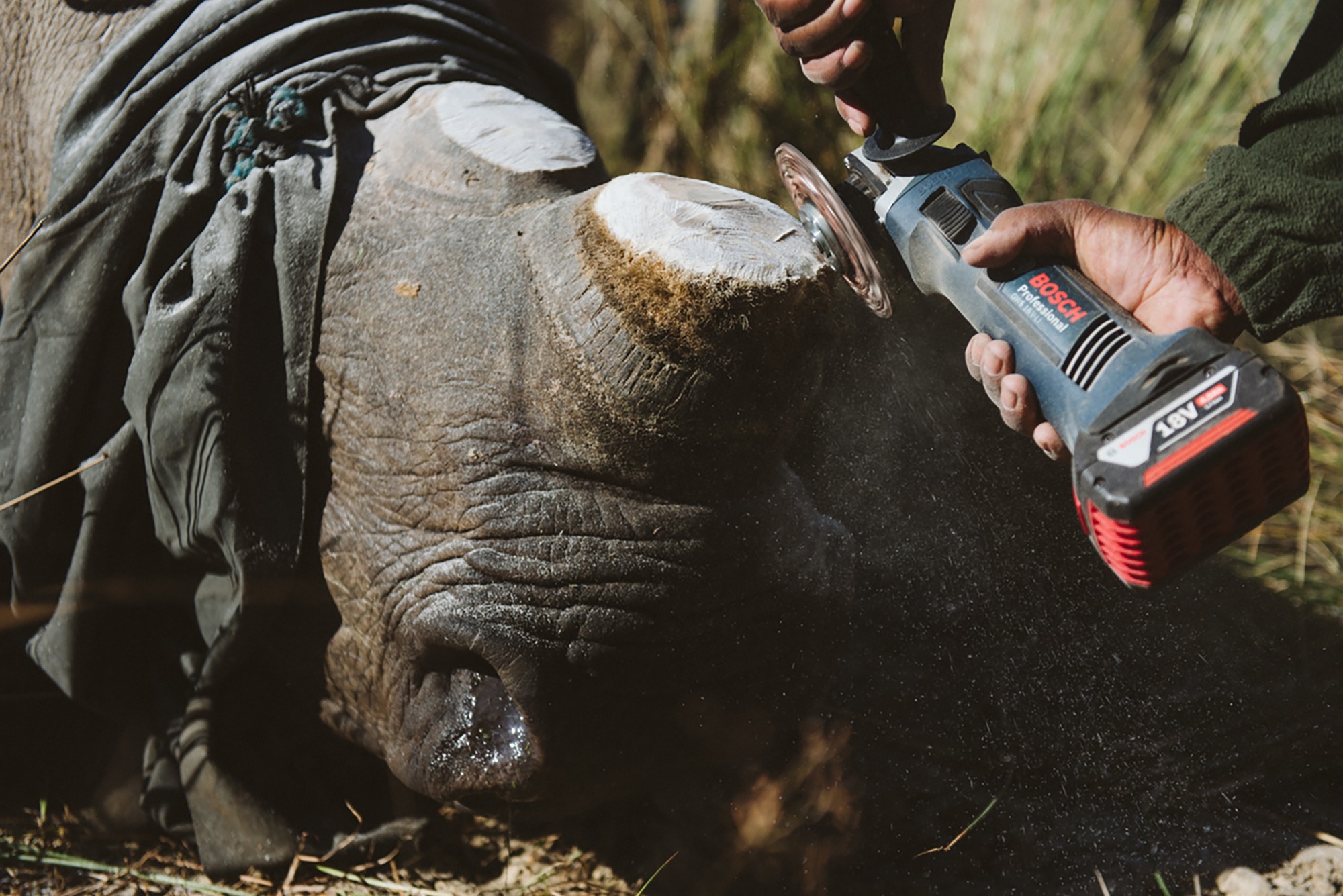
 Conservation staff trim the stump edges of a rhino horn after a dehorning operation. (Photo: Casey Pratt/Love Africa)
 Despite a modest 16% decline in rhino killings countrywide during 2025, the number of these animals poached in Kruger National Park has doubled compared with the previous year.
Significantly, the dramatic surge in rhino poaching in Kruger was mirrored by an equally significant drop in killing rates in the Hluhluwe-iMfolozi Park in KwaZulu-Natal, which has been a poaching hotspot for several years.
Conservation officials have attributed the sharp poaching decline in the 96,000ha Hluhluwe-iMfolozi Park to a mass dehorning operation, which began in April 2024 – leading to a displacement of poachers to the two-million-hectare Kruger National Park rhino stronghold.
According to the latest official statistics from the Department of Forestry, Fisheries and the Environment (DFFE), poachers killed 352 rhinos across South Africa during 2025 – a 16% decline compared with 2024, when 420 rhinos were poached for their horns.
The highest poaching rates were recorded in Kruger, where 175 rhinos were killed – almost exactly double the number (88) killed in 2024.
/file/attachments/orphans/tonyrhinostatsgraph_414315.jpeg "(Source: Department of Forestry, Fisheries and Environment)")
In Hluhluwe-iMfolozi, where white rhinos were rescued from the brink of extinction at the turn of the last century, the poaching toll dropped to 97 animals in 2025 – compared with 232 in 2024 and 325 during 2023.
SANParks spokesperson Reynold Thakuli declined to comment on 10 February on the possible reasons for the dramatic increase in killings in Kruger, referring all queries to the DFFE.
However, conservation sources in KwaZulu-Natal have attributed the renewed focus on Kruger to a poaching dispersal effect driven by the precautionary dehorning of a large number of rhinos in the Hluhluwe-iMfolozi Park, as well as other security interventions such as the installation of more security cameras.
“Once conditions become less favourable to poachers in one area, such as Hluhluwe-iMfolozi, they disperse somewhere else instead. That’s the reality,” the source said.
Elsewhere in the country, another 36 rhinos were poached in Limpopo and 21 in North West last year.
In an official statement, newly appointed Minister of Forestry, Fisheries and the Environment, Willie Aucamp, attributed the overall 16% decline to “dedication and tactical, swift coordination”.
Of the 352 rhinos poached nationwide, 266 were killed in state or provincial parks and 86 on privately owned parks, reserves or farms.
‘Sustained support'
He said that Ezemvelo KZN Wildlife had attributed the significant reduction in poaching in Hluhluwe-iMfolozi to closer collaboration between Ezemvelo and KwaZulu-Natal rhino owners through the Integrated Wildlife Zones (IWZ) Programme, as well as “sustained support from key conservation partners, including WWF, Save the Rhino International, Wildlife ACT, and Peace Parks Foundation (PPF).”
“Whilst Ezemvelo recognises that the strategic dehorning programme implemented in 2024 served as a critical catalyst in stabilising rhino poaching pressures and enabled urgent, targeted interventions, analysis of the 2025 outcomes confirms that multiple complementary interventions were central to the reduction in poaching incidents.
“Key among these were enhanced detection and early-warning capability, achieved through the deployment and integration of advanced camera technologies and sensors; and the implementation of the Integrity Implementation Plan, which included the successful polygraphing of all park law-enforcement personnel, reinforcing organisational integrity and public confidence.
Aucamp also conveyed his gratitude to private sector anti-poaching efforts, especially private rhino owners.
“South Africa continues to strengthen its international collaboration to curbing rhino poaching and wildlife trafficking. These efforts led to the country receiving the Asia Environmental Enforcement Recognition of Excellence Award late last year, which celebrates excellence in enforcement by government officials, institutions and teams combating transboundary environmental crimes,” a statement by Aucamp said. DM