




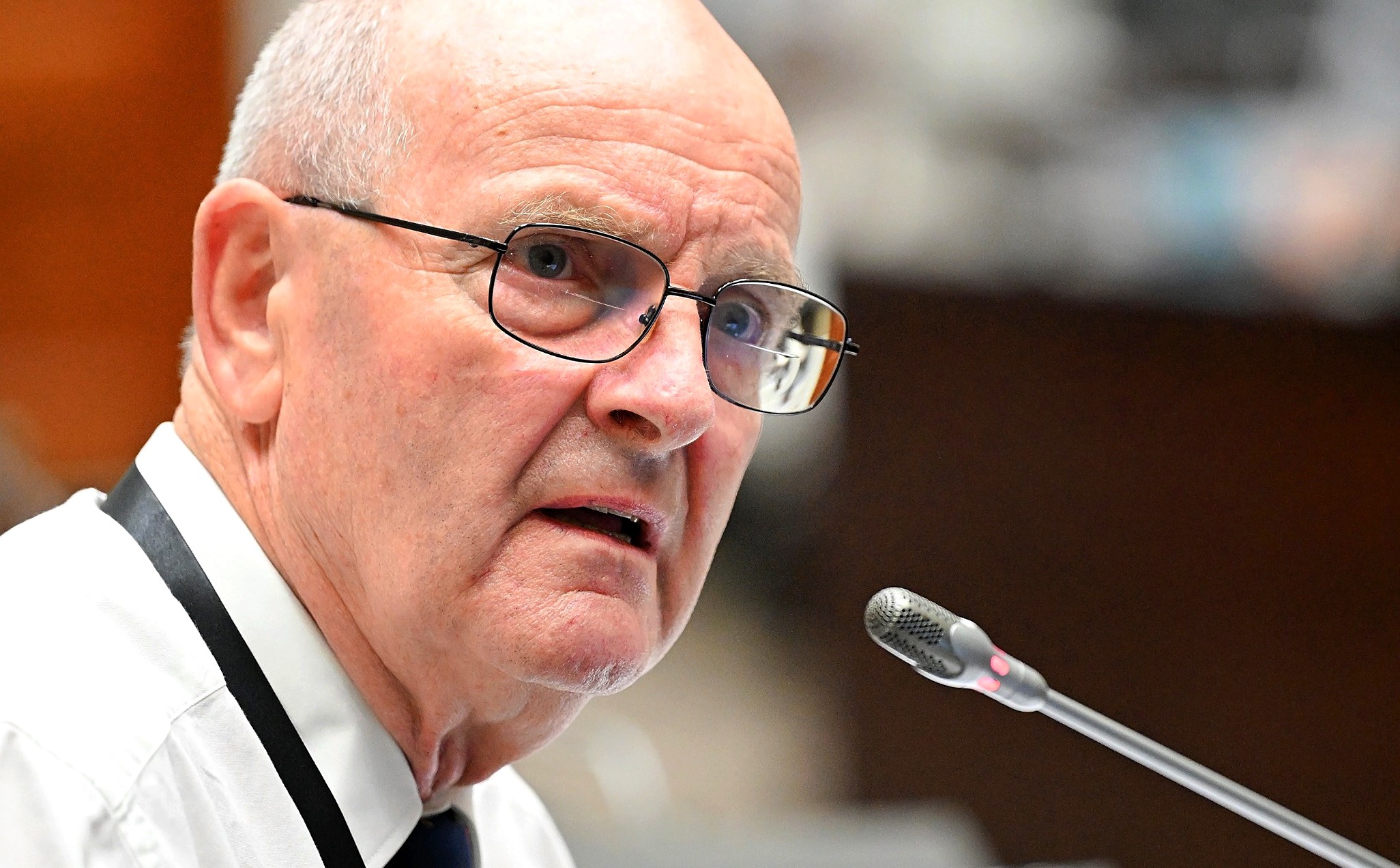
 Forensic investigator Paul O’Sullivan appears before Parliament’s ad hoc committee in Cape Town. (Photo: Phando Jikelo / RSA Parliament)
 “Since living in this country, I have not been involved in any way, shape or form with any intelligence activity whatsoever, and that is it in a nutshell,” forensic investigator Paul O’Sullivan has told Parliament.
He was testifying on Tuesday, 10 February 2026, before the ad hoc committee investigating accusations that a cartel has infiltrated South Africa’s criminal justice system, politics and private security.
KwaZulu-Natal police commissioner Nhlanhla Mkhwanazi initially made the accusations, now under investigation, in July 2025.
He has before questioned O’Sullivan’s background.
/file/attachments/orphans/ED_595174_824405.jpg "Forensic investigator Paul O’Sullivan testified in Cape Town at Parliament’s ad hoc committee on 10 February 2026. (Photo: Gallo Images / Brenton Geach)")
O’Sullivan, meanwhile, has made his stance on Mkhwanazi clear – that he does not believe the policeman is acting with honest intent.
This scandal has fuelled the idea that O’Sullivan is part of a coordinated faction, including state officials, that is against Mkhwanazi and those aligned with him, for either nefarious or legitimate reasons.
Read more: Paul O’Sullivan set to challenge Mkhwanazi’s claims before Parliament's ad hoc committee
O’Sullivan testified at the ad hoc committee for the first time on Tuesday.
He insisted he was not a spy working for another country and was in no way linked to South Africa’s intelligence services, pre- and post-democracy.
Several ad hoc committee members, though, and even its evidence leader, Norman Arendse, appeared unconvinced.
‘A perfect front’ versus a remarkable career
A large part of Tuesday’s proceedings was focused on O’Sullivan’s extensive background, with Arendse eventually putting it to him that his past, involving presidents and the winning of awards, presented “a perfect front”.
Arendse said it did not “dispel” that O’Sullivan had been, or was, involved in intelligence activities.
O’Sullivan flat-out denied this.
The Ad Hoc Committee Investigating Allegations made by Lt Gen Mkhwanazi - Mr Paul O’Sullivan starts his testimony by explaining his work. @ParliamentofRSA @SAPoliceService @NPA_Prosecutes #pktt #adhoccommittee @DefenceCluster @GovernanceClus1 @HealthSocClust pic.twitter.com/wUbpQECJj2
— Justice-and-security-Cluster (@JustSecuCluster) February 10, 2026
“As god is my witness, I was never involved with the security police in SA,” he reiterated.
Arendse later described his background as either “by design” or a “set of coincidences”.
O’Sullivan, who is now 70, was born in the UK and grew up in Ireland.
In the 1970s, he worked for the British government in counterterrorism and counterespionage roles.
‘I am not a foreign agent’
O’Sullivan now has citizenship in multiple countries, including South Africa, where he also has properties and business interests.
During a previous ad hoc committee sitting, an MP had asked Mkhwanazi whether O’Sullivan was a United Kingdom MI6 intelligence agent.
Mkhwanazi had responded that O’Sullivan had citizenship in three countries, which made him “wonder”.
Read more: CIA spies, Zuma-like ties and inevitable lies — SA’s conspiracy claims landslide
O’Sullivan addressed this issue during Tuesday’s proceedings, confirming his citizenship in three countries – Ireland, the UK, and South Africa, where he has spent about 40 years.
“The multiple passports story is a convenience,” O’Sullivan said.
“I have never acted as a foreign agent in this country.”
‘Ramaphosa was my student’
His affidavit to the ad hoc committee said that in 1989, thanks to a South African property he had invested in, he “successfully applied for permanent residency as a person of independent means”.
That year, O’Sullivan moved from the UK to live in South Africa as part of the requirements for permanent residency status.
His affidavit said he was a certified fraud examiner, aviation security specialist, voice stress analyst and a certified United States Justice Department document examiner.
AD HOC COMMITTEE | Paul O’Sullivan says when he was lecturing at the police training centre, in 1997 one of the students in his course was Cyril Ramaphosa, then a businessman, not a politician. He adds Ramaphosa was a good student. pic.twitter.com/JSQJEHyzyA
— SABC News (@SABCNews) February 10, 2026
Between 1990 and 2002, O’Sullivan was a reservist in the South African Police Service, and he said that during some of those years, he trained 1,500 reservists in Johannesburg.
Some MPs questioned whether he was qualified to provide such training.
Among those O’Sullivan had trained was a president-in-the-making.
“One day [in 1997] I was quite surprised to find one of the students sitting there was Cyril Ramaphosa,” O’Sullivan said.
AfricaCheck has confirmed that a previous news article existed that said “Constable Cyril Ramaphosa has been awarded ‘Most Conscientious Student’ by the Houghton Reserve Police College after completion of his course.”
An image accompanying the article showed a younger Ramaphosa and O’Sullivan.
Selebi and the airport contract cancellation
By 2000, he had been a police reservist for 10 years.
O’Sullivan said he became part of a “multinational team in the border police” at what is now known as OR Tambo International Airport in Johannesburg.
The following year, Airports Company South Africa (Acsa) chair Mashudu Romana invited O’Sullivan “to a meeting with the then Minister of Transport, Honourable Dullah Omar”.
According to O’Sullivan’s affidavit to the ad hoc committee, he was invited to apply for a position that involved oversight at 10 airports in this country.
O’Sullivan got the job in 2001. (He conceded during the ad hoc proceedings that he had no degree or anything equivalent, but said this had not been a requirement for the role.)
/file/dailymaverick/wp-content/uploads/2023/07/0000109706.jpg "Former top cop, the late Jackie Selebi, outside the Johannesburg high court in March 2010 for his corruption trial. (Photo: Gallo Images / Foto24 / Bongiwe Gumede)")
His affidavit said that as part of his job, he could review all security contracts, and it had been decided that he could cancel those related to a company, Khuselani Security and Risk Management.
These R300-million contracts covered three years.
“Following the cancellation… I also opened a criminal docket, in respect of corruption, regarding payments that had been made by Khuselani to various senior Acsa employees as well as to then National Commissioner of Police Jackie Selebi,” O’Sullivan’s affidavit said.
He told the ad hoc committee that after the cancellation, there had been several attempts on his life.
One of these attempts involved a bullet taking “a small chunk out of my thigh”.
As for Selebi, he was later convicted of corruption. He died in 2015.
‘Multiple attempts on my life’
Earlier on Tuesday, proceedings got off to a rocky start when the focus fell on a specific part of O’Sullivan’s affidavit.
It said: “At the outset, for reasons of personal and family security, I will not engage in discussions concerning my family, background, education or business interests in South Africa or overseas, prior to 1990.”
This did not go down well with MPs.
EFF leader Julius Malema pointed out that if they agreed to this, it would mean O’Sullivan would not have to answer, for example, about whether he had handled individuals involved with the push against apartheid.
/file/attachments/orphans/ED_595172_361620.jpg "Paul O’Sullivan and EFF leader Julius Malema at Parliament’s ad hoc committee hearings at the Good Hope Chambers in Cape Town on 10 February 2026. (Photo: Gallo Images / Brenton Geach)")
Malema said that the answer could show whether O’Sullivan had “captured” the criminal justice system before South Africa became a democracy in 1994.
O’Sullivan said he would not provide details that would threaten his personal safety.
“Over the last 15 years, there’ve been 10 attempts on my life,” he said.
“In 1996, I was shot three times. There have been multiple attempts on my life.”
O’Sullivan said “the criminal element” tried to get information of a personal nature, which he would not provide.
‘Useful addition’ to apartheid SA
Despite what his affidavit stated, issues involving O’Sullivan before 1990 were indeed under scrutiny at Tuesday’s proceedings.
Arendse referred to a typed letter, dated 23 November 1982, from a member of Parliament, DW Watterson, to SS van der Merwe, who was the Director-General of Internal Affairs at the time.
Watterson wrote about documents for O’Sullivan, who wanted to “settle permanently in South Africa”.
The letter said O’Sullivan was intelligent, well educated, and “of a very conservative political attitude” who would be “a very useful addition to the white community of our country.”
During Tuesday’s ad hoc proceedings, a handwritten letter from O’Sullivan to a politician, dated November 1982, was also read out.
Ad Hoc Committee Investigating Allegations made by Lt Gen Mkhwanazi - Mr Mdumiseni Ntuli ask about Mr Paul O’Sullivan about his knowledge of SA before he came to the country and when he decided to stay pre democracy. @ParliamentofRSA #pktt #adhoccommittee pic.twitter.com/4rf4aWOfxy
— Justice-and-security-Cluster (@JustSecuCluster) February 10, 2026
It said he was “in a predicament” because he previously had a South African work permit, but another had been refused.
“This puts me in a bit of a quandary as I so want to stay in this country, which I love so much and I believe it is one of the few countries left in the world that is not riddled with communist-inspired unions and unsettlement.”
O’Sullivan’s letter said he also believed South Africa was “still a good Christian” country.
In it, he added: “I have already applied for a course in Afrikaans as I want to completely integrate with the South African way of life.”
During Tuesday’s ad hoc proceedings, O’Sullivan conceded he had not been in a “predicament” as he had written in 1982, and this had been an exaggeration.
He said he had been in his 20s when he wrote the letter.
As for Arendse, he pointed out that at the time O’Sullivan wrote the letter about South Africa, where he wanted to “completely integrate with the... way of life”, it was a white-dominated apartheid state, the scene of forced removals and separate education.
O’Sullivan’s letter also rankled Malema.
He said: “You came to our country to become part of the privileged at the expense of the exploited.”
O’Sullivan disagreed.
He later said he had wanted to improve the lives of all South Africans.
The ad hoc proceedings are expected to continue on Wednesday, when MPs will have the opportunity to question O’Sullivan. DM