



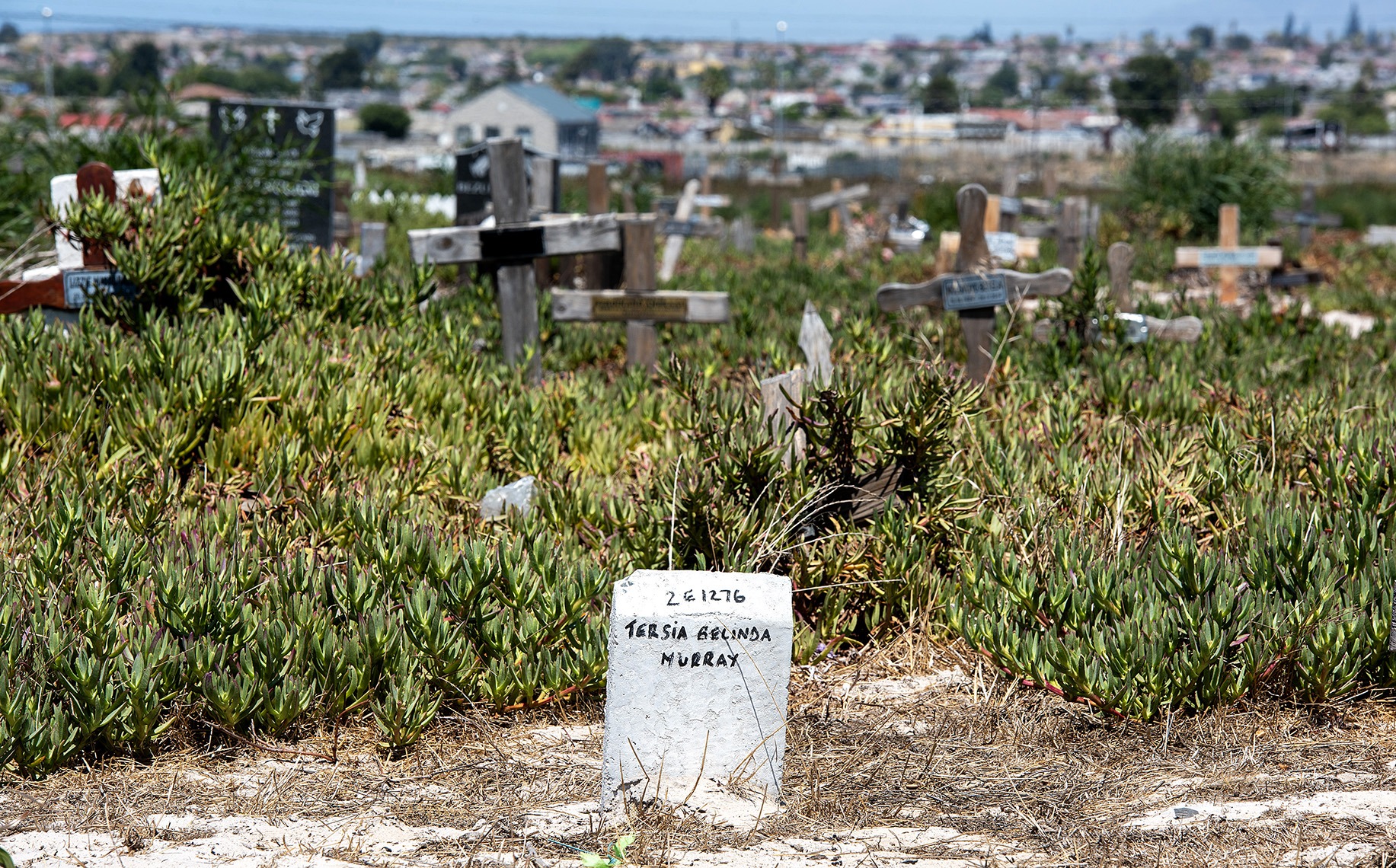
 A concrete slab placed as a headstone at the pauper's grave of Tersia Murray in the Welmoed Cemetery in Kuils River near Cape Town, 21 January 2026. (Photo: David Harrison)
 In a windblown, arid cemetery outside Kuils River lies a grave – although it can barely be identified as such. There is no headstone and no base. Uneven patches of straw are strewn upon sand. The only indication that a person is buried here is a small white concrete block, on which someone has painted the grave plot number and the words “Tersia Belinda Murray”.
This rudimentary grave marker is one of five in a row.
“There’s something with these five graves,” says the cemetery worker who showed us the row, gesturing at them.
He isn’t sure what is going on with them. He just knows that there’s a sort of mystery about them. At one stage, City of Cape Town officials arrived and hurriedly plonked down the markers; previously, there were none. Some people have been coming to look at these graves and take photographs, he says; one even laid flowers.
That surprises him, for a very good reason.
“These are paupers’ graves,” he says.
Paupers, in the City of Cape Town’s crisp and clinical language, are defined as “unclaimed and/or unidentified deceased”. These are every city’s forgotten people; those who fell through the cracks of society and ended their lives so utterly alone that there was nobody able to give them even the recognition of a name in death. Nobody will seek out their graves.
The reason we had come to this sunbleached site on a blistering morning was the same that had brought previous visitors to this dispiriting little row.
The people buried beneath the sandy soil here were not paupers. They were neither unclaimed nor unidentified. They were people with families who loved them until their last breath.
How their bodies ended up unceremoniously dumped in paupers’ graves without their families’ knowledge is the story of one allegedly unscrupulous undertaker – but more significantly, of the frightening fallibility of the system designed to protect dignity in death.
A box of lies
Tersia Murray was 66 years old when she died from lung cancer on 5 August 2024. She was a fighter, her daughter Anita Momberg says: given six months to live, but ended up holding on for 18.
/file/attachments/orphans/PHOTO-2026-02-09-14-17-36_703332.jpg "Tersia Murray died aged 66 after a courageous battle with lung cancer. (Photo: Supplied)")
It had been Murray’s wish to be cremated. A business called St Francis Funerals, run by a man called Petrus Booysen, took care of everything. The box of ashes was delivered to the family.
“We have a holiday house in Wilderness, and my mom got so sick that she never got to see it,” Momberg says, her voice choking slightly over the phone.
“My promise to her was that we would scatter her ashes at that house. We were just waiting for my brother to come from America.”
Some five months later, Momberg received an unexpected call from a woman who introduced herself as Annette van de Wall, head of compliance for the City of Cape Town’s Recreation and Parks division. She had something she wanted to discuss with Momberg regarding her late mother, and would prefer to visit her in person to do so.
Van de Wall broke the news to Momberg: whatever was in the box the family had been given by St Francis Funerals, it was not their mother’s ashes. Tersia Murray had never been cremated.
She had been wrongfully buried as a pauper in Welmoed Cemetery. Petrus Booysen, the undertaker, was believed to have acted fraudulently. The City would open a case against Booysen, and Momberg would be a witness.
“It was a moment that completely knocked the air out of me,” recalls Momberg.
“I remember feeling disbelief first, and then deep hurt. This was my mother! To be told she’d been buried as a pauper without our knowledge or consent was just devastating.”
Anita Momberg owns her own property business. She organises conferences. She’s a mother. She somehow found time to enter Mrs South Africa, and, in 2023, she reached the finals. She is, in other words, both terrifyingly efficient and determined. And Momberg was not about to let this go.
/file/attachments/orphans/WelmoedCemeteryKuilsriverPaupersGraveDH2639copy_329372.jpg "A slab of concrete placed as a headstone at the pauper's grave of Tersia Murray in the Welmoed Cemetery, Kuils River near Cape Town, 21 January 2026. (Photo: David Harrison)")
Another family, another betrayal
Momberg didn’t know it at the time, but hers was not the only house visit that City of Cape Town officials had to pay that January.
Two months earlier, the City had been contacted by a raging daughter, Freda Fortune: another fighter who refused to be fobbed off with half-truths.
Fortune’s mother had died on 18 August 2024, and it was her wish to be cremated, with her ashes interred in a private grave plot in Maitland Cemetery, which her family had owned for decades. As devout Apostolic believers, they wanted the family to rest together in death.
Fortune, too, had used the undertaker services of Booysen. Her first red flag came from the difficulties the family had in pinning down Booysen to deliver her mother’s ashes.
Eventually, Booysen sent a youngster to deliver the ashes unexpectedly to the florist shop where Fortune worked. In Fortune’s recollection, he jumped out of a van, brusquely shoved a box at her, and sped off.
“Here I’m standing on the pavement with this box in my hands, crying,” remembers Fortune.
“Because of that, I didn’t take note that he hadn’t sent a cremation certificate.”
The certificate was needed by Maitland Cemetery, however, to bury the ashes. When Booysen eventually supplied it, Fortune immediately noticed that the date of her mother’s alleged cremation was wrong. When she contacted the crematorium to clarify the mistake, she was told the truth: her mother had never been cremated.
From City officials, she learnt that her mother had been buried as a pauper in the row at Welmoed Cemetery.
“A pauper!” says Fortune, her voice rising in disbelief even now, more than a year later.
“A pauper is someone who is thrown away.”
Fortune had something in her favour: because of her history in the florist business, she had worked with many undertakers. She phoned one up and asked him if there was any way she could identify whose ashes might be in the box she was given without a DNA test.
He told her: Take a screwdriver. Open up the box at the bottom. There might be a black plate with a number on it.
There was. Fortune read her undertaker friend the number. He looked it up, and reported back. The box contained the ashes of a woman whose name Fortune had never heard before.
If not for Fortune, the truth might never have been discovered. If not for Momberg, who approached the media in January 2025, determined to go public, the grieving families may never have realised there were others in the same situation: at the current count, at least 11 families.
Justice on hold
The journey to accountability initially seemed to be moving with promising speed. By the end of January 2025, as the Cape Argus reported, Booysen had been arrested and appeared in court. He was charged with five counts of fraud; one for each of the five paupers’ graves at Welmoed Cemetery.
/file/attachments/orphans/WelmoedCemeteryKuilsriverDH2657copy_612460.jpg "A view across the Welmoed Cemetery in Kuilsriver near Cape Town, 21 January 2026. (Photo: David Harrison)")
/file/attachments/orphans/WelmoedCemeteryKuilsriverPaupersGraveDH2539copy_749222.jpg "A City of Cape Town employee at Welmoed Cemetery points out pieces of concrete slab that mark paupers’ graves in the Welmoed Cemetery in Kuils River near Cape Town, 21 January 2026. (Photo: David Harrison)")
Booysen was released on bail, with a court date set for March. It would not happen. The matter was withdrawn from the court roll due to lack of evidence, re-enrolled for June, and then withdrawn once again.
The “evidence”, in this case, consisted of ashes and bodies.
What was in the ash boxes Booysen gave to families, if not their loved ones’ remains?
Fortune was the only family member Daily Maverick spoke to who had an answer to this question, thanks to her own investigation. Momberg’s box was confiscated by SAPS for testing, and she hasn’t seen it since.
/file/attachments/orphans/PHOTO-2026-02-10-14-45-44_284892.jpg "This box was given to the Muller family with the assurance that it contained Monica Muller’s mother, Glenda Muller’s ashes. (Photo: Supplied)")
SAPS Western Cape spokesperson Thembakazi Mpendukana told Daily Maverick: “Kindly be advised that the case you’re referring to is still under investigation and there are no new developments to report at this stage.”
The bodies, though, are the critical element of the case. Though they know it will be traumatising, the families are desperate to have them exhumed – partly to prosecute Booysen, but partly also to confirm that those graves do indeed contain their loved ones.
Unsurprisingly, these families are no longer particularly trusting. For Momberg and another woman, Monica Muller, there is an additional urgency to the exhumation.
Muller’s mother Glenda, who died in July 2024, was eventually tracked down by the City to one of the Welmoed paupers’ graves. When Muller and Momberg compared the burial documents they had been given, they realised that the grave numbers given for both their late mothers were the same.
A City official admitted to Muller that it was a “gemors” [a mess].
Does that grave contain the remains of both Tersia Murray and Glenda Muller, or just one, or neither?
“We don’t know at all,” says Muller. “We have to wait until they exhume the graves.”
/file/attachments/orphans/PHOTO-2026-02-10-14-43-57_107518.jpg "Glenda Muller was 57 when she unexpectedly passed away on 30 July 2024. (Photo: Supplied)")
The exhumation that cannot be authorised
The City of Cape Town’s website makes applying for an exhumation sound like a relatively straightforward, if bureaucratic, process. Submit a medical certificate, proof of permission from a relative, get approval from the municipality and cemetery. The application form doesn’t even require you to give a reason for exhuming the body – though you must specify, somewhat macabrely, the “receptacle in which human remains will be placed”.
But this changes, it turns out, if there’s an active police investigation. And in this case, the question of who can give permission for the exhumation to take place has become a Kafka-esque roadblock.
When Daily Maverick asked the City of Cape Town when the bodies looked likely to be exhumed, we were told: “The application for exhumation awaits a court order, as it forms part of [the] SAPS trail of forensic evidence required to put this matter back on the court roll”.
A Public Protector report into the case published in November 2025 states: “The matter was subsequently re-enrolled in court on 11 June 2025, at which stage SAPS applied for an order to exhume the affected bodies. However, the Director of Public Prosecutions advised that it did not have the requisite authority to issue an exhumation order. Consequently, the case was withdrawn on the grounds of insufficient evidence to pursue a conviction.”
In other words: the case can’t go to trial without the bodies being exhumed because the bodies are the key part of the evidence. SAPS says the NPA has to issue the order. The NPA says it doesn’t have the power to issue the order. The City definitely doesn’t think it has the power to issue the order.
But until someone does, Booysen can’t be prosecuted.
Yet the undertaker’s alleged actions are only one part of this story.
What Momberg, Fortune, Muller and the other families were left with was one burning question: How could this possibly have happened?
As they were about to learn, extracting answers from the City of Cape Town would end up involving Paia applications, a Public Protector investigation and, now, an approach to the court. DM
In part two of this series, we reveal how Cape Town’s bureaucratic maze became a shield for accountability – and how the families are fighting back.
Petrus Booysen did not respond to calls and messages from Daily Maverick. The City of Cape Town’s response to questions is recorded in Part II of this series.