




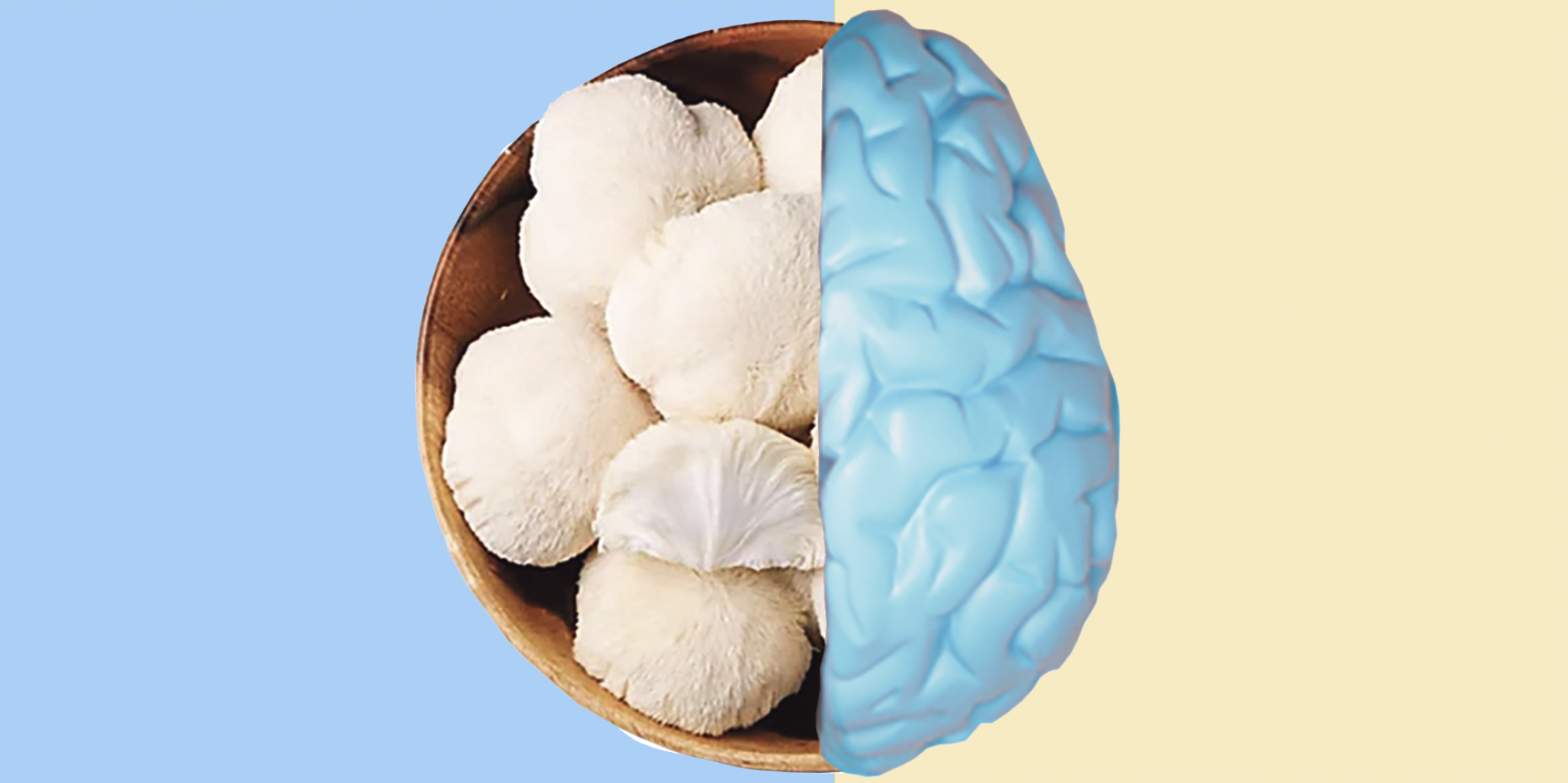
 Much of lion’s mane’s commercial appeal rests on its association with nerve growth factor, or NGF, a protein involved in the growth and maintenance of neurons. (Photo: Unsplash. Illustration: Freepik)
 The shaggy white fungus known as lion’s mane has traded the forest floor for the wellness aisle. Once a secret shared among mycologists, Hericium erinaceus is now a staple across South Africa’s major retailers.
This represents a lucrative opening for companies like Bioshroom. Simon Hazell, its chief executive officer, described the sector as a “billion-dollar niche”.
Hazell’s route into mushrooms came through a different protein frontier altogether.
“I started a business called Inseco a couple of years ago, an insect protein business. I was the founder of that business and ran it for a couple of years […] and then in about March, April (2025) I was introduced to this mushroom opportunity,” he told Daily Maverick.
The leap from insects to fungi makes sense through a biotech lens. Both require clinical precision over agricultural guesswork.
“It’s not that hard to grow a little bag of lion’s mane at home, it’s got a few sort of hobbyist growers,” Hazell said. “But it’s a very different kettle of fish growing it all year round, under beneficial conditions, global Good Agricultural Practices conditions, organic conditions.”
Lion’s mane’s opportunity, however, seems to be centred around selling trust in a crowded and noisy wellness space where consumers are becoming both more curious and more sceptical.
From zero to 100
Data Bridge Market Research valued SA’s functional mushroom market at R93.3-million ($5.86-million) in 2024, and projects it will reach R138.9-million ($8.72-million) by 2032, growing at a compound annual rate of 8.05%. Lion’s mane is a central driver of that growth, largely because of its association with cognitive health and ageing.
When Peter Herrmann in 2015 founded Harmonic Mycology, a business that produces high-quality, organic medicinal mushroom products, he said that there were, to his knowledge, no lion’s mane products in the country.
“Cultures had to be sourced internationally for us to get started. So we really have gone from zero to 100 since then,” he said.
That acceleration mirrors a global pattern. Internationally, lion’s mane has become associated with the idea of neurogenesis, the growth and repair of nerve cells, and with the broader cultural obsession with mental performance.
“Not only is lion’s mane now cultivated and sold widely, it has reached a sort of mainstream popularity, especially in the world of health and wellness,” Herrmann said. “Today it stands as the mascot for all mycology and has made explaining our work so much easier than in years prior.”
Craig Fourie, owner of Mushroom Guru, which is a company specialising in medicinal mushroom cultivation, education and products, linked the surge to demographics.
“The wellness industry is becoming the next ‘big thing’. It is growing quickly because the people driving the industry are baby boomers. They are now at an age where they are looking for natural substances that can help them live longer, look better and also slow aging,” Fourie said.
Retail pricing points to enthusiasm and experimentation. Products range from under R300 to nearly R600 per unit, with significant variation in format, dosage and quality.
Neurogenesis or narrative
Much of lion’s mane’s commercial appeal rests on its association with nerve growth factor, or NGF, a protein involved in the growth and maintenance of neurons. In marketing material, this is often simplified into claims about focus, memory and brain optimisation.
“From a practical clinical perspective, the nerve growth factor effect is significant enough that we use lion’s mane regularly in patients with cognitive decline,” said Dr Craige Golding, a specialist physician in anti-ageing medicine. “We use it in Alzheimer’s patients, and also in other neurodegenerative conditions such as MS and Parkinson’s. The feedback we consistently receive is that patients simply do not want to stop using it, because they experience a profound difference,” Golding said.
He explained that lion’s mane reduces inflammation, protects against oxidative stress, and also promotes neuron growth, repair and connection, which translates into improved memory, focus, and mental clarity.
The science of the shaggy mane
Dietician Lila Bruk clarifies that while lion’s mane is a popular ingredient, it requires a nuanced approach:
🍄 It is low calorie with modest amounts of fibre, protein, and B vitamins, but won’t dramatically shift your nutrient intake.
🍄 Its true value lies in beta-glucans, erinacines and hericenones, which may stimulate nerve growth factor (NGF).
🍄 While promising, “recommending it as a guaranteed cognitive enhancer or cure-all isn’t supported by robust clinical evidence yet”.
🍄 Look for “dual extraction” and “standardised beta-glucan content” to ensure you’re getting active compounds.
🍄 Can cause digestive upset, skin rashes or headaches.
Who should avoid it?
🍄 People with mushroom allergies.
🍄 Those with autoimmune conditions or on immunosuppressant therapy.
🍄 Individuals taking blood-thinning medication.
Dietician Lila Bruk said the mushroom’s popularity reveals both progress and risk in the way consumers engage with food and supplements.
“The positive about this is that there is a general awareness about the benefits of food beyond simply calories,” Bruk said.
At the same time, she warned that marketing narratives often flattened science into simple promises.
“Most of the marketing around lion’s mane focuses on broad claims like ‘boosts brain function’ or ‘improves focus’, often based on small laboratory or animal studies. Human clinical trials are limited in number and size, so robust conclusions about health effects in the general population simply aren’t there yet,” she said.
Powder vs extract
Turning lion’s mane into a sellable product introduces an added layer of complexity. Raw mushroom powder contains chitin, a structural compound that humans struggle to digest.
According to Fourie, this is where many products fall short.
“An extract contains no chitin and is therefore the better option when it comes to consuming any mushroom. An extract is also more concentrated, which means that you need to take much less to get the same and/or better result,” he said.
Bruk said consumers seeking meaningful benefits needed to look beyond branding.
“If someone wants to consume lion’s mane with the best chance of getting meaningful amounts of beta-glucans and erinacines, they should choose high-quality extracts, not just anything labelled ‘mushroom coffee’,” she advised.
Maximising the benefits
For someone who wants to consume lion’s mane Bruk advises:
📋 Look for products utilising both water and alcohol extraction to ensure you get the full range of water-soluble and fat-soluble compounds.
📋 Seek out labels that specify standardised beta-glucan content (ideally 20%-30% or higher).
📋 Many “functional coffees” or lattes contain amounts too low to be effective; always verify the actual concentration of bioactives.
📋 Ignore marketing buzzwords and look for supplements that provide detailed, third-party analyses.
📋 Whole mushrooms offer more fibre and nutrients, but usually contain fewer bioactives than concentrated extracts.
Herrmann explained that because chitin is hard to digest, you either need high potency liquid extracts for quick absorption or activated wholefood powders, which use heat to make the nutrients accessible at a better price point. Ultimately, the choice depends on your budget and whether you prefer the convenience of a tincture or a smoothie-ready powder.
Regulation and credibility
As the local market becomes more crowded, producers like Bioshroom are increasingly focused on exporting.
“There is absolutely an export market, and this product can be exported – it’s got a long shelf life, it’s really dense, it’s high value, so exporting it to partners and brands across the world is very much on our horizon,” Hazell said.
The Bioshroom growth process
Bioshroom’s emphasis is on traceability and pharmaceutical-grade processing.
- Prep: A specialised mix of ingredients is bagged to create “fruiting blocks”.
- Sterilisation: Bags are loaded into an autoclave – a massive industrial pressure cooker.
- Liquid inoculation: Unlike growers who use grain, Bioshroom injects the bags with liquid culture (mycelium grown in nutrient-rich liquids). This prevents the final product from being diluted by grain starches.
- Climate control: Inoculated bags move to strictly monitored chambers where temperature and humidity are constant.
- The 20-day wait: After roughly three weeks in these controlled rooms, the mushroom “head” begins to emerge from the bag.
- Harvesting: Bioshroom harvests only the “pure fruiting body” (the mushroom head).
Ambitions also impose discipline. In SA, lion’s mane products are regulated by the South African Health Products Regulatory Authority as Complementary Medicines, requiring strict manufacturing and testing standards. This regulatory burden raises costs but also acts as a filter in a wellness market that is prone to exaggerated claims.
Capsules and kitchens
Fresh lion’s mane, prized for its seafood-like texture, is beginning to appear in culinary markets. Hazell said Bioshroom had started supplying chefs within a small radius of its facility.
“I’ve cooked it up, it’s amazing… it’s like a delicacy, it’s honestly delicious, so we’re quite excited about the fresh produce opportunity,” he said.
Whether that market can scale remains uncertain. Fresh mushrooms require cold storage, fast distribution and reliable buyers, challenges that Fourie said many growers avoided by focusing on dried products.
“Lions mane can definitely be used as food, yet it is more expensive than other gourmet mushrooms,” Fourie said. “Yes, it is a luxury wellness product, and also a passing trend.”
As Herrmann noted, competing on volume with subsidised Asian producers is unrealistic in the short term. The opportunity lies instead in quality, traceability and scientific credibility.
Lion mane’s explosion on the wellness scene shows how quickly global trends can take root locally. For the industry as a whole, this fantastic fungus may yet prove whether SA can capitalise on the momentum of the functional food sector without repeating the excess of wellness booms past. DM