




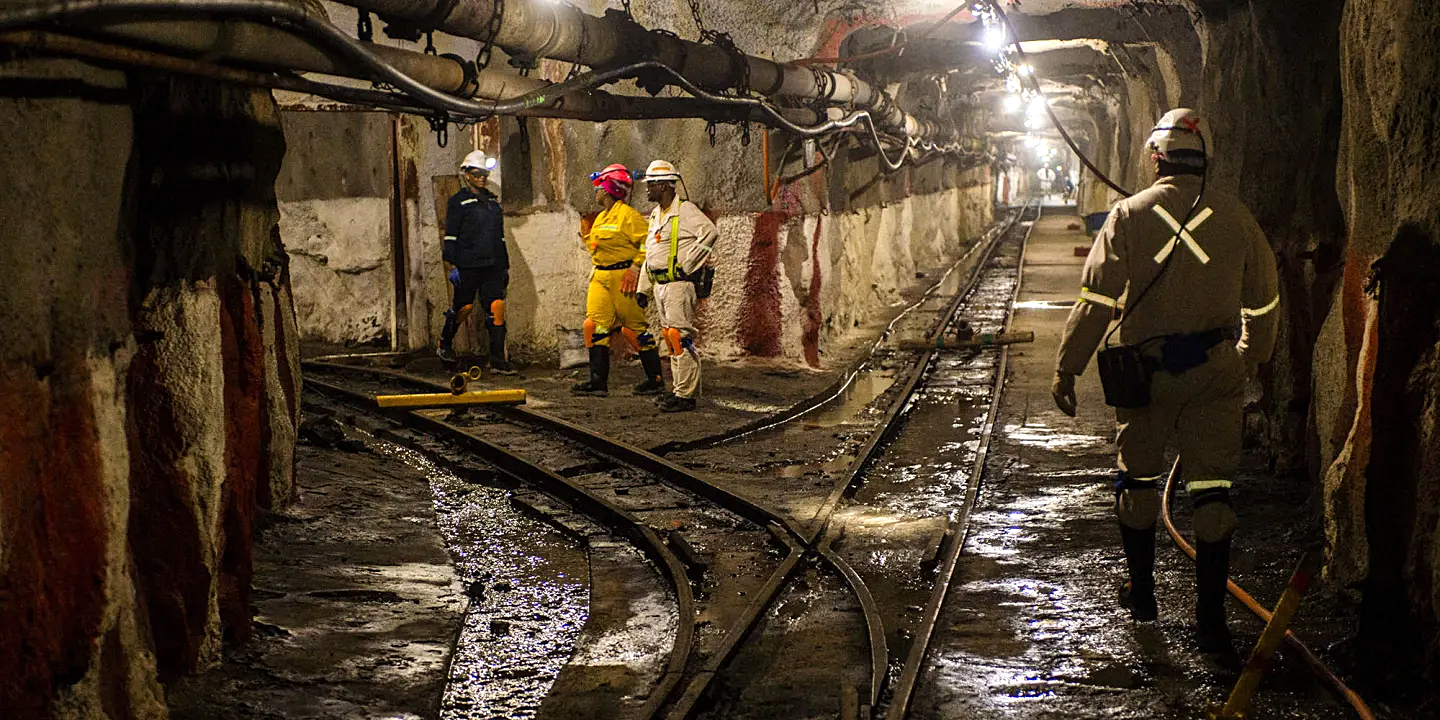
 Despite a R21.8-billion profit surge in 2025, South Africa’s mining sector faces infrastructure crises, including electricity costs and rail transport inefficiencies. (Photo: Waldo Swiegers / Bloomberg via Getty Images)
 To help you dear reader (and perhaps us as well as we are running throughout the Cape Town International Convention Centre from interview to presentation) make sense of all this, here is a data breakdown on the state of the South African mining industry at a glance.
These facts and statistics were presented to the media on Monday, 9 February by the Minerals Council South Africa as it launched its 2025 Facts and Figures report.
Mining by the numbers
The industry remains the heavy lifter of the South African economy. While some sectors are wobbling, mining continues to provide the fiscal backbone that keeps the lights on — metaphorically speaking, at least.
The old guard
Gold was the safe haven asset that started to do some heavy lifting this year. Despite accounting for only about 10.5% of production volume, gold managed to punch above its weight class, contributing nearly 20% to total sales earnings.
A R21-billion bump
The bottom line is looking healthier, provided you are digging into the right stuff. Profits jumped by R21.8-billion in the first nine months of 2025 compared with the previous year. The surge was led by coal, gold and iron ore.
Employment: small gains, big multipliers
In a country where job news is usually grim, the mining sector managed to add 2,000 jobs by Q3 2025.
“Mining and its direct suppliers support nearly 900,000 jobs and the livelihoods of 3.6 million South Africans,” said Mzila Mthenjane, CEO of the Minerals Council. “Mining is a powerful multiplier. Growing mining grows the economy and jobs.”
The handbrakes: electricity, logistics and exploration
It wouldn’t be a South African story without the “buts”. The sector is currently fighting a three-front war against infrastructure and legislative decay.
The cost crisis of electricity is a major competitive issue for the country. Mthenjane noted that a more holistic approach to reducing electricity costs was required. He pointed to Eskom CEO Dan Marokane’s awareness of the tariff issue as a sign of progress, but emphasised that expanding the grid with 14,000km of transmission lines was the only way to unlock the billions waiting in renewable energy projects.
Rail remains the industry’s Achilles heel. While there is talk of getting back to the 77 million tonne coal export peak, Transnet is still missing its own marks.
“While the improvement in rail services is encouraging, Transnet is simply not meeting its own targets and it is a long way from achieving the 226 million tonnes it railed in 2017; however, it could reach its 250 million tonnes by 2030 target with private sector participation,” said Mthenjane.
Perhaps most worrying is the lack of new finds. South Africa used to account for 5% of global exploration spend. Today, we are at a measly 0.6%.
/file/attachments/2988/Screenshot2026-02-09at135232_257046.png "Graph: State of Mining in SA, Minerals Council South Africa, July 2025")
“The lifeblood of mining is exploration. Without it the mining sector has no future. In SA, exploration expenditure was R781-million in 2024, down from a peak of R6.2-billion in 2006, according to StatsSA data. This is deeply troubling for our sector and it needs urgent attention,” Mthenjane said.
Export earnings and the Trump factor
Total mineral product export earnings saw a slight 2% dip to R498.1-billion. While precious metals like gold helped keep the ship steady, base metals took a massive 20% hit – dropping from R208-billion to R165.1-billion.
The elephant in the room is the US trade policy. The tariffs implemented by the Trump administration have clearly left a mark on the base metals sector, even if the primary minerals were explicitly excluded from the initial rounds.
2026: Stabilisation or growth?
Looking ahead, the Minerals Council is cautiously optimistic. Export markets are projected to grow in 2026, and there is relief in the halls of the Cape Town International Convention Centre that Germany is finally picking up some economic pace. However, “volatility” remains the word of the day.
“The mining sector’s competitiveness is constrained by high and rapidly increasing power tariffs, underperforming rail and ports services and rising unit labour costs,” said Bongani Motsa, acting chief economist at the Minerals Council. “Execution on logistics recovery, energy reliability and affordability as well as reduced permitting times for prospecting and mineral rights will determine whether 2026 shifts from stabilisation to sustained growth.” DM