




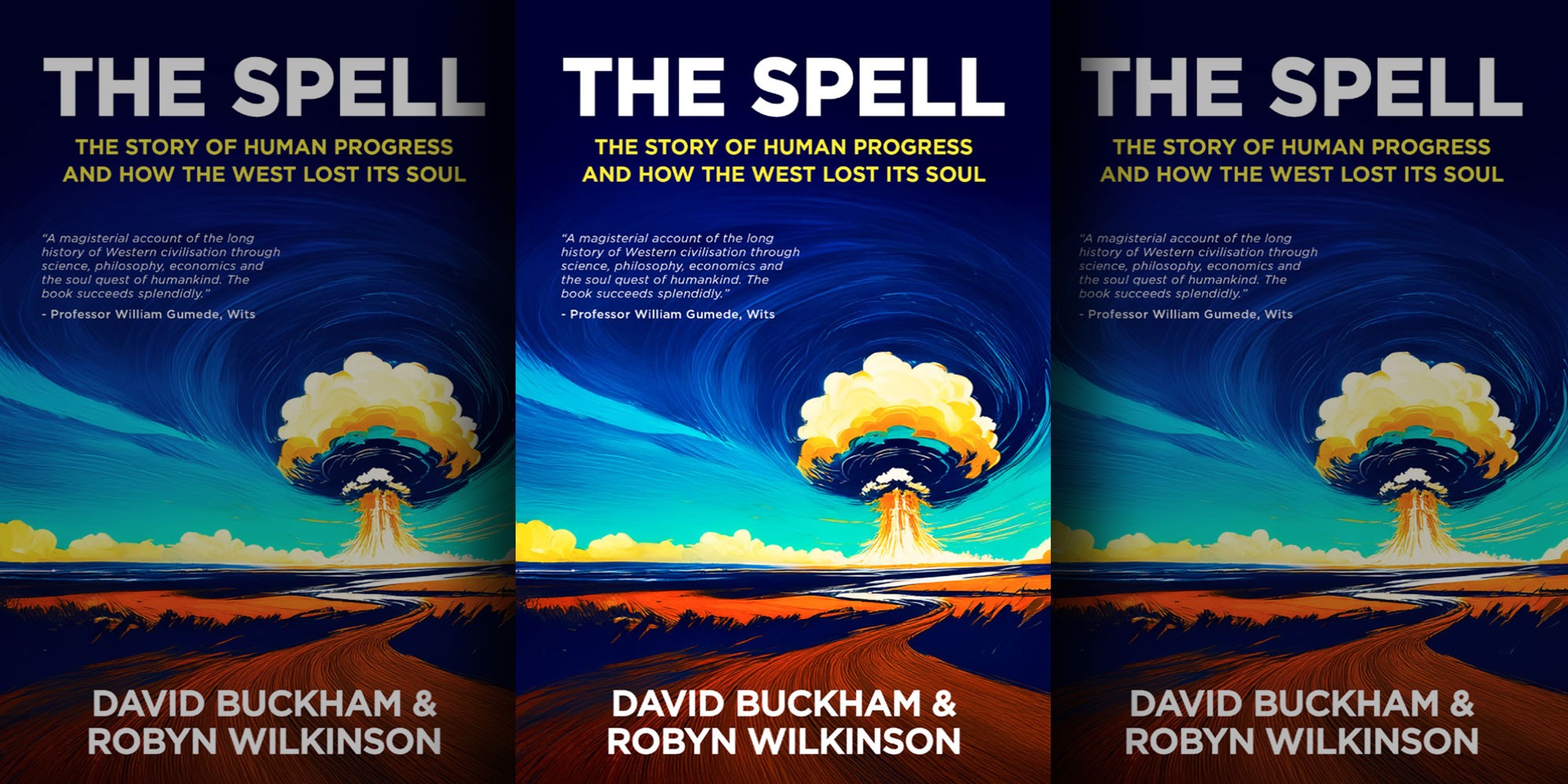
 The Spell by David Buckham and Robyn Wilkinson is published by Burnet Media. (Image: Burnet Media)
 In The Spell, David Buckham, author of the recent bestseller Orthogonal Thinking, and his frequent co-author Robyn Wilkinson (The End of Money) take a deep dive into the chaotic and messy history of Western civilisation, offering possible answers to these and other questions.
Pulsing with the authors’ signature enthusiasm, underpinned by wide-ranging research, the book aims to help us make sense of our history, politics and our place in the world.
Delving into the 2,000-plus years of Western civilisation, it extracts a handful of momentous events and key personalities who defined their eras and far beyond: Socrates, Henry VIII, Thomas Malthus, TE Lawrence, Henry Kissinger. Also in the mix is a selection of fictional on-screen characters: Superman, Tarzan (yes, really), Walter Kurtz, Dr Strangelove… These are compelling people, their stories mesmerisingly depicted.
Divided into sections echoing the Five Ages of Man, a construct conceived by Ancient Greek poet Hesiod, the book tracks the rise and decline of Western thinking, from what The Spell identifies as the (pre-Christian) Golden Age to the current (reimagined) Iron Age.
The authors’ point is that the West has somehow lost its soul along the way. To illustrate their thesis, they pick and retell stories. And what stories they have chosen!
From the horrifying fate in 2018 of Jamal Khashoggi (graphically described in an unforgettable Preface) to the devastation wreaked by the Irish famine of 1844 and the disastrous consequences of Bob Geldof’s 1985 Band Aid initiative, the tales are at once compelling and dismaying.
It’s a vast canvas, spanning history from Ancient Greece to the Crusades, the emergence of Islam and of Protestantism, nihilism, world wars, Vietnam, the atom bomb, the creation of Israel, and the Green movement. The 17th century scientific revolution is given due attention, too; shown to be hugely significant, upending the philosophical status quo and trying to reconcile “longstanding religious beliefs with ascending scientific ones”.
Rich in plot, meticulous in detail
The book is rich in plot, meticulous in detail and peopled by a colourful real-life cast. There are dangerous men – bandits, marauders, thieves – and they are accompanied by thinkers, heroes and people of principle, guided by (as Steven Pinker sees it) the “better angels of our nature”.
Many modern conflicts “are the legacies of conquest”, says The Spell. Slavery, plunder and entrenched international interference were among the consequences of colonialism – consequences that still reverberate today.
Unlike in traditional fairy tales of yore, many of these stories do not end well.
It goes badly for Adolf Hitler and the unlamented Ethiopian dictator Mengistu Mariam; just two of many dictators over the centuries who didn’t grasp that there would be no happily ever after for people whose only motivation was cruelty, pain, greed and power over others.
Beneath the façade of tales are often hidden some uncomfortable truths. The Spell takes a sharply critical look, for example, at the way that well-intentioned campaigns to supply aid to drought-beset or war-torn countries often achieve, ironically, the worst possible outcomes.
“There was a very real [point where],” noted Rony Brauman of Médecins sans Frontières, assessing the handling of the Ethiopian famine-genocide in 1985, “aid to victims was transformed into support for their executioners.”
But back to the value of stories: they provide us (in addition to entertainment) with an interpretation of our past.
It’s no surprise that, over the ages, the storyteller has had the power and persuasion of a seer. One of the most dramatic examples of the power of storytelling is the classic The Thousand and One Nights, an ancient collection recounting how an Arab high official’s daughter, Scheherazade, tells a story, or a tantalising fragment, every night to the murderous but increasingly fascinated King Shahryār, who ultimately spares her life.
Collective human urges
But stories are not drawn entirely from the past; they are composed of “inklings and fears and collective human urges about what may occur in the future”.
“Only through myth,” wrote Nietzsche, “are all the powers of the imagination and of Apollonian dream rescued from their random wandering around.”
Instead of that aimless wandering, it may be more helpful, suggest the authors, for us to simply acknowledge that, like human beings throughout the ages, we are irrevocably under the spell of stories.
“All stories are interpreted in different ways… We tell each other stories to get by.”
This is a treat of a read. Like all good stories, it’s not to be missed. DM
The Spell is published by Mercury, an imprint of Burnet Media. It’s available at a retail price of R390.