




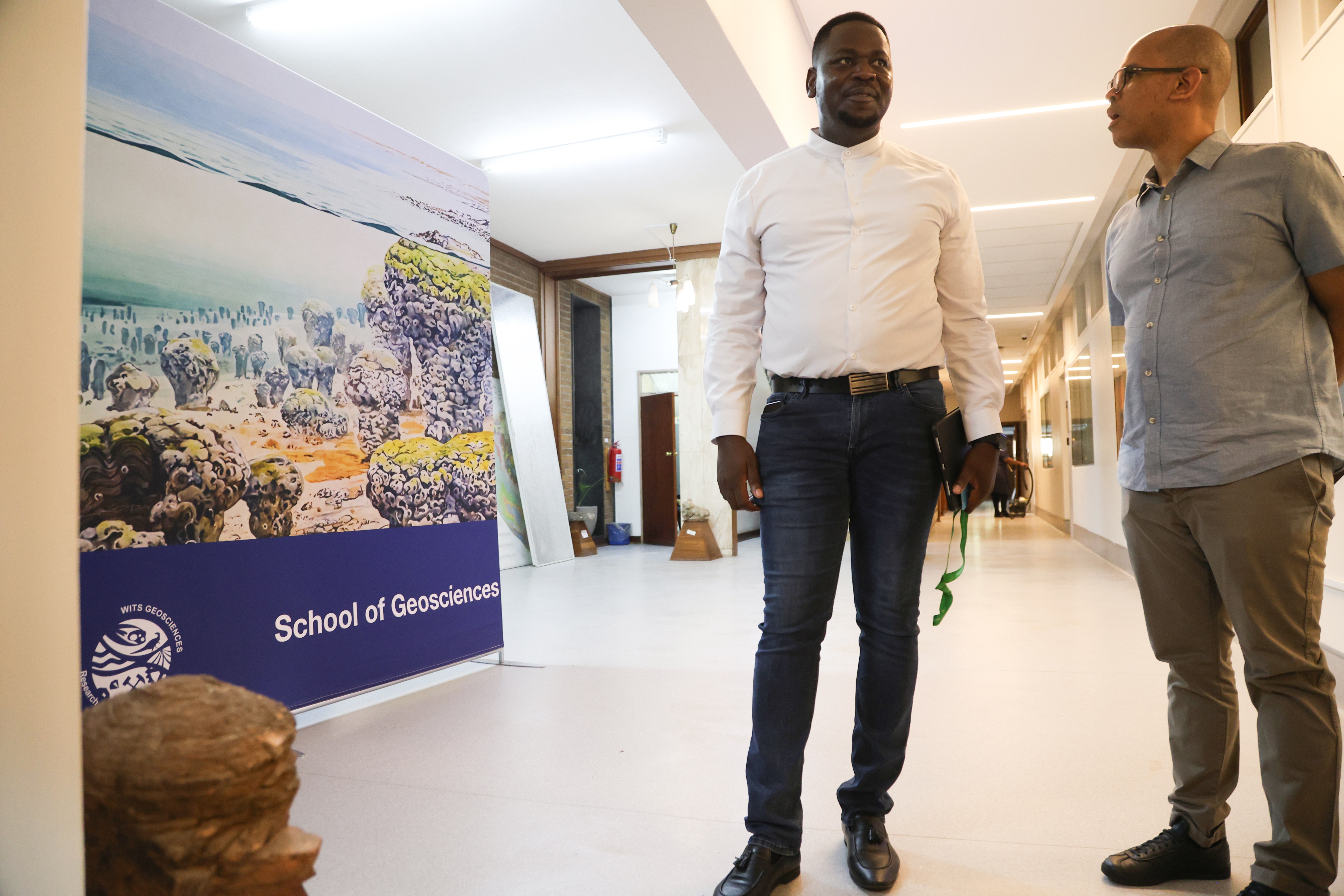
 Glen Nwaila, the Director of the African Research Centre for Ore Systems Science at the University of the Witwatersrand, and Dr Derek Rose on 26 January 2026. (Photo: Felix Dlangamandla)
 Africa is often said to hold about 30% of the world’s known mineral wealth, but this number is mere speculation based on old and sparse data.
“It is speculative. It could be more than 30%, but no one knows,” said Glen Nwaila, director of the African Research Centre for Ore Systems Science at the University of the Witwatersrand. “Africa is only receiving about 10% of global exploration spend, and much of that is led by junior miners.”
One promising initiative to help boost exploration in Africa was the launch of this focused research centre, as well as the Earth Observatory, at the university in November last year – in the historic heart of the City of Gold.
“The core of the lab is to simplify exploration and tell us what we have and where it is sitting,” Nwaila told Daily Maverick during a recent tour of the facility.
A one-of-a-kind in Africa, the centre’s facilities feature cutting-edge geoanalytical techniques, including sample preparation and geometallurgy, as well as isotopic and geophysical analysis – all the tools required for 21st-century exploration.
One of the key themes at the Investing in African Mining Indaba in Cape Town this week will be exploration and finding ways to bridge the yawning gap between speculation and the reality of the treasures that lie beneath the ground.
Exploration is the lifeblood of the industry: without it, there is no mining. And mining is the keystone industry: virtually all goods and services that are exchanged in the global economy would not be possible without mining. Viewed through this prism, mining exploration is the foundation on which the global economy – and civilisation as we know it – stands. In an age when “critical minerals” are all the rage, exploration is critical to unlocking this resource wealth in Africa.
But Africa, which for centuries has been plundered by outside powers for its resources, is not attracting the investment flows for exploration on the scale warranted by its rich terrain.
“Africa has been consistently overlooked in global mineral exploration investment, despite offering some of the highest returns per dollar spent. Its share of global exploration spending has declined consistently, falling from 16% in 2004 to just 10.4% in 2024,” said a report last year by the Washington-based Center for Strategic and International Studies.
/file/attachments/orphans/24-exp-2.jpg)
“Despite Africa’s vast geological potential and a landmass three times the size of Australia and Canada, those two countries received 15.9% and 19.8% of global exploration spending in 2024 – significantly more than the entire African continent. This reveals a critical disconnect between Africa’s potential and actual investment, underscoring the need to rebalance exploration priorities.”
As the report also noted, Africa is the most cost-effective region in the world for mining exploration. The mineral value to exploration spending ratio – or return on investment in exploration – for Africa is 0.8 compared with 0.5 for Australia and 0.6 for Canada, yet much more money is spent on exploration in those territories than in Africa.
Rewards vs risk
A number of factors explain this state of affairs, notably the higher risks associated with Africa’s political and investment environment. The rewards are potentially high, but they come against the backdrop of elevated risk.
Exploration is a risky business by its very nature. To attract capital requires the elimination of political and economic risks. A geological endowment can be rendered sterile by the political setting above ground.
As was noted in the Center for Strategic and International Studies report, “conflict has driven out investment. Mozambique is a resource-rich country with the third-largest graphite reserves in the world. However, Mozambique’s mineral exploration activity has sharply declined amid escalating violence in Cabo Delgado,” it stated, in reference to the unfolding jihadist insurgency in the country’s northernmost province.
“In December 2024, Australian company Syrah Resources declared force majeure at its Balama graphite mine due to instability in the region, resulting in a default on its $150-million loan from the US International Development Finance Corporation… Amid the conflict, exploration spending, which totalled $25.5-million in 2014, fell to just $1.4-million in 2024 as a direct consequence of the conflict.”
Meanwhile, coups and political instability in the Sahel region have thwarted investment and exploration activities, whereas “resource nationalism” has cropped up in resource-rich states such as Tanzania.
/file/dailymaverick/wp-content/uploads/2023/02/GettyImages-1246839270.jpg "Gwede Mantashe, South Africa’s mineral and petroleum resources minister, speaks on the opening day of the Investing in African Mining Indaba in Cape Town on 6 February 2023. (Photo: Dwayne Senior / Bloomberg via Getty Images)")
And in indaba host South Africa, uncertain government policies, backlogs for prospecting applications and the needless delay in the roll-out of a proper mining cadastre have all combined to undermine exploration. SA’s share of global exploration expenditure has collapsed to about 1% from more than 5% two decades ago.
Green shoots
Still, there are green shoots emerging in this arid investment landscape. President Hakainde Hichilema in Zambia has worked hard to open his country to mining investment after his predecessor, Edgar Lungu, repeatedly hiked royalties and withheld tax refunds, and the exploration taps have been turned on again.
In SA, BHP, the world’s largest mining company, is backing junior miner Orion Minerals’ copper and zinc exploration projects in the Northern Cape. The $500,000 investment is a drop in the global exploration bucket and not a material amount for a company the size of BHP. But this is its first investment of any significance in SA in years, and an indicator of the interest being generated in the Northern Cape.
It also underlines the point that SA, an industrialised economy in many ways defined by mining since the discovery in the late 19th century of mother lodes of diamonds and gold, still has plenty of exploration potential.
/file/attachments/orphans/6I1A2417_884260.jpg "The Earth Observatory at Wits University has all the state-of-the-art tools that are needed for 21st-century exploration. (Photo: Felix Dlangamandla)")
Which brings us back to the Earth Observatory at Wits. It is a resource that students (the exploration geologists of tomorrow), governments and industry can tap in the quest to map Africa’s mineral riches.
Daily Maverick’s tour of the facility included the state-of-the-art mass spectrometry laboratory.
“It’s like a forensic lab. We can date the age of rocks and see where they come from. This allows us to form geological models so we know what to look for when we explore,” said Nwaila. He added that, unlike most private laboratories, the Earth Observatory interpreted the data.
In one section of the observatory is a mini flotation machine called an Explorox that mimics a mine’s processing facility at the plant. Small bags of what looks like dust on the floor represent the tailings or waste, and liquid in vials contains the minerals, be they copper, nickel, cobalt or platinum group metals. At a mini scale, it offers a stunning contrast between what gets discarded and the valuable commodity that emerges.
The Explorox also tells one the grade and allows for researchers to determine the best process route to recovery, including the costs of extraction per tonne of ore.
With initiatives like these coming on the back of a new global scramble for critical minerals, Africa’s geological endowment will gradually move from speculation into the shining light of science. DM
This story first appeared in our weekly DM168 newspaper, available countrywide for R35.
/file/attachments/orphans/DM-06022026001CPTJHB_933247.jpg)