




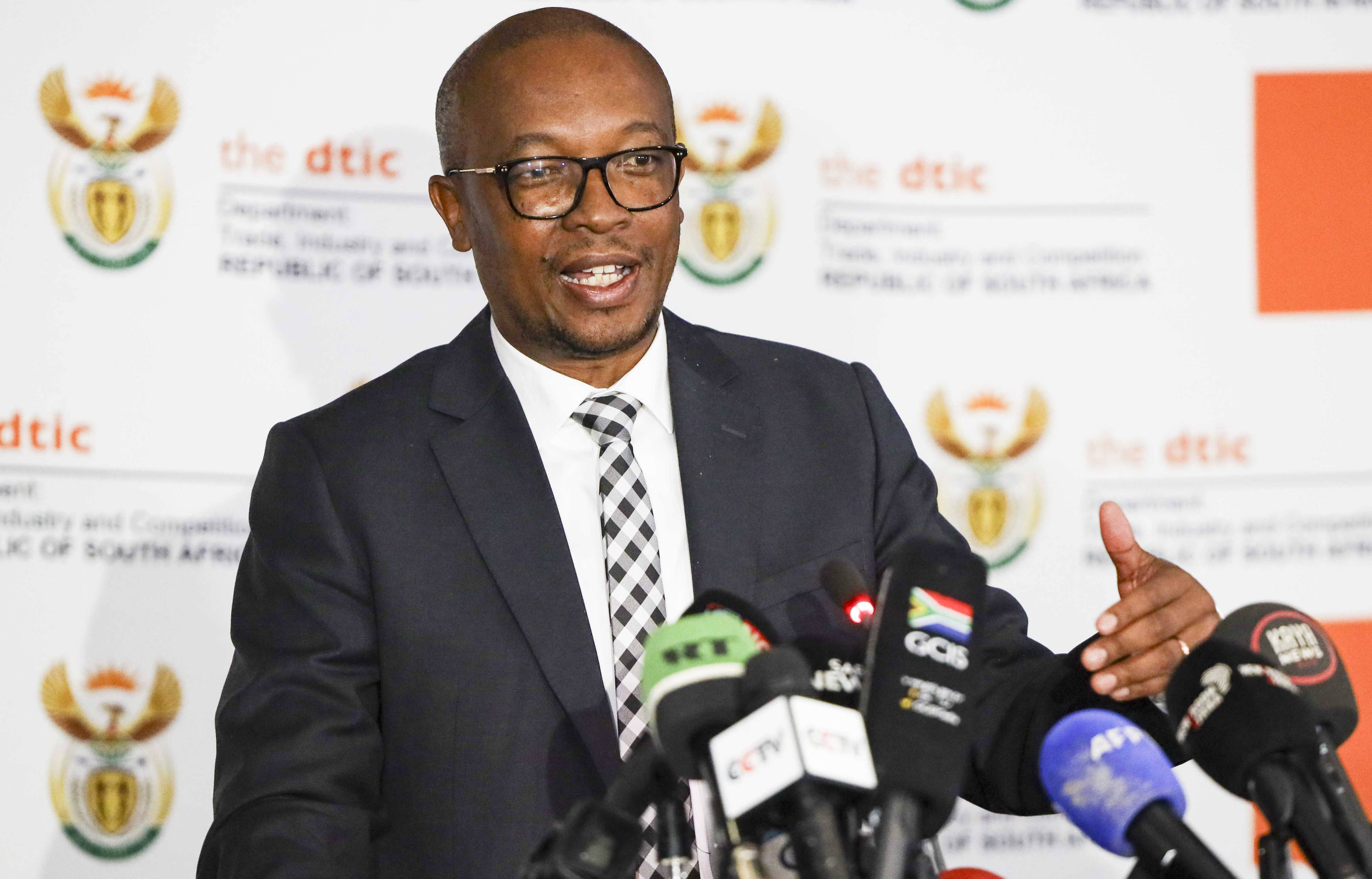
 Minister of Trade and Industry Parks Tau. (Photo: OJ Koloti / Gallo Images)
 It has been a summer of stuttering starts at the Department of Trade, Industry and Competition (DTIC). Twice in late January, the Presidency scheduled and then abruptly cancelled the official launch of the much-trumpeted Transformation Fund.
But on 29 January, with little fanfare, Minister Parks Tau quietly pushed the button, providing the first insight into what may be the most aggressive pivot in broad-based black economic empowerment (B-BBEE) policy since the 2013 amendments. The draft amendments to the Codes of Good Practice, which are now open for public commentary for 60 days, place a singular, controversial mechanism at the heart of South Africa’s economic future: a state-backed transformation fund.
Under the existing framework for enterprise and supplier development (ESD), companies wanting to score B-BBEE points manage their own ESD initiatives or partner with third-party intermediaries to support black-owned small businesses. It is dispersed capital allocation: imperfect and often criticised as a box-ticking exercise, but it gives the private sector autonomy over where its compliance spend goes.
The proposed amendments, specifically statement 400, upend this. The new codes’ intention is to incentivise businesses to contribute their ESD capital directly to the Transformation Fund, which aims to raise an initial R20-billion, partially by borrowing R10.8-billion from the African Export-Import Bank.
This is supposedly designed as a “catalytic vehicle” to finance black-owned and black-managed enterprises in the industrialisation and manufacturing space. Tau is basically saying that the private sector’s fragmented approach to development hasn’t worked fast enough, and the state now wants to take the wheel.
Read more: ‘Madness’ or ‘necessary intervention’? Parks Tau’s R100bn transformation fund draws mixed reactions
Tired of the status quo
In the deal’s corner is a triumvirate comprising the DTIC, the National Empowerment Fund (NEF) and investment manager 27four. They contend that leaving ESD funds in the hands of disparate corporate programmes has failed to dismantle the structural barriers to entry for black industrialists.
Tau turned to well-worn government-speak when writing in the gazetted draft that the state “cannot achieve transformation alone. […] The Transformation Fund is a vehicle for tangible change to ensure economic growth is shared by all South Africans.”
This sentiment echoes a statement by Fatima Vawda, managing director of 27four, at the launch in August 2025. “We believe transformation is not a tick-box exercise; it is the foundation for a stronger, more resilient economy. The Transformation Fund is a powerful mechanism to ensure capital flows to where it is needed most.”
It’s a seductive argument. Pooling the billions currently scattered across thousands of small, disjointed corporate ESD programmes could theoretically create a capital base large enough to build factories, fund major acquisitions and reshape supply chains.
Mzi Dayimane, CEO of the NEF, framed it as necessary for survival.“South Africa’s economic renewal depends on our ability to back black industrialists and entrepreneurs with the funding, networks and market access they need to thrive.”
But thriving is a loaded word in this economic climate, and not everyone believes the state is the right custodian. The Democratic Alliance (DA) predictably fired the first salvo on the day after the gazette appeared, arguing that the fund is in effect unfunded and lacks crucial buy-in from the very businesses expected to finance it.
Toby Chance, the DA’s spokesperson on trade and industry, views the fund as a case of overreach and the state assuming it has superior investment acumen to the private sector. “This amounts to the state telling business, ‘We are better at spending your money than you are’, despite the dreadful track record of the state’s financing institutions,” he wrote in a blog post.
After a decade of State Capture, when state-owned enterprises were hollowed out by looting, the proposal to centralise billions in a state-guided fund understandably raises red flags about governance. “Funding decisions must be made by professional investment managers who target innovation, job creation and growth, not racial box-ticking,” Chance wrote.
Although the involvement of 27four adds a layer of private-sector professional management, the ultimate oversight remains decidedly political. For many in the C-suite, trading direct control of their ESD spend for added points on a scorecard will feel more like a tax than an incentive.
The ideological battleground
Beyond the boardroom mechanics, the amendments have reignited the raging debate about the efficacy of race-based policy. There are two distinct flanks in the opposition to it.
One flank is the repeal-and-replace movement spearheaded by civil society group Free SA. In January, it launched a national campaign calling for the scrapping of race-based laws and dismissing the government’s review process as a sham.
“We do not need another technical ‘review’ behind closed doors,” said Reuben Coetzer, spokesperson for Free SA. “South Africans know that B-BBEE has failed. It is time to repeal it entirely and replace it with a new empowerment model based on need, not race.”
The other flank is the Institute of Race Relations (IRR), which has prepared briefings rejecting what it terms the “BEE premium”. It advocates a model of economic inclusion for the disadvantaged, shifting the focus from race to poverty.
Speaking to Daily Maverick in an interview responding to our previous reporting on the transformation debates, IRR campaign manager Makone Maja was scathing in her assessment of the status quo.
“[BEE is] fake transformation to the extent that the government procures these goods and services at a premium, and that these are services that are mostly used by impoverished people. [...] That is how you create deeper levels of poverty,” she said.
She also highlighted the absurdity of elite enrichment continuing unabated under the guise of empowerment. “Is it reasonable that Patrice Motsepe is eligible for BEE? Why should those people still be eligible [for] programmes that could be going to people who are truly impoverished?” she asked.
For now, the B-BBEE Act of 2003 remains the primary legislation, but the Codes of Good Practice are the operational manual. If these amendments pass in their current form, the strategic calculus for ESD changes overnight.
At present, a company might spend its 2% or 3% of net profit after tax on a supplier development programme that integrates a black-owned logistics firm into its own supply chain. It’s a symbiotic relationship: the small business gets capital and coaching, and the corporate gets a reliable supplier and B-BBEE points.
Read more: After the Bell: Parks Tau’s terrible transformation fund idea makes a comeback
Under the new proposal, the incentive structure tilts heavily towards simply handing that cash over to the Transformation Fund. It simplifies compliance (write a cheque, get the points), but it cuts the thread between big business and small suppliers.
The hesitation from the Presidency in January suggests that the government knows it is a gamble. Pushing for centralised funding in a low-growth economy while simultaneously borrowing billions from international banks to seed it is a high-stakes bet.
For now, the Transformation Fund is just a gazetted ambition. But if the ink dries on these amendments, the era of corporate autonomy in transformation may well be over, replaced by the era of the centralised pot.
And as history has taught us, the bigger the pot, the fiercer the fight for the ladle. DM
This story first appeared in our weekly DM168 newspaper, available countrywide for R35.
/file/attachments/orphans/DM-06022026001CPTJHB_933247.jpg)