



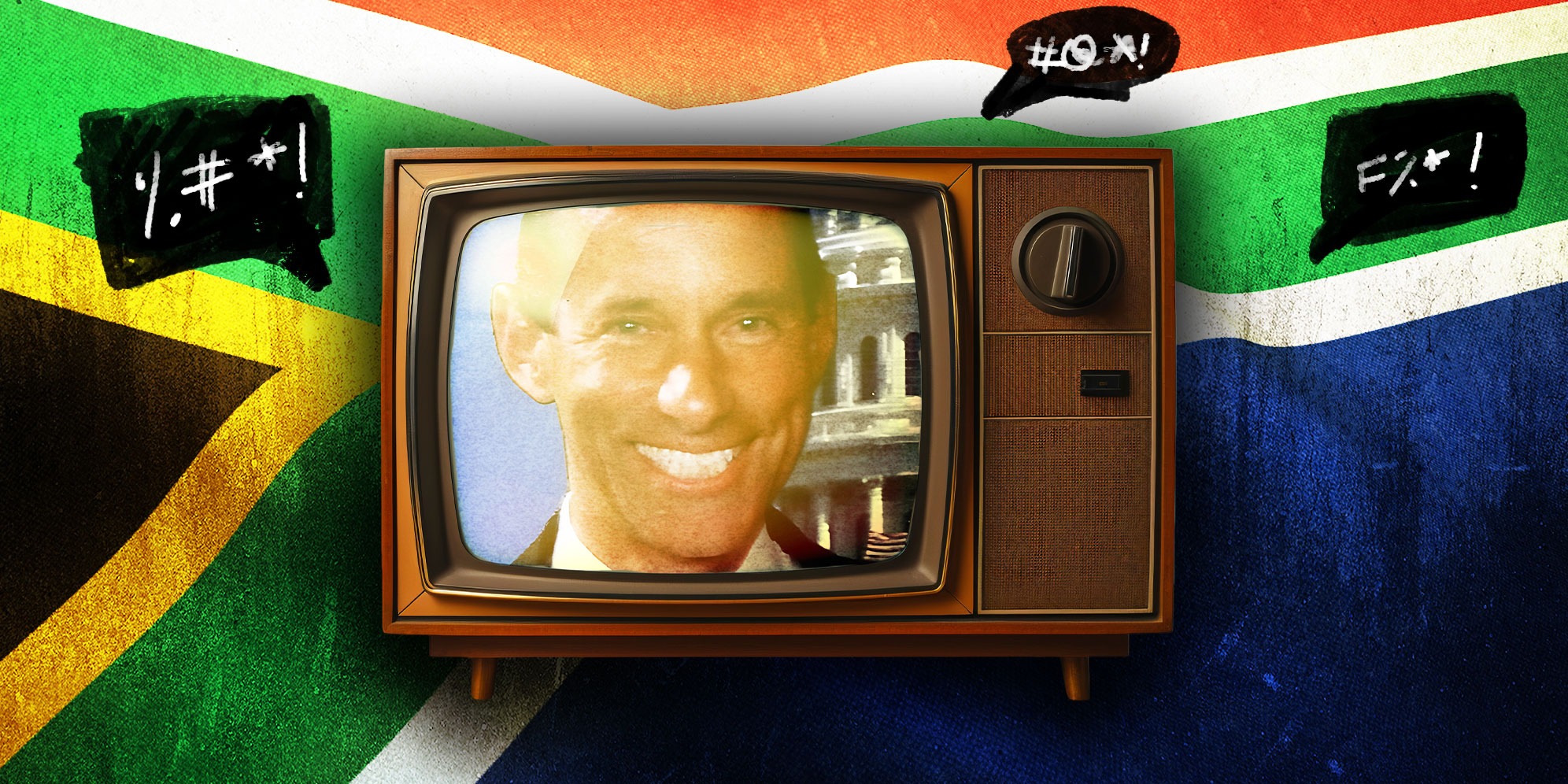
 Illustrative Image: Frank Garcia. (Photo: LinkedIn) | South African flag. | Television screen. (Image: Freepik) | (By Daniella Lee Ming Yesca)
/file/dailymaverick/wp-content/uploads/2025/10/label-analysis-2.jpg)
Frank W Garcia is the Trump administration’s nominee to be the next Assistant Secretary of State for African affairs. As such, he will be the senior official responsible for directing US government relations with the nations of Africa.
It is noteworthy that Garcia, a congressional staffer focusing on intelligence issues, has limited experience with African issues. Further, his appointment symbolises a turn in US government policies away from humanitarian issues and development assistance. Congressional staffers are important in making Congress and its committees work as they do the research and speechwriting, and serve as a member’s or a committee’s eyes and ears in dealing with government bureaucracy.
Instead of the older consensus on America’s African policy, we can guess Garcia will focus much more on the transactional, reciprocal trade issues so beloved by Donald Trump, as well as regional security concerns. In doing that, his efforts will demand close coordination with the Commerce Department, the US Trade Representative’s office and the Department of Defense, as well as those of the intelligence community.
He will also have to figure out how to work with Massad Boulos, Trump’s special senior adviser for the Arab world and Africa, and a former a truck salesman in west Africa. During 2025, Boulos was point man for Trump’s diplomatic initiatives in Africa, such as bringing the conflict in the eastern Democratic Republic of Congo to an end. Boulos has also led American involvement in the “Quads” initiative on Sudan, including Egypt, Saudi Arabia and the United Arab Emirates, although the group, so far, has been unable to achieve a ceasefire in a conflict now reaching apocalyptic levels.
As with all other senior foreign affairs appointees, before taking office Garcia will undergo hearings and a vote by the Senate Foreign Relations Committee, and then the full Senate’s confirmation vote.
Currently, Garcia is a senior adviser to the House of Representatives’ Permanent Select Committee on Intelligence. Previously he was the staff director for the intelligence subcommittee overseeing defence department intelligence offices. Before that, he was a professional staff member for the intelligence committee responsible for congressional oversight of technical intelligence collection. He has also had some private sector employment with a company providing technical support to the defence community. As far as we have been able to determine, Garcia has no public trail of scholarly writing or policy analysis on African issues.
Garcia replaces Nick Checker, a former CIA analyst who has been the Senior Bureau Official for African Affairs, but who was not the assistant secretary. The Africa Bureau is one of four regions at the State Department led by an unconfirmed Senior Bureau Official.
Garcia’s academic background includes the Naval Postgraduate School, the National War College, the University of Rhode Island and the University of South Carolina. He also served for two years at the National Reconnaissance Office as a navy captain.
His employment history offers no clues about his engagement with African policy themes such as institutional support for African economic growth, US-Africa development partnerships or humanitarian issues.
On the face of it, the choice of Garcia seems different from the kinds of people who usually become assistant secretaries in State’s geographical bureaus. Such nominees usually have been career foreign service officers who have served – often several times – in different countries as ambassadors. Some nominees have been individuals who served both in the foreign service and in academia.
The idea for that is real first-hand experience in a region gives insights, perspectives, human connections and a depth of knowledge useful in developing and refining policies presumed to be in the national interest and rooted in the realities of the region they will be associated with. However, Trump has demonstrated a distrust of and disregard for the government’s career diplomats, as well as US government programmes in Africa – and Africa itself. It seems clear the Trump administration undervalues the usual skill set, preferring people who will carry out Trump’s favoured transactional policies without demurrals.
The Robert Lansing Institute noted in an analysis published by Newsday: “This personnel move is part of a broader reorientation of US-Africa policy towards transactional priorities under Trump’s “America First” doctrine. In context, this appointment reflects larger shifts in trade, diplomacy and security engagement across the continent. What stands out most is how changes in US strategy – from trade extensions to diplomatic retrenchment – are reshaping Washington’s role in Africa at a critical geopolitical moment.
“The timing of this nomination reflects a broader shift in American foreign policy direction, particularly toward emphasising narrow national interests over humanitarian or development engagement. Recent analyses of US strategies indicate a reframing of Africa not primarily as a partner for global development, but as an arena for transactional deals and resource competition. Under the 2025 US National Security Strategy, Africa receives only a brief mention [three pages in an eighty page-plus document], mostly in the context of countering China and accessing critical minerals – and not as part of a broader commitment to democratic partnerships.”
One element of that recalibration was the recall of dozens of US ambassadors from African capitals, leaving many embassies without Senate-confirmed ambassadors holding regional expertise. This may well increase the importance of Garcia’s role at the Africa Bureau at State, since he will be one of the few senior anchors of US engagement with Africa.
One positive development has been the renewal – for a year – of the African Growth and Opportunity Act. However, it is possible that this act could be allowed to lapse after this year, or it might be altered in future with important impacts on qualifying nations.
Read more: Resuscitation of AGOA gets few cheers in SA
Moreover, it remains uncertain if South Africa is automatically eligible, or if it may be subjected to what is termed an “out-of-cycle review”. This might be due to the current US administration’s animus towards aspects of South Africa’s domestic policies, such as the repeated (albeit baseless) charge of a white farmer genocide, or due to its closeness with Russia, China and Iran (as in the recent naval exercise), and its pursuit of an International Court of Justice suit against Israel.
The choice of Garcia seems a signifier of an America intent to focus on the competition for resources (especially strategic minerals) with other major players such as China and Russia and other smaller nations, in contrast to long-term development partnerships or civil society engagement, in effect turning the continent into a kind of shopping mall for key resources rather than any space for multidimensional partnerships.
America’s quasi-diplomatic vacuum is occurring even as many African nations are looking for more consistency in engagement on economic development, global warming and climate resilience, and conflict resolution. Further, successful long-standing programmes such Pepfar have been reduced, paused or eliminated, contributing to further humanitarian pressures. The shift from development and aid to a trade-centric engagement and especially the focus on strategic minerals – but absent robust diplomatic structures – generates anxiety among African officials and business leaders.
Meanwhile, the thinning out of diplomatic and soft-power capabilities such as foreign assistance programmes is giving greater space and freedom of action to China, Russia and other state actors who are deepening their ties via investment, infrastructure projects and security cooperation – but often without the governance conditions Washington historically has emphasised.
The nomination of a politically aligned intelligence specialist for the Africa Bureau is symbolic of a transformation of US-Africa policy, marked by the drawing down of diplomatic engagement, the reprioritised trade strategy and transactional geopolitical thinking. The key questions will be how successfully Gracia will be able to manoeuvre in such complex waters, as well as how well African states will respond to his overtures as he begins his labours. DM