




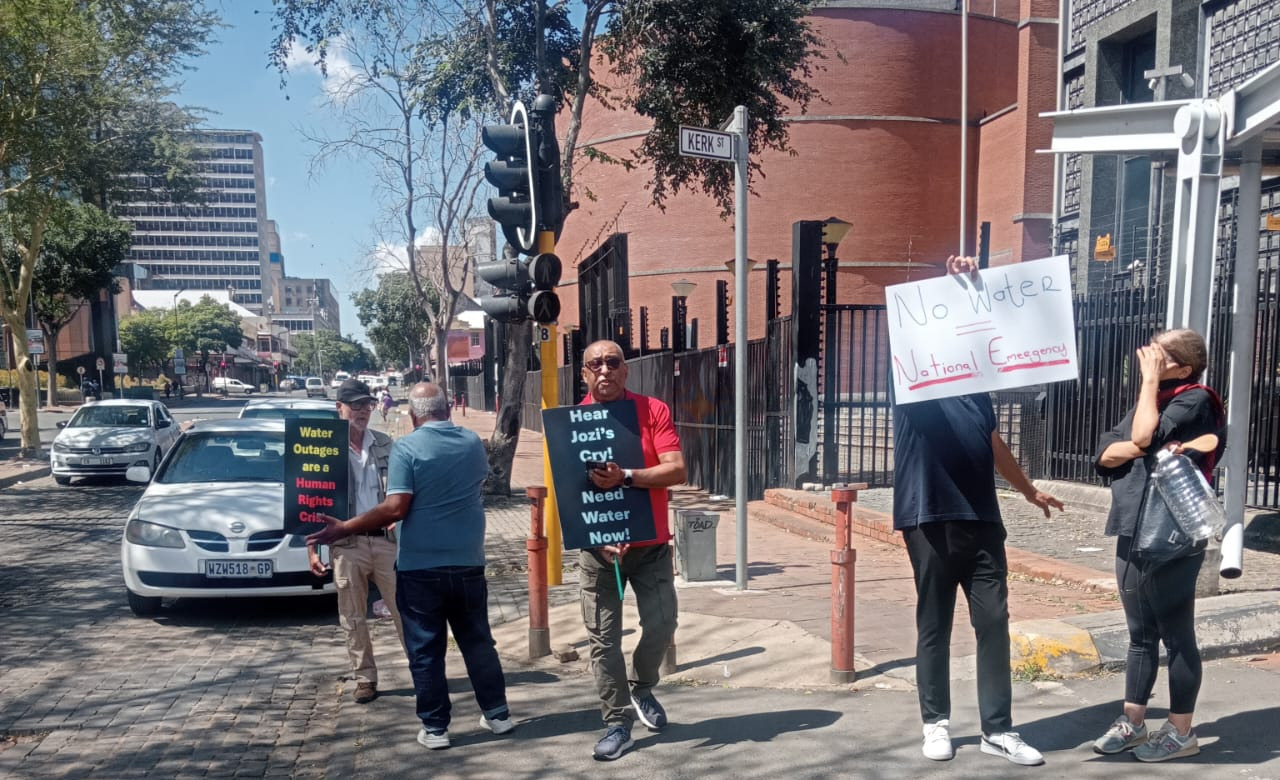
 Protesters picketed outside Joburg Water on Sunday, 8 February, to call for the city's water crisis to be declared a national disaster. (Photo: Water Crisis Committee)
 The Water Crisis Committee marched to the head offices of Johannesburg Water in Newtown on Sunday, 8 February, to demand that the government declare Johannesburg’s worsening water crisis a national disaster. Included in the civil society organisation’s demands were calls for greater direct communication from Johannesburg Water and Rand Water to consumers, and tighter water restrictions.
The protest came in response to a multisystem failure that has left parts of the city, including Midrand, Melville, Brixton and Selby, with inconsistent or no water supplies for days or even weeks. The failure was attributed to an explosion at the Zuikerbosch Water Treatment Plant on 27 January, followed by a leak at the Klipfontein Reservoir inlet.
The organisation has argued that declaring the crisis a national disaster would unlock emergency funding and capacity. It said the provision of water tankers is not a replacement for a functioning water system.
“Intermittent tanker provision, characterised by long queues, inconsistent schedules, unequal access and the absence of proper oversight, does not meet the standard of “sufficient” access contemplated by the Constitution. Nor does it satisfy the obligation of reasonable and sustainable service delivery under the Water Services Act,” said the Water Crisis Committee.
Johannesburg’s water is supplied by Rand Water, which sends formal communications to municipalities. But civil society organisations like the Water Crisis Committee and WaterCAN have criticised the lack of direct communication with consumers. The committee argued that the lack of communication undermines trust and transparency and violates the Consumer Protection Act (CPA).
“Johannesburg residents are paying service fees for water that is not being delivered, yet they have received neither a full explanation for the drastic reduction in supply from Rand Water nor credible timelines for restoration. This failure to communicate undermines both the spirit of the CPA and the basic standards of transparent public service delivery,” said the committee.
‘Pouring water into silt’
Water consumption has remained high in the city as temperatures climb above 30°C. In a statement published on Saturday, 7 February, Rand Water warned that persistently high usage of water in Gauteng, particularly in Johannesburg and Tshwane, was placing “significant strain” on the overall water supply network and contributing to outages in other areas. As a result, water supplies are set to be reduced.
“Rand Water, after engaging with high water-consuming municipalities, will be reducing water supply to these areas to restore water supply in affected areas to stabilise the entire bulk water supply system,” said.
Ravin Singh is the co-convener of the Water Crisis Committee. He told Daily Maverick that the supply of groundwater would not be increased until the Lesotho Highlands Water Project is completed in 2028/2029. Hence, the city urgently needs to repair its ageing infrastructure and consider coordinated measures to mitigate the crisis in the interim.
“The problem is you cannot be pouring water into silt. Right now, 56 percent of the water gets wasted. And then your reservoirs are leaking, your pipes are leaking. So, while we wait for the 2028/2029 completion of that project, the city needs to repair its reservoirs, build additional reservoirs, and repair the pipeline, so that when you receive water, it’s not leaking,” he explained.
He said the committee’s suggestions include imposing tighter water restrictions in consultation with residents, as well as campaigns to teach the public how to reduce their water consumption. DM