
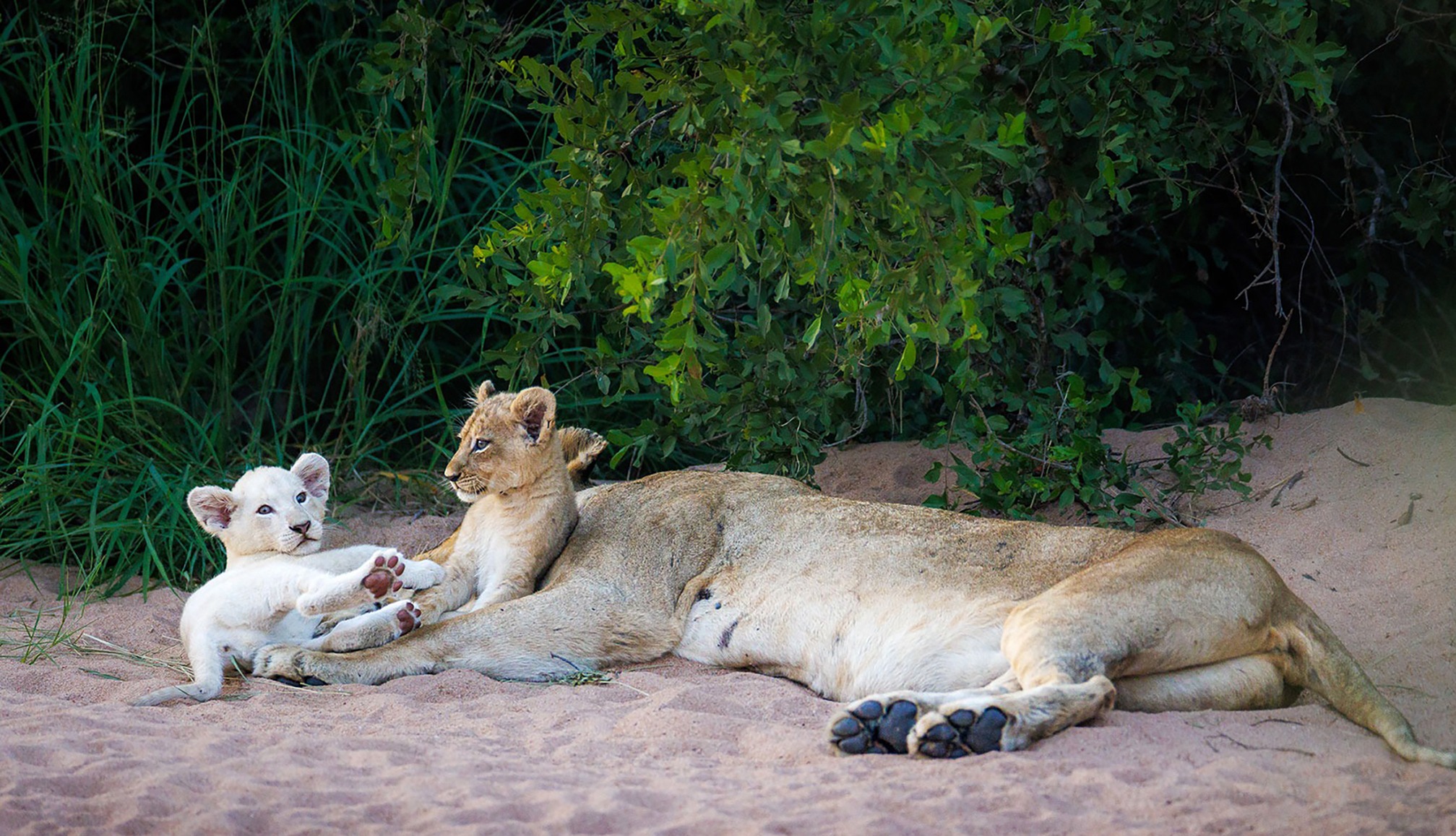
 A two-month-old white lion cub shows off its paws in Timbavati Private Nature Reserve. (Photo: Chad Cocking)
 Water is a “ferocious” thing, Timbavati warden Edwin Pierce says when recalling the low-pressure onslaught that rolled in from Mozambique and dumped up to 1,000mm of slow, saturating rain on parts of the 56,000-hectare private reserve in mid-January. “Trying to control it is practically impossible.”
Like other flood-hit reserves in northeastern South Africa, Timbavati was forced to close some of its doors to ride out a year’s worth of rain in just about 10 days — widely described as the greater Kruger region’s worst floods since January 2012. This famous reserve, known for its white lions, also weathered some losses.
But now the flood waters are subsiding. And, in their disastrous wake, nature’s wet bounty has offered something of a compensation: prolific wildlife viewing one cannot see in the hot, dry Lowveld just any year, argues Pierce.
/file/attachments/orphans/Chad-Cocking_white-lion-2_392911.jpg "Timbavati's first white lion cub in a decade. (Photo: Chad Cocking)")
“In 2000 and 2012, we learnt big lessons about floods,” Pierce says. “This year, we actually positioned our rangers in high-risk zones we knew would be cut off. We knew they had enough food and water. They could do what they needed to do.”
As also seen at other reserves, it was hard past lessons and militaristic forward-planning that ultimately drove the response of a relatively resilient sector — one that can start reopening its doors to exceptional natural sights, Pierce argues. He acknowledges Timbavati was “very lucky”.
Pierce says the reserve’s challenges were largely confined to restricted lodge access, not large infrastructure damage: “You can now do everything you’d normally do before the heavy rain.” Some Timbavati guests may even be in for an uncommon arrival — a white lion cub born in the reserve two months ago. This is the first cub to be sired here in 10 years, says local safari camp co-owner Don Scott.
“Our lodges are being extremely tight on viewing protocols to ensure any human activity does not endanger his survival,” cautions Scott of Tanda Tula Safari Camp. “The survival rate of lion cubs in the wild to adulthood is only around 30% … especially considering his bright white coat. We all remain extremely hopeful that all cubs in this litter will succeed.”
/file/attachments/orphans/Chad-Cocking_white-lion-3_285974.jpg "Timbavati's white lion cub, now two months old, with a sibling. (Photo: Chad Cocking)")
The situation in Kruger
Timbavati’s immediate neighbour to the east, Kruger National Park, received between 200mm and 1,000mm in the same period, according to the South African Weather Service.
Kruger rolls out over two million hectares — a vastly bigger area than its private sector neighbours — so it was Kruger that sustained much more infrastructure damage from those ferocious waters.
Initial estimates peg the park’s toll at R500-million, but spokesperson Reynold Thakhuli told Daily Maverick that South African National Parks was still assessing the full cost before making outright recommendations.
Kruger’s private sector neighbours praised the state park’s “exemplary” response to a national disaster that leading scientists have linked to climate change.
“It’s very difficult to be prepared for something of such magnitude. Kruger did phenomenally well,” Pierce says, referring to the park’s evacuation response in which not one human life was lost in unimaginably tough terrain. “They had clear responses and communication. Their biggest priority — also one of ours — was staff and guest safety.”
So, should you go to Kruger, well, now? While some rest camps and roads in the northern Kruger area are still closed, most of the rest of the park has reopened to the public.
This has sent operators such as MoAfrika Tours and safari entrepreneur Bongani Mnisi’s Wildlife Safaris back into the park.
Mnisi acknowledges infrastructure damage that “will take time” to fix, but notes that a private professional guide can still help non-expert visitors make the most of “an atmosphere that everyone wants to be in”.
What to see if you go
That is cautiously optimistic news for an emblem of global natural heritage that helps sustain livelihoods in Limpopo and Mpumalanga provinces, as well as other national parks in South Africa.
By picking Kruger, budget-conscious travellers who cannot afford a private guide or five-star options may still experience the thrills and spills of a water-infused landscape, but they might have to alter their game plan, says wildlife relocation consultant Tim Baynham.
A Hoedspruit-based expert specialising in the greater Kruger region’s more covert residents — scorpions and snakes — Baynham warns that the post-rain riches also mean “thick bush”. And that means “hard-to-spot” animals.
But, he counsels, “the rain brings out the insects. There is water everywhere: all your frogs and amphibians are very much loving this kind of weather. Focus on the small stuff.”
“Everything in Kruger is flowing right now,” Riaan Kruger, manager of Sabi Sand Nature Reserve, told Daily Maverick. Speaking in his personal capacity, he observes: “If I could have, I probably would have found myself birding in northern Kruger for the next two weeks.”
He also points out that Sabi Sand, the enclave of private reserves near southern Kruger’s Skukuza rest camp, is fully operational again after being doused with around 350mm of rain.
“Sabi Sand has had a good impala lambing season. That brings increased predator activity,” he smiles. “And good leopard sightings are what we’re known for.”
Alternative safaris: a feast for the ears
The bushveld may now be a feast for the eyes in its gown of resplendent green — but it is also one for the ears, says Sound Safaris’ Sarah Solomon.
A “deeply immersive experience”, a “sound safari” uses “sensitive” microphones and individual headphones to tune into the bushveld’s dawn and dusk chorus.
“We stop in different areas and habitats, with the vehicle turned off, and listen in to the amplified sounds,” says Solomon. “You hear much more than with your ears alone.”
One such destination serviced by Sound Safaris is Klaserie Private Nature Reserve, where tourist operations have resumed, says spokesperson Krystle Woodward.
About “25% of lodges are currently closed for renovations, while all others are fully operational and continue to welcome guests”. Some river crossings were damaged, and the ground is still saturated in “isolated” areas.
“These sensitive sections are being avoided until they have dried out.”
But the 60,000-hectare Klaserie is a “vast reserve”, so there “are large areas that remain accessible for both game drives and guided walks”, Woodward notes. “The reserve remains in excellent condition for wildlife viewing. Guests can expect the same high standards of hospitality, guiding and conservation-focused tourism from operating lodges.”
Hoedspruit Wildlife Estate, a transit point for many visiting Kruger, is also open for business.
A spokesperson for Safari Moon Luxury Bush Lodge, Woodward says visitors can enjoy the lion’s share of the estate’s “game drive routes and green belt areas, with ample opportunity for walking, hiking, cycling and running, all while experiencing regular wildlife sightings”.
/file/attachments/orphans/Sound-safaris-Nick-Smith2_576953.jpg "Guide Nick Smith leads a sound safari in Jejane Private Nature Reserve, August 2025. (Photo: Stuart Hancock)")
Pothole safaris and how to avoid (some of) them
Greater Kruger, in other words, is begging to be explored as before — but that depends on where you go and how you get there.
Nomkhosi Tshabalala of the Kruger Lowveld Chamber of Business and Tourism says the “region’s road network was severely affected with some areas being inaccessible”. However, she says, “we are not closed off to the world”.
Ba-Phalaborwa Municipality spokesperson Jonas Mahesu urges caution and advises that the R71 and Mica routes contain, at the very least, “scattered potholes”. He says “teams are on-site, busy with repairs”. The R40 is “unsafe — best to avoid it if possible”. Be prepared for “stop-and-go” queues where some lanes are impassable.
Or you can fly — and cautiously plan any subsequent road travel by asking your final destination for the best-available advice. For instance, when asked, Timbavati and Sabi Sand confirmed road accessibility.
Two key airports (Eastgate and Kruger-Mpumalanga) service the Lowveld.
Yet Safair’s new Cape Town-Hoedspruit budget flights — a manifest relief for anyone travelling on a weaker currency — are grounded until the airline’s larger runway at Hoedspruit’s small Eastgate Airport is fixed.
Contractors are “working on the remediation, which is encouraging,” says chief marketing officer Kirby Gordon. “The provisional completion date is 14 February, although this remains subject to change depending on progress. We’re staying in close contact with the airport team … ”
/file/attachments/orphans/Alex-Shapiro-Timbavati-Rangers2_414735.jpg "Anti-poaching rangers crossing Timbavati's Monwana, a non-perennial river, 29 January 2026. (Photo: Alex Shapiro)")
Why not to skip Kruger: the bigger conservation picture
Sabi Sand’s Riaan Kruger visited Skukuza, the national park’s largest rest camp, immediately after the flood.
“Skukuza is in great nick,” the Sabi Sand reserve manager says. “The park needs all the support it can get at this stage — people really should avoid cancelling their trips.”
Timbavati’s Pierce notes: “Private reserves form Kruger’s western buffer, so money from our guest activities is pushed directly back into reserve management. Tourist support means we can safeguard what’s happening on Kruger’s western boundary.” DM
Recent flooding in Mpumalanga and Limpopo has raised the risk of malaria, says the University of Pretoria. It urged taking precautions, especially near mosquito breeding sites such as stagnant water.
For more on the Kruger Recovery Fund, visit the pages launched by SANParks and SANParks honorary rangers.