




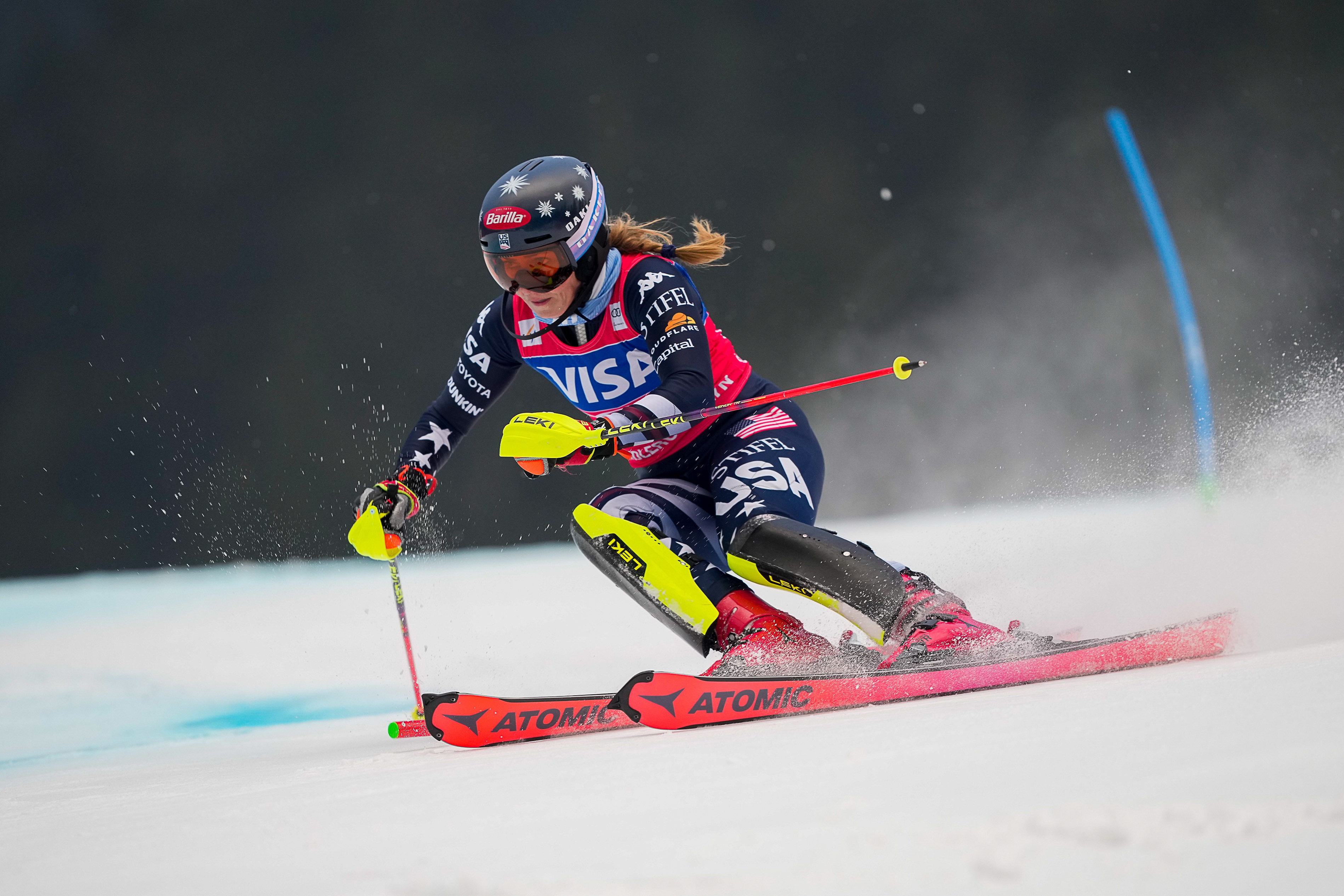
 Mikaela Shiffrin of the US could make history at the 2026 Milano Cortina Winter Olympic Games. She is eyeing gold in the slalom, giant slalom and the debut Team Combined event. (Photo: Millo Moravski / Agence Zoom / Getty Images)
 The Olympic Games are always worth celebrating because they represent a brief moment of global unity and honour the best of humanity.
In an increasingly polarised and angry world, gathering thousands of athletes from across the globe for 17 days of sporting competition is a welcome distraction.
For the residents of the Milan region in northern Italy, which is hosting the 2026 Winter Games in Milano Cortina, it is also a time to heave a sigh of relief.
As the Olympic flame arrived in Milan, weaving through the historic streets towards the opening ceremony at the San Siro Stadium on Friday, 6 February, the atmosphere was less of a triumphant parade and more of a collective exhale.
For the organisers of the Games, the journey to this moment has been what CEO Andrea Varnier described as “arduous”. It was a marathon of mounting budgets, “near-impossible” deadlines and geopolitical chill.
/file/attachments/2987/2260197182_948588.jpg "The women’s downhill ski training course at the Tofane Alpine Skiing Centre for the Milano Cortina 2026 Winter Olympics. (Photo: Al Bello / Getty Images)")
The financial trajectory of these Games has also ballooned, as they so often do for the four-yearly showpiece.
Organisers came nowhere close to meeting the original, lean $1.3-billion (R21-billion) budget (surprise!). The original budget was focused on using existing infrastructure, yet the staging costs came in at $1.7-billion (R27-billion).
In addition, broader infrastructure improvements cost a staggering $3.5-billion in public money.
“This journey has proven to be even more arduous than initially imagined, with challenges and difficulties, some expected and some unexpected and probably unnecessary,” Varnier told the International Olympic Committee session in his final progress report before the start of the Games.
“The financial situation of our organising committee has been extremely difficult throughout the years,” he said. “We must, however, acknowledge that the Games cost more than initially foreseen in the candidature budget.
“You will not find in these Games everything you might have expected or everything we originally wanted to have.”
/file/attachments/orphans/GettyImages-2260047609_255515.jpg "US athlete Grace Henderson during slopestyle training for the 2026 Milano Cortina Winter Olympic Games. (Photo: Hannah Peters / Getty Images)")
Venue problems
With whispers of the Games eventually costing closer to €5-billion (R95.2-billion) if you factor in hidden regional costs, not everyone is happy.
Critics, including Italy’s Court of Auditors, pointed fingers at everything from pandemic delays to skyrocketing steel prices since the start of the Russia-Ukraine war.
The Cortina bobsleigh track, a €150-million (R2.8-billion) project resurrected from 1956 Games ruins, was meant to be the crown jewel of 2026. But construction was halted repeatedly owing to to environmental lawsuits from green groups decrying habitat destruction for rare alpine flora, labour shortages and even avalanches burying work sites.
/file/attachments/orphans/GettyImages-2206259256_246564.jpg "An aerial view of the Cortina d’Ampezzo Valley, with the bobsleigh track for the 2026 Winter Olympics in the foreground. (Photo: Simone Padovani / Getty Images)")
The Milan Cortina organising committee scrambled to certify 13 competition sites, from the futuristic Santa Giulia skating oval in Milan’s regenerating suburbs to the Tre Cime di Lavaredo slopes for snowboarding.
Snow scarcity forced artificial backups in Valtellina, irking purists who see it as cheating Mother Nature.
Then there’s the human drama: 1,200 construction workers clocked overtime amid strikes, with unions protesting “unsafe conditions” on precarious mountain builds.
One fatality – a scaffold collapse – cast a pall, prompting Prime Minister Giorgia Meloni to pledge oversight while defending the Games as a “national renaissance”.
Environmentalists aren’t buying the spin. Protests have lit up piazzas from Verona to Belluno, with banners reading “Olimpiadi No Grazie” waving against a backdrop of melting glaciers.
The Dolomites, a Unesco World Heritage site, are warming twice as fast as the global average, and critics argue the Games accelerate the damage.
Organisers tout sustainability – 80% of venues were pre-existing, electric shuttles are zipping athletes around and there’s a “zero-waste” vow – but skeptics cite the bobsleigh track’s 400,000 cubic metres of excavated earth, now piled up as evidence of the damage.
“We’re partying on a sinking iceberg,” activist Elena Rossi of Fridays for Future Italia, told Reuters. She chained herself to a Cortina digger last year.
/file/attachments/2987/UP1EM260RHYJI_454205.jpg "Men’s sngles luge training at the Cortina Sliding Centre, Cortina d'Ampezzo, Italy. (Photo: Athit Perawongmetha / Reuters)")
Rich Games
There has also been criticism from citizens that the Games have been priced out of the reach of average people.
While the city has been “spruced up” to a gleaming polish, many Milanese are “underwhelmed”. The property boom following the 2015 World Expo, coupled with an influx of wealthy residents post-Brexit, has created a city where many locals feel like spectators in their own homes.
Organisers were quick to point out that 57% of tickets were priced less than €100 (R1,900). However, for the average family, the “flagship” experience tickets are well out of reach. The opening ceremony tickets ranged from €260 (R5,000) to €2,000 (R38,000).
Despite these and other problems, like all Olympics, when the action starts, the problems will be put on hold for a few weeks to allow the athletes to shine.
On and off piste
In Cortina, the “speed” is currently measured in millimetres. Following heavy snowfall, 250 workers and nine grooming machines have been working 12-hour shifts at 1km/h to prepare the Olimpia delle Tofane course. The goal: a surface dense enough to handle skiers hitting 140km/h.
/file/attachments/2987/UP1EM260QP8I1_329256.jpg "The Olympic rings ahead at the Tofane Alpine Skiing Centre. (Photo: Aleksandra Szmigiel / Reuters)")
Read more: SA skier Matt Smith on his Olympic goal and confronting critics
The figure skating programme kicks off with the team event, a discipline that rewards depth over individual stardom. The US arrived as the favourite, led by "Quad God" Ilia Malinin, but the memory of the Beijing 2022 doping scandal – medals weren’t awarded for two years – still hangs over the rink.
/file/attachments/orphans/GettyImages-2259709831_439419.jpg "Quad God Ilia Malinin of the US at a training session at the Milano Ice Skating Arena ahead of the 2026 Milano Cortina Winter Olympic Games. (Photo: Matthew Stockman / Getty Images)")
Then there is the Lindsey Vonn story. The 41-year-old US superstar skier is attempting to compete despite a freshly ruptured anterior cruciate ligament suffered on 30 January.
While a season-ending injury for most, American teammate Landon Wendler – who has previously competed in moguls with the same injury – insisted that competing is possible.
“If you have strength and stability in your knee, it’s entirely possible to be done,” Wendler said. “It is very painful, but we athletes will do whatever it takes.”
/file/attachments/2987/UP1EM260MV6FF_515050.jpg "Lindsey Vonn of the US tore her ACL a week before the 2026 Winter Olympics but will compete at Milano Cortina. (Photo: Lisi Niesner / Reuters)")
There are a record five Winter Olympians in Team SA for the 2026 Games in Milano Cortina. It’s five more than there were in Beijing in 2022.
Read more: Teen sensation Lara Markthaler takes South Africa to the Olympic slopes
Matthew Smith (men’s cross-country skiing), Nicole Burger (women’s skeleton), Lara Markthaler (women’s Alpine skiing), Thomas Weir (men’s Alpine skiing) and Malica Malherbe (women’s freestyle skiing) will fly the flag for South Africa.
/file/attachments/orphans/NicoleBurgerSouthAfricaCREDITIBSFDATE2024_415404.jpg "Nicole Burger will become the first South African woman to complete in skeleton at the 2026 Milano Cortina Olympic Winter Games (Photo: IBSF)")
Unfortunately, SuperSport, under the new ownership of French media giant Canal +, won’t be broadcasting the Games live. There is also uncertainty about whether there will even be daily highlights packages to catch up on events.
As South Africans we have become accustomed to excellent global sporting coverage from SuperSport. Its premium decoder package is not cheap (in excess of R1100) but it has traditionally been comprehensive.
Axing live Olympics coverage on Africa’s premium sports broadcaster is a worrying sign of things to come.
It’s also unfortunate, given the size of Team SA’s squad in Milan. Obviously, none of the South Africans is expected to win medals but their stories are really about the journey to make it to the Olympics, generally against the odds.
There are a total of 15 athletes from Africa in Milan, and with what appears to be limited television coverage, growing winter sports on this continent will continue to face challenges. DM
Athletes to watch
Mikaela Shiffrin (USA) – Alpine skiing: The most successful skier in history with 108 World Cup victories. After failing to win a medal in Beijing 2022, she is on a mission to “make peace with the Olympics”. She is eyeing gold in the slalom, giant slalom, and the debut Team Combined event.
Ilia Malinin (USA) – Figure skating: Nicknamed the Quad God, the 21-year-old is the only human to ever land a quadruple Axel in competition. He is the heavy favourite for gold and is known for his “Raspberry Twist” and a signature Hershey’s chocolate pre-performance ritual.
Eileen Gu (China) – Freestyle skiing: The Snow Princess returns after her three-medal haul in Beijing. Now 22, she remains the most marketable athlete in the Games, competing in slopestyle, big air and halfpipe.
Johannes Høsflot Klæbo (Norway) – Cross-country skiing: Already a five-time gold medallist, Klæbo is attempting a historic sweep. If he wins multiple golds in Milan, he could surpass the legendary Bjørn Dæhlie as the most successful male Winter Olympian ever.
Connor McDavid (Canada) – Ice hockey: Widely considered the best hockey player on the planet, the Edmonton Oilers captain is making his long-awaited Olympic debut. He leads a “dream team” Canadian side desperate to reclaim gold.
Francesco Friedrich (Germany) – Bobsleigh: The Ice Kaiser has won double gold (two-man and four-man) at the last two Olympics. Success in Italy would be an unprecedented feat in sliding sports.