




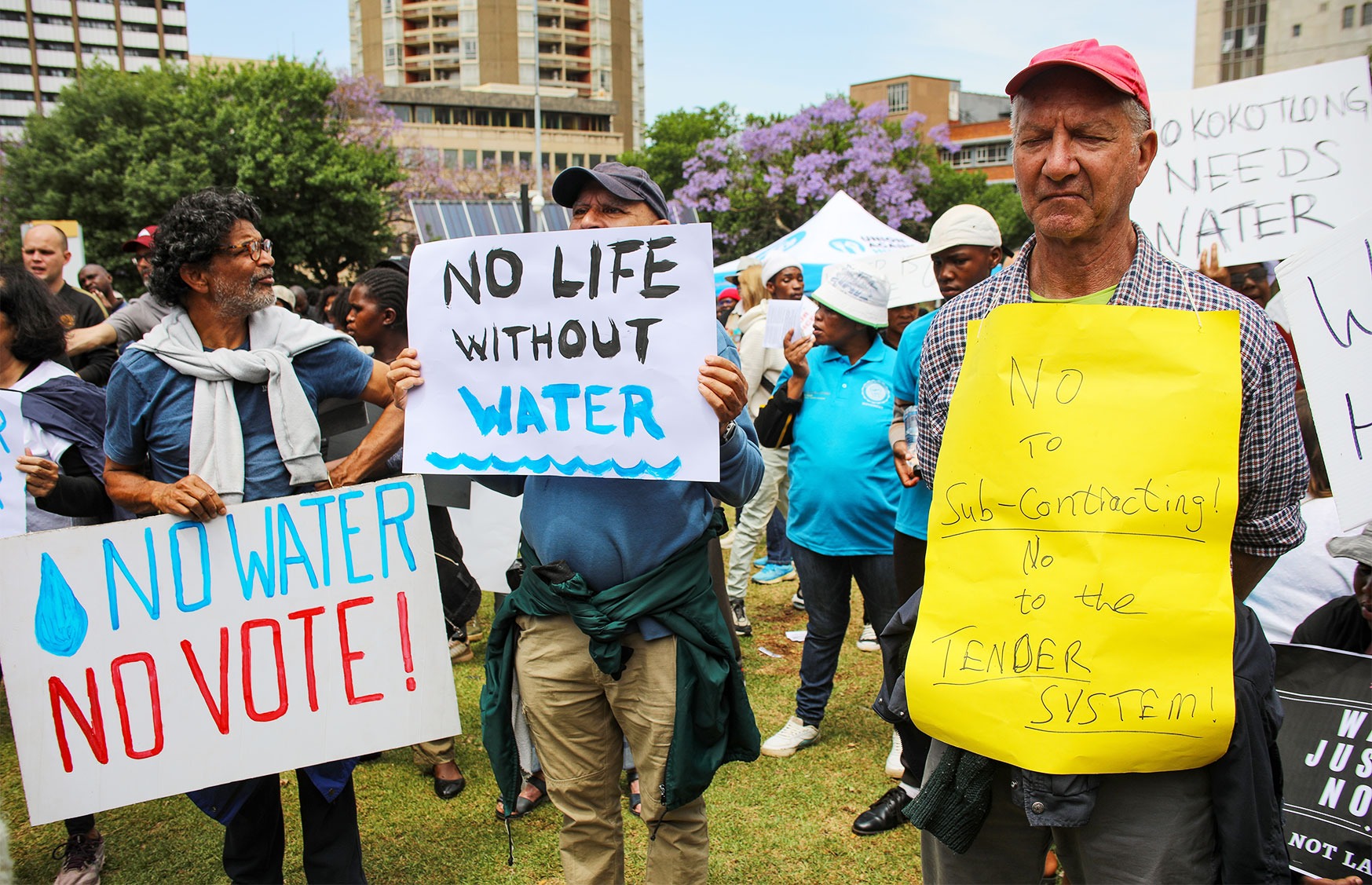
 Johannesburg residents protest against the water crisis outside the City of Johannesburg Council Chamber on 1 November 2025 in Johannesburg, South Africa. The group demanded an urgent action to end what they describe as a ‘human rights and economic emergency’ caused by the worsening crisis. (Photo: Gallo Images / Fani Mahuntsi)
 “The water outages are lasting longer and longer. It’s starting to feel like nobody cares,” said Parkhurst resident Johnny Pienaar.
His comment echoed the growing sentiment among Johannesburg residents as they reel from water outages caused by a multi-system failure during a heatwave where temperatures have climbed above 30°C.
In Midrand, residents protested on Tuesday, 3 February 2026, after six days of outages caused by a pump’s motor explosion at the Zuikerbosch Water Treatment Plant on Tuesday, 27 January 2026. Although the explosion was repaired a few days later, a leak at the Klipfontein Reservoir inlet extended the outage further.
Other areas including Melville, Brixton, Yeoville, Berea, Orange Farm and Auckland Park have been left with no water or low water pressure due to planned maintenance work on the Commando System between 3 and 5 February.
/file/dailymaverick/wp-content/uploads/2025/03/ED_537868.jpg "Water is sourced from a JoJo Tank in Protea Glen on 4 December 2024 in Soweto, South Africa. According to media reports, residents claimed that they hadn’t had water for six days. (Photo: Gallo Images / Fani Mahuntsi)")
Systems across Soweto are also severely constrained, as critically low to empty reservoirs are resulting in low pressure and water outages in areas like Doornkop, Dobsonville, Meadowlands, Naledi, Zola and Protea Glen. Diepsloot community leader Loyiso Toyiya told Daily Maverick on Thursday that the area had been without water for several days.
“It was out for three to four days,” Toyiya told Daily Maverick on Thursday afternoon, confirming that it had since returned.
But other areas have experienced persistent shortages. Joburg Water has attributed the outages to a combination of high demand, ageing infrastructure and technical issues. On 5 February, Joburg Water stated on its X account that two of the affected reservoirs servicing Midrand – Erand and Grand Central reservoirs – were open and had resumed pumping water. But angry residents were not appeased.
“Your updates say that we are supplying fairly but we do not have water at all right now??” read one post by @TourmalineBloom.
“There was a little bit of water last night, just to wake up without water again and then being told that we should have water because the reservoir is supplying water. At this point we can’t even be angry any more. It’s astonishing how incompetent you are at doing your job,” read another by @DivanDivvy.
Only two tankers for 60,000 residents
Midrand ward councillor Annette Deppe told Daily Maverick that in the evenings water was diverted from Erand Reservoir to feed other reservoirs and tower systems that were at critical levels, including Grand Central Towers, Rabie Ridge and President Park. As a result, the high-lying areas of Midrand did not get water.
“In Midrand, there’s quite a lot of ups and downs with yields. There’s some areas that are very high, and [the water is] not getting to those townhouses. And a lot of those townhouses are three, four stories high. So people from the third and fourth levels are not getting water.”
/file/attachments/2987/GroundUp-water-protestinset1_621013.jpeg "Water tankers fill up at a fire hydrant in Midrand. A Joburg Water official on site said that there were not enough water trucks to supply the whole area. (Photo: Ihsaan Haffejee)")
She said that only two water tankers had been supplied to Ward 132, which has more than 60,000 residents. Many residents had not had water for more than seven days, and as a result had complained to her about the shortages and lack of communication from Rand Water and Joburg Water.
“Parents were complaining that they were sent a message halfway through the day to say come fetch the kids. And they couldn’t leave work. There were some kids that disappeared because they went home with other kids. It was a disaster,” she said.
“Then I’ve got parents who are on life support, their children are looking after them and they couldn’t bathe them, they couldn’t wash them. Midrand police station phoned me this morning and said they hadn’t got water and it was a crisis because the guys in the cells were fighting each other because there was no water. I’ve got thousands of stories. People really feel like the City doesn’t care.”
She added that the water crisis in Midrand was compounded by population growth in the area and the City failing to upgrade the infrastructure for 30 years.
Businesses forced to close
Residents in Melville have been without water for more than 14 days, while areas like Selby have experienced intermittent or no water supplies for close to five months.
The water shortages have affected businesses too. On Melville’s busy 7th Street, businesses have been forced to close due to water shortages. At Campus Square Mall in Auckland Park, near the University of Johannesburg, multiple businesses reported that the mall had been without running water for roughly two weeks and had had to rely on tankers. Several bathrooms across the mall were closed and blocked off, and a faint odour of sewage was detected in parts of the complex.
/file/attachments/orphans/IMG_1961_502247.jpeg "There has been no public access to bathrooms at Campus Square Mall due to persistent water shortages. (Photo: Reitumetse Pilane)")
At the Zone Fitness gym, staff member Noor Roos told Daily Maverick that attendance had dropped.
“People don’t come as often. People who train before work can’t do that any more because they can’t clean themselves before work. You can even start to smell strange odours around.”
WaterCAN’s executive director Ferrial Adam said in a statement on 3 February that the water shortages reflected a broader, citywide problem caused by a fragile, poorly maintained system that could not cope with the failures, and called for better, more direct communication from service providers.
According to Joburg Water advisories published on 6 February, the following reservoirs are still critically low with poor pressure to no water: Brixton Tower, Ennerdale Reservoir, Alexander Park Reservoir, South Hills Tower, Doornkop Reservoir, Jabulani Tower, Naturena Reservoir, and Protea Glen. Hursthill 1 and 2 reservoirs are on bypass with poor pressure to no water expected. The Roodepoort system is the only water system in which all reservoirs are supplying adequately.
Joburg Water did not respond to requests for comment. DM