




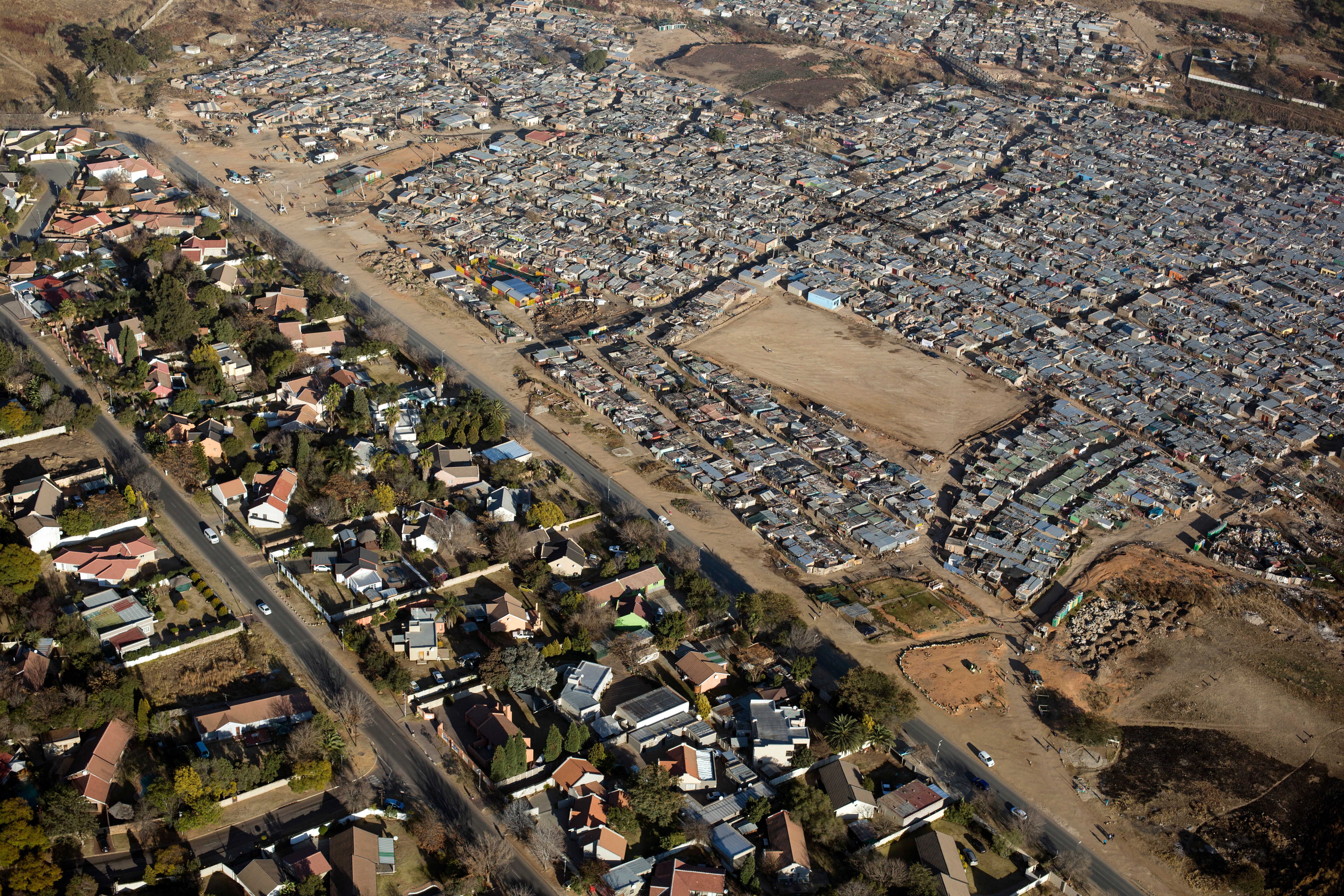
 This photograph illustrates the stark difference between the poor black informal settlement of Kya Sands in Johannesburg and Bloubusrand, a middle-class area with larger houses and swimming pools. (Photo: Per-Anders Pettersson / Getty Images)
 /file/dailymaverick/wp-content/uploads/2025/10/label-Op-Ed.jpg)
The presence of trees – especially ones that do not provide edible fruits – often signals a certain level of affluence and comfort. This observation brings to mind a statement by Aunty Olu in an episode of Bob Hearts Abishola. While assessing Bob as a potential suitor for their niece, the family followed him home and began imagining the kind of house he might build for them. In that moment, Aunty Olu remarked that “I will plant trees so that our neighbors will know that we do not rely on our gardens for food”, despite her husband’s insistence that they grow a vegetable garden instead.
That statement highlights the lived realities of many non-affluent neighborhoods, where residents cannot afford to use land in ways that do not yield immediate economic benefits. In such contexts, houses are often built close together, with rooms added for rent owing to economic hardship. Consequently, the closest many households come to having trees is through edible fruit trees or small gardens cultivated with vegetables and other food crops. This is not due to a lack of awareness of the aesthetic or environmental benefits of ornamental trees and flowers; rather, it reflects an economic constraint that makes it impractical to allocate land for purposes that do not directly contribute to subsistence or income.
This reality becomes even more troubling when one considers municipalities such as Stellenbosch. I was fortunate to attend the Situatedness Conference at Stellenbosch University, where a speaker, Hanrie Viljoen, in her presentation titled “Who are the Flowers for?”, highlighted the plight of service workers who are forced to lie in open fields under the scorching sun during their breaks, close to areas where hundreds of thousands of rands are spent on seasonal flower planting to beautify Stellenbosch Central during festive periods. This contrast starkly reveals the lived realities of those who struggle to make ends meet within an otherwise affluent urban centre.
The disparity becomes even more pronounced when Stellenbosch Central is compared with other neighbourhoods within the municipality, such as Kayamandi, where access to green spaces is significantly more limited. While Cloetesville and Idas Valley appear to fare somewhat better in terms of tree planting, these differences nevertheless reflect uneven patterns of environmental investment across the municipality.
Planting trees is not inherently problematic, particularly given that seasonal planting during festive periods is often aimed at attracting tourists. Tourism is a significant sector that contributes substantially to municipal income. However, this practice becomes deeply insensitive when considered alongside the plight of the majority of residents within the municipality who live and work in emotionally and physically draining environments. Many of these individuals cannot afford to leave because their survival depends on the income they earn there, yet little is done in terms of regulation, responsive infrastructure or meaningful intervention to improve their conditions – a concern also raised by Viljoen.
I am not advocating that planting trees in less-affluent neighbourhoods is the solution. Rather, I call for greater sensitivity to the lived realities of the underprivileged in society: an approach that pays close attention to their needs and meets them where they are.
Comfortable rest areas could be provided for service workers whose labour is essential to the tourism industry, of which beautification through flower planting is only one component.
At the same time, the needs of non-affluent neighborhoods must be taken into serious consideration. Although different communities have distinct needs, these often include basic concerns such as security, proper sanitation and access to clean, potable water.
Addressing the needs of all members of society thus becomes a hallmark of a just, supportive and thriving community – an ideal towards which every society should strive. As American activist Fannie Lou Hamer famously stated: “No one is free until everybody is free.” DM
Emmanuel Oboh is a PhD student of philosophy at the Centre of Applied Ethics, Stellenbosch University.