



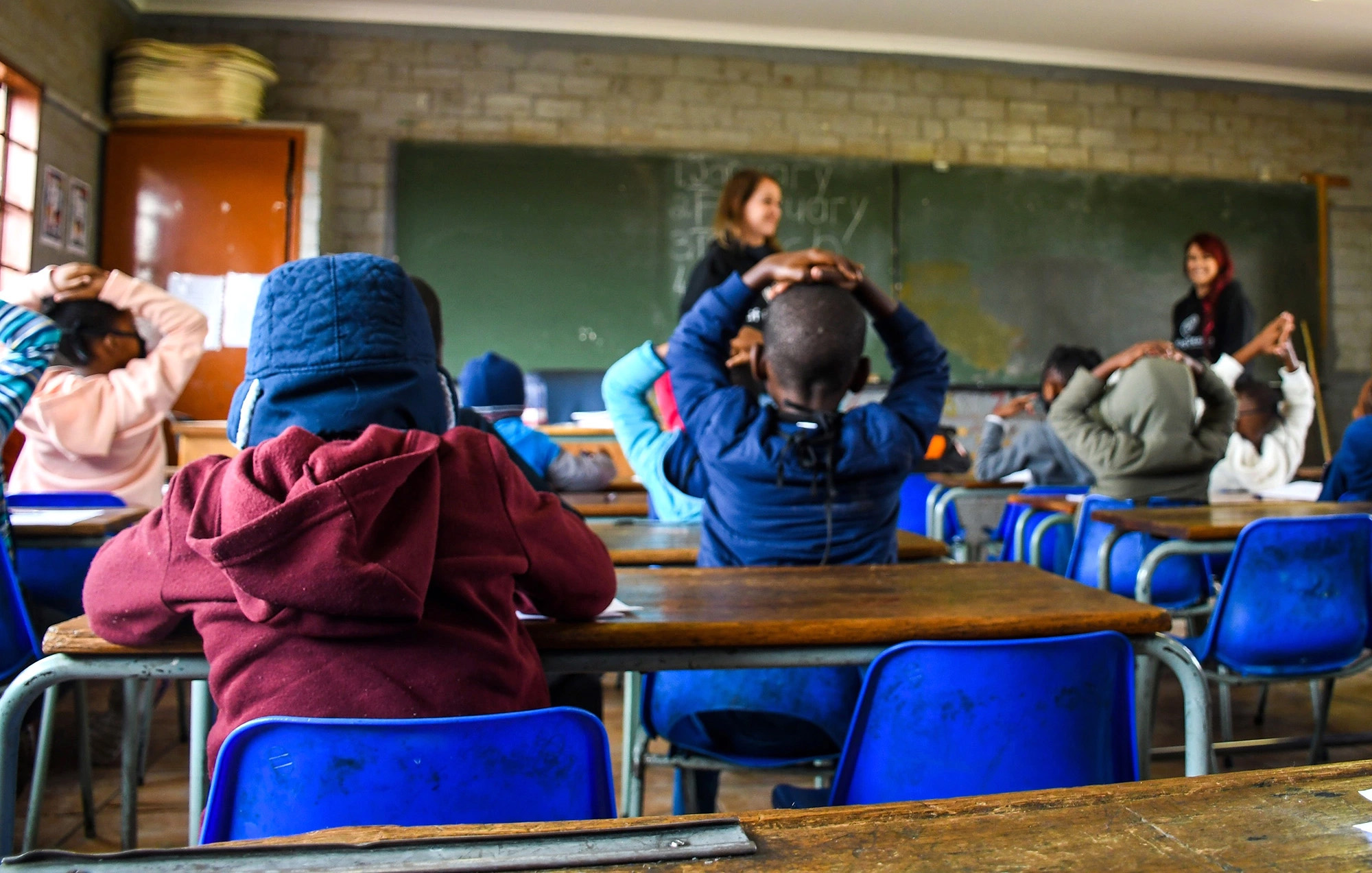
 The ‘shared-facility model’ proposes a solution to SA’s educational language debate by allowing multiple schools with different languages of instruction to operate on the same site. (Photo: Julia Evans)
 /file/dailymaverick/wp-content/uploads/2025/10/label-Op-Ed.jpg)
South Africa’s debate about language in education has become strangely stuck. Everyone agrees, at least in principle, that learning in one’s mother tongue matters. The Constitution says so. Decades of international evidence say so. Teachers know it instinctively. And yet, when the conversation shifts from principle to practice, it hardens into fear, litigation and zero-sum politics.
The result is paralysis.
At the centre of this paralysis sits an unspoken assumption: that expanding mother-tongue education in African languages must necessarily come at the expense of existing schools, particularly Afrikaans-medium schools with strong infrastructure, stable governance and proven educational outcomes. Once that assumption takes hold, the debate is no longer about children or learning. It becomes about loss, displacement and institutional survival.
It is precisely this dead end that the “one facility, two or more schools” model seeks to escape.
The idea is disarmingly simple. School buildings are public assets. They are bricks, halls, laboratories, sports fields and libraries. They are not, or should not be, exclusive cultural territories owned by a single linguistic community for all time. If that sounds provocative, it is only because we have grown used to treating scarcity as natural, rather than questioning how we organise what we already have.
The model separates physical infrastructure from institutional identity. Multiple fully fledged schools, each with its own language of instruction, leadership, governance and pedagogical culture, can operate from the same physical site. They share facilities, not identity. Space, not soul.
Not an abstract theory
This is not an abstract theory. It is a practical institutional logic observed in countries that take multilingualism seriously without turning it into a battlefield. During a recent study visit to Finland, educators and administrators spoke about shared facilities as entirely unremarkable.
Schools exist to serve communities, not to defend symbolic ownership of buildings. Language streams coexist because the system is designed to add capacity, not to redistribute insecurity. The lessons from that visit are explored in detail in a report on language, learning and social cohesion that was recently published by the Inclusive Society Institute.
For South Africa, the implications are profound.
Take a typical suburban area with a well-resourced Afrikaans-medium school. Under the prevailing logic, expanding access to mother-tongue education in, say, isiXhosa or isiZulu is framed as a threat: to standards, to culture, to institutional continuity. Predictably, resistance follows, courts are approached and energy is burned in conflict, rather than classrooms.
The shared-facility model changes the question. Instead of asking who must give up what, it asks how existing capacity can be expanded. An isiXhosa-medium school could be established on the same campus, with its own principal, governing body and teaching staff. Timetables, entrances and governance arrangements would be clearly defined. No forced mergers. No dilution of standards. No symbolic conquest. Just additional schools serving additional learners.
/file/dailymaverick/wp-content/uploads/2024/10/0X0B0607.jpg "The shared facility model would decouple language from geography in South Africa. (Photo: Leila Dougan)")
Crucially, this approach decouples language from geography. At present, high-quality mother-tongue education in African languages is often confined to rural or township contexts, while suburban and well-resourced areas drift steadily towards English-only schooling. This is not because of a conspiracy, but because of institutional inertia and parental anxiety in an unequal labour market.
The consequence is predictable. African-language schooling is quietly positioned as remedial, second-best or transitional, rather than as a credible, high-quality choice across society. Once that perception hardens, multilingualism survives only on paper.
By enabling African-language schools to operate within the same physical environments as historically advantaged schools, the shared-facility model interrupts that drift. It makes mother-tongue education visible, normal and respectable in precisely those spaces where it is currently absent. That matters not just for learning outcomes, but for dignity and belonging.
Legitimate concern
There is, of course, a legitimate concern that shared facilities could become sites of friction. Anyone who has worked in education knows that clarity of governance is non-negotiable. This model does not work by muddling authority or collapsing identities. It works by drawing firm lines: separate leadership, separate accountability, separate pedagogical vision, coupled with shared rules for shared spaces.
Where this discipline is absent, conflict will follow. Where it is present, something more interesting can emerge: informal professional exchange, more efficient use of scarce resources and a gradual normalisation of linguistic diversity without forced integration.
From a social cohesion perspective, this is perhaps the model’s most underestimated strength. SA often treats cohesion as something that must be declared or enforced. In practice, it is built quietly, through predictable institutions that function fairly over time. When different language communities see one another operating side by side within the same public institution, without displacement or humiliation, trust accumulates. Not overnight. Not symbolically. But persistently.
It is important to be clear about what this model is not. It is not a blueprint to be imposed from Pretoria. It is not a denial of historical injustice. It is not an argument against Afrikaans, or for English, or for any language at the expense of another. And it is certainly not a claim that mother-tongue education alone will fix SA’s deep educational inequalities.
What it is, is an invitation to think expansion, rather than redistribution.
SA does not suffer primarily from a shortage of constitutional principles. It suffers from a shortage of institutional imagination. We keep returning to the same fights, because we keep framing the problem the same way. Language policy becomes a proxy for unresolved historical anxiety, rather than a practical design challenge grounded in how children learn and how systems grow.
A way out of permanent stalemate
The “one facility, two or more schools” model does not resolve all tensions. It does, however, offer a way out of permanent stalemate. It allows the government to pilot, learn and adapt without triggering existential battles. It allows communities to protect what they value while participating in something larger. And it allows multilingualism to be built into the everyday functioning of schools, rather than staged as a recurring political drama.
If SA is serious about mother-tongue education, the question is no longer whether it is desirable. That debate is settled. The real question is whether we are willing to move beyond fear-driven binaries and design institutions that expand opportunity without demanding sacrifice as a precondition.
Sometimes progress does not require new laws, new slogans or new enemies. Sometimes it requires a simpler, braver thought: that one school building can hold more than one future. DM
Daryl Swanepoel is the CEO of the Inclusive Society Institute (ISI).