




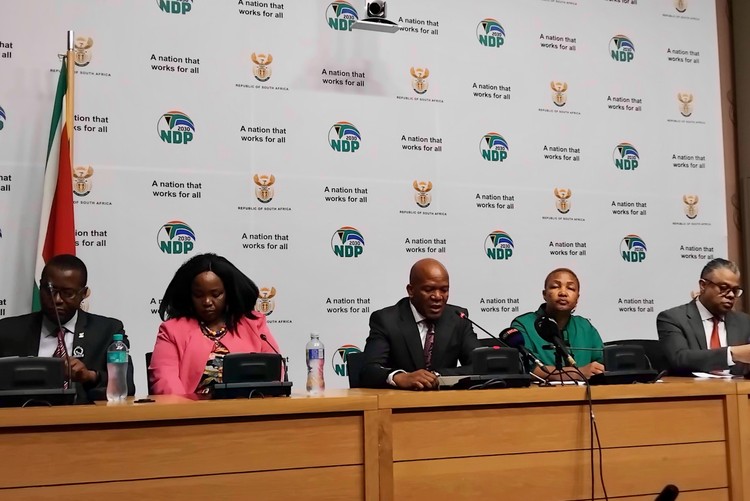
 During a briefing on Thursday, Sassa said it had reviewed about 240,000 grants and suspended 70,000. From left, Sassa and Department of Social Development officials: Fanie Sethokga, Maureen Mogotsi, Themba Matlou, Zodwa Mvulane and Brenton van Vrede. (Photo: Marecia Damons)
 The South African Social Security Agency (Sassa) says it has stepped up its social grant review programme as part of a broader push to tighten compliance under stricter National Treasury conditions.
In a briefing at Parliament on the agency’s third-quarter performance on Thursday, 5 February 2026, Sassa CEO Themba Matlou said that about 240,000 grants had been reviewed so far with about 70,000 suspended for non-compliance.
About 495,000 people had been flagged by income verification exercises as being potentially ineligible. Nearly 400,000 beneficiaries have been notified that their eligibility was under review.
Matlou said the process had so far saved the government about R44-million a month, almost R500-million a year.
Last year, the Department of Social Development told Parliament that the Treasury had introduced stricter conditions for Sassa’s budget, including monthly income checks, expanded verification and regular reporting.
Nearly 45% of the population depends on grants. Finance Minister Enoch Godongwana recently announced that the Social Relief of Distress grant would be extended until March 2027. The Department of Social Development has been allocated R260-billion for 2026/27 and R271-billion for 2027/28 for social assistance.
As part of the review process, Sassa has expanded data-matching and verification partnerships. These include credit bureaus, banks, the South African Revenue Service, the National Student Financial Aid Scheme, government payroll systems, and correctional services.
Matlou said these checks were aimed at identifying beneficiaries with undeclared income and employment or alternative sources of support, as well as cases where circumstances had changed and grants should no longer be paid.
In the third quarter, 162,000 beneficiaries were selected for additional verification, while a further 201,000 were identified through government payroll data as possibly receiving grants despite being employed by the state.
About 25,000 beneficiaries were issued letters in December requesting that they present themselves for reviews.
Beneficiaries given a chance
Matlou said the review process was guided by the Social Assistance Act, which required Sassa to confirm beneficiaries’ continued eligibility.
Although beneficiaries were legally obliged to report changes in their circumstances, he said reviews were necessary to “safeguard the system”.
Meanwhile, Sassa executive manager for grant operations Brenton van Vrede said grants were not cancelled automatically. Beneficiaries were given one month to complete a review after being notified. If they failed to appear, Sassa issued further notices before suspending the grant, followed by a final notice before cancellation.
Beneficiaries may still lift a suspension by completing the review within the final month. Van Vrede said Sassa often extended these timeframes to accommodate beneficiaries who did not receive their notifications or were unable to visit local offices.
Sassa introduced a “fourth payment date” for beneficiaries under review, allowing them to receive grants later than the regular cycle as a signal that they must contact the agency. Matlou said this was not a suspension but a way to alert beneficiaries that they needed to visit a Sassa local office.
Matlou said the agency had also increased capacity at local offices and expanded self-service options and biometric enrolment to reduce queues and improve access.
In October 2024, Joel Cedras and Veer Gosai, two University of Stellenbosch students, uncovered potentially massive fraud with the Social Relief of Distress grant. Following a parliamentary inquiry, Sassa committed to taking steps to reduce fraud. DM
This article first appeared in GroundUp.