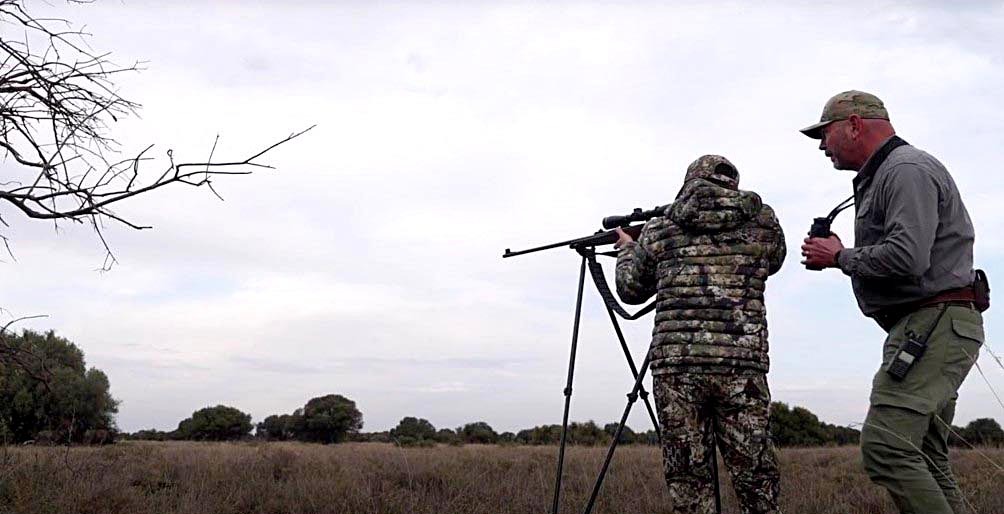
 Wicus Diedericks (right) supervises a buffalo hunt at his ranch in the Northern Cape. (Photo: Rockwood website)
Northern Cape rhino breeder and hunting lodge owner Hendrick “Wicus” Diedericks will have to delay his plan to sell rhino horns to foreign buyers, despite winning two court cases that pave the pathway towards this goal.
Shortly before the Christmas holidays the Northern Cape Division of the High Court in Kimberley issued a surprising legal ruling that appears to threaten a decades-long ban on global rhino horn sales by the Convention on International Trade in Endangered Species of Wild Fauna and Flora (CITES).
CITES is a 1975 international treaty to protect endangered plants and animals from the threats posed by the international wildlife trade.
Diedericks, a self-described “philanthropist” and conservationist, went to court in 2023 to argue that CITES rules allow him to sell his horns because the animals were bred in captivity and therefore no longer wild.
His bid to sell these horns legally echoes the similar, failed ventures of former rhino breeder John Hume.
Diedericks’s case hinges on a legal interpretation of whether article VII (5) of the multilateral convention has been incorporated into South Africa’s domestic conservation laws.
/file/attachments/orphans/wicus4sourceRockwoodwebsite_623890.jpg "Hunting lodge owner Hendrick Diedericks disputes fears that the sale of captive-bred horns will create new mechanisms for criminals to launder horns from the poaching of wild rhinos. (Photo: Rockwood website)")
In simple terms, this 77-word article allows for a simpler certificate process for exports of certain animal and plant products, doing away with more stringent export and import permit requirements designed to control or prohibit any trade in endangered species.
Article VII (5) has been controversial since at least 1994, with several member states voicing concern that it was being abused to circumvent the treaty’s objectives.
In 2023, Diedericks asked provincial government officials for permission to export at least 10 horns from his captive herd of more than 400 white rhinos, held at a 33,000-hectare conservancy in the Northern Cape. When officials refused to do so, the case ended up before Judge Albert Nxumalo, who ruled in Diedericks’s favour.
Thereafter the case went before Judge Lawrence Lever and Northern Cape Judge President Pule Tlaletsi, who also ruled in Diedericks’s favour on 31 October 2025.
Their joint judgment – narrowly focused on the interpretation of legal issues – raised several eyebrows in conservation circles, while Diedericks and Wildlife Ranching South Africa (WRSA) were jubilant.
On his Rockwood wildlife hunting and ranching website, Diedericks hailed the court ruling as a landmark case which had “opened the door for legal and regulated international trade in rhino horn – a decision that could save the species, fund conservation and uplift rural communities across South Africa”.
/file/attachments/orphans/wicus5conservationhuntingwithpurposesourceRockwoodwebsite_768965.jpg "Judges have ruled that the hunting lodge and rhino conservancy in the Northen Cape is ‘not run for commercial purposes’. (Source: Rockwood website)")
WRSA interpreted the ruling to mean that horns from captive-bred rhinos may now be exported under a simpler permit regime, instead of the more stringent CITES import/export permit system that effectively bans the global sale of rhino horns.
“This is a huge win for private rhino breeders and conservationists, because it unlocks potentially millions in revenue that can be reinvested into protection and community development,” WRSA said on 3 November.
But, not so fast.
In response to queries from Daily Maverick, the Department of Forestry, Fisheries and the Environment (DFFE) confirmed on 30 January that it had lodged an application for leave to appeal to the Supreme Court of Appeal in Bloemfontein against the entire Kimberley High Court judgment and court order.
(Significantly perhaps, the application for leave to appeal was dated 11 November 2025, just two days before former environment minister Dion George was sacked at the behest of the DA and replaced by Willie Aucamp, who took office on 17 November.)
/file/attachments/orphans/wicus6entrancetorockwoodprivategamereservesourceRockwoodwebsite_804252.jpg "The entrance to the five-star Rockwood Private Game Reserve. (Photo: Rockwood website)<br>")
While judges Lever and Tlaletsi may refuse to grant leave to appeal, legal scholars consider this to be unlikely given the novel legal issues in question. The department would also be entitled to petition the Supreme Court to hear the appeal.
Questions of law aside, the controversial Kimberley judgment also has significant international legal ramifications, potentially undermining the enforcement of the five-decade-old CITES ban on any commercial rhino horn sales. South Africa is also custodian of the world’s single-largest remaining population of white rhinos.
Daily Maverick sent questions to the CITES Secretariat in Geneva on 4 December, requesting clarity and comment, but no responses have been received.
However, according to the notice of appeal prepared by the State Attorney’s Office, judges Lever and Tlaletsi “erred” in several respects in their ruling and appeared to have ignored some of the fundamental principles of the CITES treaty to ensure strict regulation of any trade in endangered species.
The DFFE’s legal representatives have also taken issue with the judges’ acceptance that Diedericks did not seek to make a commercial profit out of his trade in rhino horns.
In their ruling, the judges say Diedericks’s Rockwood operation is registered as a “wildlife trader: rhino breeding (non-commercial purposes)”.
“Diedericks describes his conservancy as breeding rhino to help ensure the survival of the species and play a part in the prevention of its extinction. This self-description by (Diedericks) is not disputed by the (DFFE Minister and MEC) and is accepted by this court.”
Later, they declare: “The applicant (Diedericks) has run his conservancy for a decade. It is clearly aimed at conservation. It is clearly a captive breeding operation. It cannot be disputed that it is not run for commercial purposes.”
/file/attachments/orphans/wicus3ethicalrhinohuntingSourceRockwoodwebsite_969503.jpg "Hendrick Diedericks (centre) promoting ‘responsible’ rhino hunting. (Image: Rockwood website)<br>")
Yet, according to the DFFE’s appeal application, Diedericks has previously submitted “more than 100 permit applications for the export of rhino horns for commercial purposes to various locations worldwide, mainly in Asia”.
On his website, Diedericks states that prior to establishing the Rockwood Private Game Reserve and five-star luxury hunting lodge in 2013 he was a farmer and businessman.
“Our exclusive, all-inclusive packages are designed for hunters, couples and groups who want world-class trophies, luxury hospitality and the opportunity to contribute directly to rhino protection... The lodge also offers an on-site spa, gym, heated swimming pool and curio boutique.
“We hunt to protect. We don’t breed to hunt. The proceeds from your luxury hunting safari directly safeguards the future of the Southern White Rhino, as it is applied to help cover our vast security, veterinary, baby rhino nursing, and research expenses.”
The website also advertises a “limited” number of rhino hunts per year, along with a variety of other animals such as buffalo, eland, wildebeest, blesbok, springbok, roan and gemsbok.
“Limited targeted rhino hunting on our reserve helps to advance demographic and genetic conservation goals, by addressing the problems of excess males and inbreeding. The additional revenue stream from rhino hunting also helps to fund our reserve’s rhino conservation mission.”
While the rhino hunting fees are not displayed, a seven-night “culling package” for six plains game species costs $41,700 per group of six hunters ($6,950 per hunter).
Diedericks, currently on a business trip in the US, told Daily Maverick his intention was to adhere strictly to the CITES framework.
“The (private) custodians looking after rhino are bleeding. We get no government support... It is getting more costly every year... John Hume had no option but to surrender (when he ran out of money).”
On whether the sale of captive-bred horns would create new mechanisms for criminals to launder horns from the poaching of wild rhinos, Diedericks claims that these concerns are invalid because all horns could be traced back to specific animals via DNA testing.
“This is more than a legal win – it’s a lifeline for rhinos and a bold step toward 21st-century conservation. Let’s celebrate this victory and keep fighting for a future where rhinos thrive and communities prosper!” he stated on the Rockwood website shortly after the Kimberley court decision was announced.
But those celebrations may be short-lived if the Bloemfontein judges reach a different conclusion. DM