




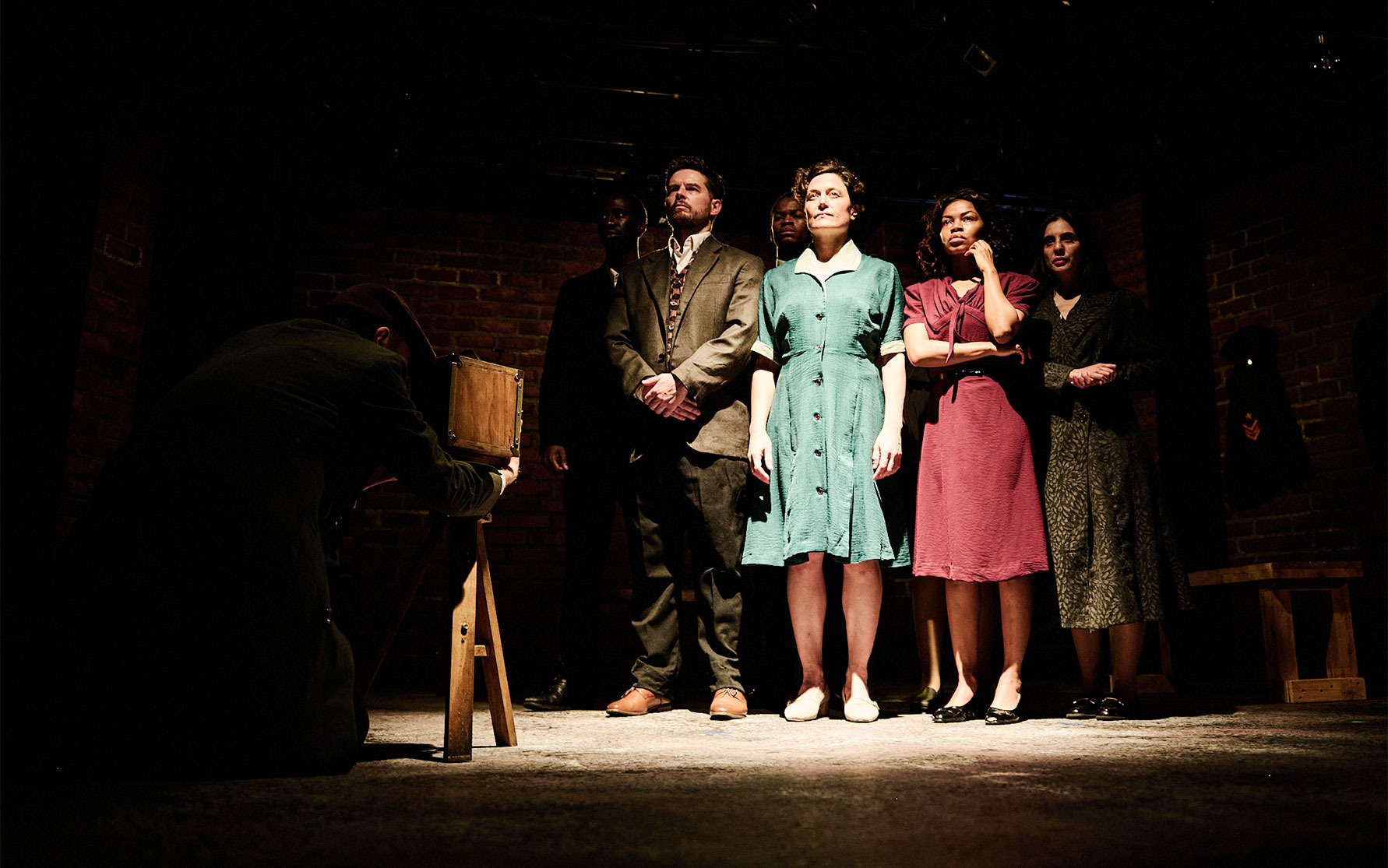
 Themes of noble service, betrayal, humour and horror unfold as the narration moves from contemporary Johannesburg to 1940s Warsaw. (Photo: Thom Pierce)
 Your parents, some discover, do not always tell you the truth. And most often for good reason.
This beautiful new play, Nobody Told Me, now at Theatre on the Square in Sandton, covers gripping material that takes us from contemporary South Africa to Poland and the Warsaw Ghetto in 1940 where 400,000 Jews, confined by the Nazis, struggle to survive while gradually being shipped out to the death camps.
Among them is a young girl, Wanda, longing to remain by the side of her mother, a medical doctor, who chooses to serve her community and, ultimately, face death, while her daughter is spirited away and raised a Christian.
Along the way in this production, we find a young man in Johannesburg, raised Polish Catholic, discovering that his mother is Jewish and that his grandmother was the courageous medical doctor, Halina Rotstein.
The play is written by Luc Albinski, and on opening night, his mother – the real Wanda – is in the front row.
Themes of noble service, betrayal, humour and horror unfold as time-travelling narration moves from contemporary Johannesburg and the elderly Wanda to 1940s Warsaw and her six-year-old self, slowly losing her mother and Jewish faith and adopting, on pain of death, quite literally, a new identity as a Christian.
/file/attachments/orphans/What-makes-Nobody-Told-Me-a-great-play-is-that-it-connects-to-the-audience-in-a-personal-way_Theatre-on-the-Square_587416.jpg "Jade Scheepers as young Wanda in Nobody Told Me. (Photo: Thom Pierce)")
The play opens in prewar Warsaw, following a group of young medical doctors at the start of their careers, confident, ambitious and full of life. Their days are marked by professional pride and optimism, even as political tensions quietly build. The arrival of World War 2 is kept offstage, suggested through the encroachment of German and Soviet forces from opposite sides of Poland.
As violence and persecution unfold, people cling to routine and fragments of normal life, sometimes in denial, sometimes paralysed by fear. Tragedy and suffering exist alongside the ordinary rhythms of daily life, revealing how catastrophe often advances not in a single moment, but through continuation.
Dr Halina and her Jewish colleagues are moved to the ghetto. Others desperately attempt to hide their identity and blend in with Polish society. Neighbours betray neighbours. A Jew-hunting gang of Poles, led by the embittered character, Kacper, ably played by actor Dihan Keun, extorts or turns in Jews for monetary gain, including the people who are his prewar social betters.
/file/attachments/orphans/Tragedy-and-suffering-exist-alongside-the-ordinary-rhythms-of-daily-life_Theatre-on-the-Square_802929.jpg "The cast of Nobody Told Me. (Photo: Thom Pierce)")
When war and disorder descend, the person who kills or betrays you is most likely to be someone you know.
Inside the ghetto, terror takes hold. Dr Halina continues her medical work at Czyste Hospital, caring for the sick and bound by her Hippocratic Oath, even as the walls close in. Jewish police, recruited by the Nazis and forced to meet quotas under threat of having their own families deported or killed, attempt to arrest the young Wanda. She is to be taken to the railway station, from where people are transported to the Treblinka death camp, deep in the forest, about 80km outside Warsaw.
Dr Halina, meanwhile, coaches her daughter on Christian hymns and scripture. Nazi soldiers march up and down in search of Jews, venturing among the audience with threatening effect.
Dr Halina is given a chance to escape. In every direction, the choices are grim: to remain and die in medical service to her community, or to attempt to flee, a path that may also end in failure and death, but death among strangers. Elsewhere, a married couple take poison as the SS moves in to arrest them.
/file/attachments/orphans/Theatre-as-a-form-of-catharsis-can-give-voice-to-the-past-and-create-space-for-reflection-and-healing_Theatre-on-the-Square_727732.jpg "The cast of Nobody Told Me. (Photo: Thom Pierce)")
There is something vivid and moving about this performance.
What makes Nobody Told Me worth watching is not just its conformity to the dramatic principles of good theatre, although this is effective: the narrative plot is clear, characters are authentic and well developed, staging is vivid and visceral. What makes it a great play is that it connects to the audience in a personal way. These dreadful events are real, they happened, and there are people in the room who experienced them.
Throughout its history, South Africa has served as a place of refuge for people fleeing horrific conflict, from Poland to Rwanda, carrying those histories with them. Theatre, as a form of catharsis, can give voice to the past and create space for reflection and healing. In this regard, the play has served its purpose. Dark chapters in human history reveal human character, noble courage and deep depravity passes as the Devil comes to Earth to mock God.
Perhaps most compelling about this play is that its author, Albinski, with little previous experience as a playwright, and a successful professional career elsewhere, is seemingly operating out of sense of duty in writing and producing it, to ensure that memory is not lost, that homage is paid to his courageous grandmother, Dr Halina, that justice is achieved through honouring memory. DM
Nobody Told Me is written by Luc Albinski, staged by Bulgarian director Ilina Perianova and performed by an all-South African cast. Although the current run until 7 February at Theatre on the Square is sold out online, the play will be running in Cape Town from 17 August with plans to return to Johannesburg in early 2027.