



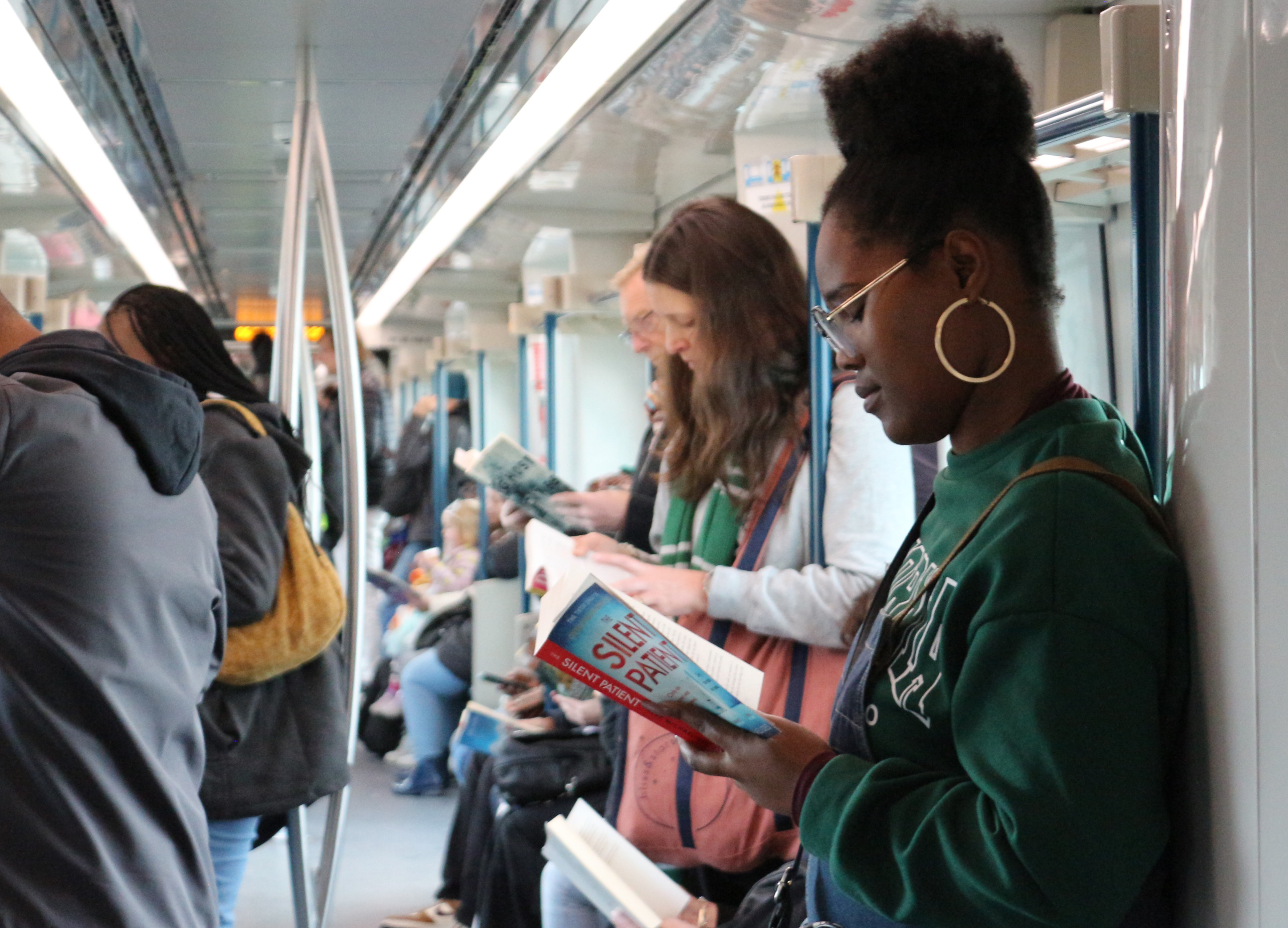
 Over 200 participants in the Cape Town Silent Book Club meet on the Southern Line train between Muizenberg Station and the Cape Town CBD on 5 July 2025. (Photo: Tamsin Metelerkamp)
Book clubs are about far more than books. Yes, there are books at their core. The smell of paper. The small thrill of holding a new book in your hands. The weight of your chosen pile in your bag at the end of the night, and the quiet pleasure of waking up to it the next morning (I would put my pile right next to my bed so that it would be the first thing I’d see when I woke up).
But the real structure of a book club is built from softer, less tangible materials. Threads of conversation, ritual, memory. Things you cannot hold in your hands but feel immediately when you enter the room. At their best, book clubs speak directly to some of our most private longings: to belong somewhere, to be recognised, to have our lives witnessed.
I belonged to a book club for 10 years. It was immovable in my diary, a fixed point around which the rest of my month quietly arranged itself. We rotated hosting duties, which meant cooking a proper meal and selecting the books for the gathering. Some of my happiest memories are of the workday easing to an end, the city falling away behind me, and the anticipation of that evening ahead.
I remember walking into houses already thick with the smell of garlic, coriander, slow-cooked sauces. Comfort made aromatic. Food always tastes better when you’re sitting around a table with people you’ve come to love.
You might expect a book club to begin with books. Ours never did. We talked first, and for a long time. We caught up on one another’s lives, lingered over stories, worried things over together. The table rang with laughter. Those women were there through the deaths of my parents, through my divorce, through the full sweep of ordinary joy and grief that makes up a life.
A social act
We gathered in the evenings when the sun still shone on our faces and watched it slip away. We gathered in the heart of winter, when the rain pelted down and we had to unpeel layers: coats, scarves, gloves. At the time, I assumed those evenings were endless, that the shape of that belonging was permanent.
It was only after one of our founding members took her own life that I understood that the architecture of what we had could not survive that loss, not in the context of a book club. I still believe in the kind of community a book club promises. But I know now that what we had cannot simply be rebuilt. Some forms of belonging, once broken, do not return in quite the same way.
Books, whether fiction or non-fiction, are never static. They move ideas, experiences and ways of making sense of the world. They travel between hands and homes, across different moments in a life. In a book club, that movement becomes visible. A single book gathers multiple readings.
Reading is often imagined as a solitary act, but book clubs reveal how social it really is. Meaning is not made alone. It is shaped in conversation, disagreement, laughter and the careful telling of personal truths around a table. Stories stretch beyond the page and into lived experience, changing how we understand ourselves and one another.
What mattered just as much as the books was the space we gathered in. Living rooms, dining tables, kitchens pulled into temporary service as places of thought and confession. These were ordinary domestic spaces, but something happened to them when we assembled. They softened. They opened. They became containers for far more than reading. Physical space turned into a conduit for connection, for community, for an expanded sense of home. In those rooms, we were allowed to take up space ourselves.
My memories of that time are rich with conversations about the books we read. We argued over A Little Life, lingered uncomfortably with its pain, questioned our own limits as readers. We dissected the clever cruelty of Gone Girl, delighting in its sharp turns. We held When God Was a Rabbit more gently, letting it unfold alongside our own stories.
A particular alchemy
But woven just as tightly into my memory are the conversations that had nothing to do with plot or character. We talked about relationships ending, bodies changing, jobs lost, depressions named aloud for the first time. The book club table held all of it without judgement.
And then there was the space for silliness, the kind of speculative nonsense that only feels safe among people you trust. Long, ridiculous debates about hypothetical crimes that would never be committed. At one point we became convinced that the perfect murder involved a Pick n Pay plastic bag filled with frozen ice, deployed with great confidence and very little forensic understanding, the weapon obligingly disappearing as the ice melted. We argued the merits of it at length, fuelled by wine, bad logic and the certainty that we were far cleverer than we were.
Book club happened once a month, but it spilled beyond the evening itself, lingering in the days that followed. The laughter from those conversations loosened something in us. Those moments mattered. They were proof of ease. Of safety. Of a shared understanding that not everything had to be profound to be meaningful. In that space, we were not just readers. We were witnesses to one another’s lives.
I hold two truths simultaneously. I know, intimately, what that book club gave me: a sense of steadiness, a place to land, a group of women who knew the texture of my life and stayed. And I know what I lost when it ended, how that particular alchemy cannot be recreated on demand. Some communities are of their moment. Once broken, they cannot be reassembled in quite the same way, no matter how much you long for them.
But that does not mean the impulse disappears. The need for shared space, for reading together, for making meaning in company, remains. It simply finds new forms. Public book clubs offer a different kind of possibility. They are less intimate at first, less enclosed, but no less vital. They allow for arrival without history, for participation without obligation.
In Cape Town, the Mother City Book Club opens its doors for new membership once a quarter. The Silent Book Club, with chapters in Johannesburg and Cape Town, offers something quieter but no less communal: the simple act of reading side by side, together but unpressured. In Durban, the Silent Book Club Durban North hosts book swaps and silent reading events, open to anyone who loves books and the company of others who do too.
These spaces remind us that books still move. They move us towards one another, into rooms and spaces where we can sit, read, talk, laugh and sometimes say the unsayable. Physical space still matters. Gathering still matters. Even when it looks different. Even when it begins again, imperfectly, with strangers. DM
Joy Watson is Daily Maverick’s Book Editor at Large.