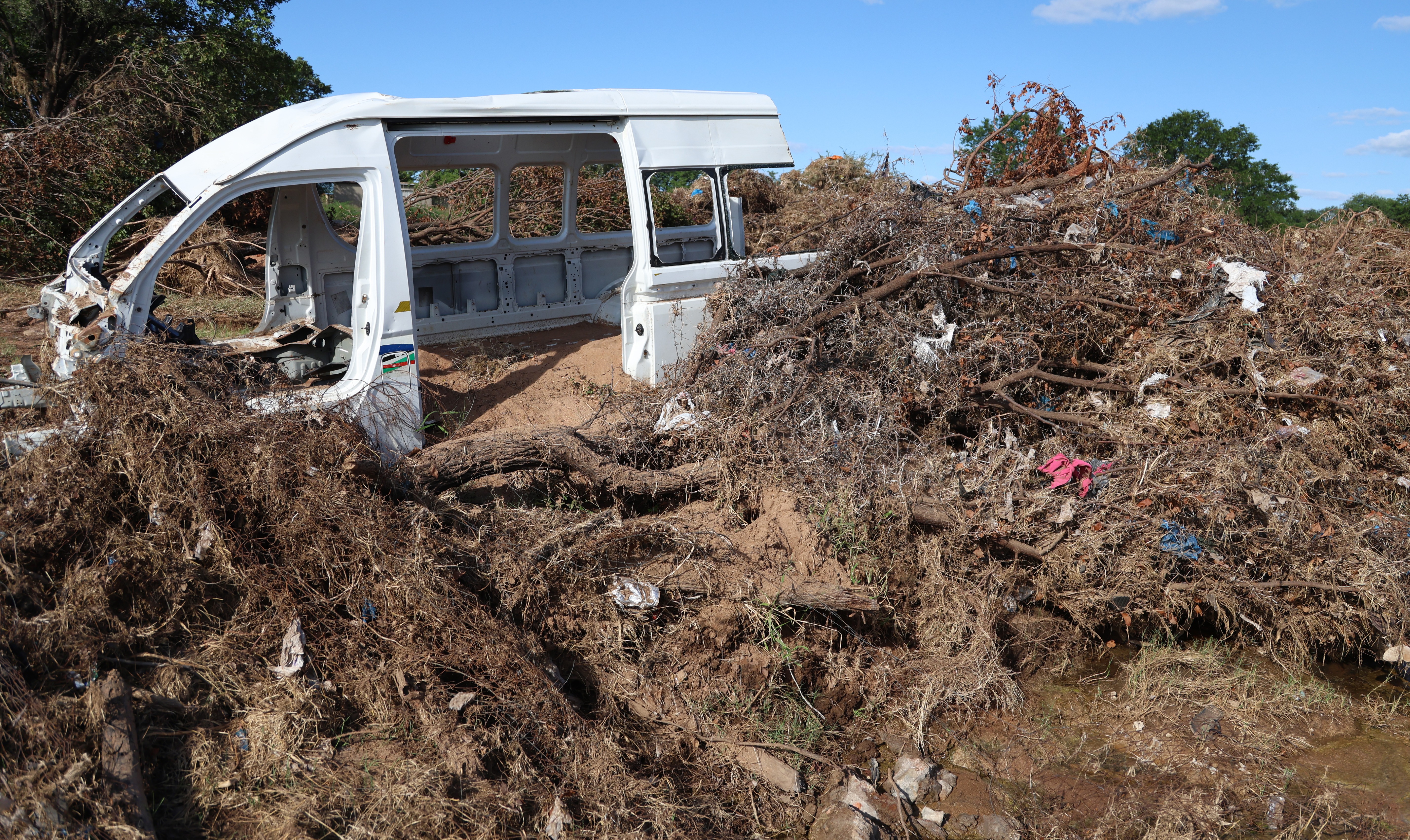
 The remnants of a taxi lie in an open veld, a reminder of the flooding that swept through the Giyani area in Limpopo in mid-January. (Photo: Felix Dlangamandla)
 When you walk the path of devastation left behind by the floodwaters that tore through Mbaula Village in Limpopo, you see the scene in snapshots. A pair of baby shoes caked in mud; clothing tangled in treetops and telephone wires; stone foundations and rubble where homes once stood; a single wire bed frame sunken into sun-baked clay.
A local community leader, Sipho Dzambukeri, points out a black hose snaking through the debris. They used it as a lifeline to pull people to safety, he explains.
Our path takes us from the site where Olga Shivambu’s home once stood to the point where she was rescued – the river of water dragged her for more than one kilometre, battering her against tree trunks, before she was able to climb up a fallen bough and reach the branches, where she waited eight hours for extraction by helicopter.
Her four-year-old son, Siyanda Baloyi, was torn from her back in the water. He still hasn’t been found.
/file/attachments/orphans/6I1A2898_102775.jpg "Sipho Dzambukeri of Mbaula Village in Limpopo, recounts how a woman had to hold on to a tree to survive the floods. (Photo: Felix Dlangamandla)")
For this community, the calamity was completely unexpected. The last floods they remember were in the early 2000s, and they were nowhere near as destructive. Not even the chief of the village, Kotlani Elvis Mabunda, was safe – he spent several hours on the roof of his home with his family, surrounded by water, waiting to be rescued.
Of the 128 households affected, 57 homes were flattened completely, says Dzambukeri. About 445 people have been left without a home, 101 of them children.
Some are renting temporary accommodation or staying with fellow community members, while 117 are sheltering in the local Pentecostal Protestant Church.
“Day by day, they are recovering, though it won’t be easy,” Dzambukeri says.
“On [15 January], it was very bad. You were not going to speak with any one of them. Everyone was crying. We were swimming in the water to go and rescue them. […] Even if you reached the level of water [at ankle height], they said, ‘No, take me out’.”
/file/attachments/orphans/WFD_1757_217187.jpg "The flooding destroyed 57 houses in Mbaula Village, leaving more than 400 people without homes. (Photo: Felix Dlangamandla)")
/file/attachments/orphans/6I1A3117_773411.jpg "A church is temporarily housing displaced residents after heavy rains in Mbaula Village, Limpopo. (Photo: Felix Dlangamandla)")
A mother’s nightmare
Daily Maverick visited Shivambu at her in-laws’ home, where she has been staying with her husband since the floods washed their home away. Sitting under a tree in the yard, the physical scars she sustained when the floodwater swept her away were visible on her arms and legs.
Perhaps equally as evident were the emotional and psychological scars reflected in her body language, her voice shaking as she recounted what she experienced in the early hours of Thursday, 15 January, when the flooding began.
“When the floods hit, I was asleep. I just got shocked to see water inside the house,” Shivambu said.
The young mother, who was sleeping in the room with four-year-old Siyanda, said she immediately contacted her husband, desperately asking him for help. “[I told] him that we are dying with water and he must be fast because the house is full of rain, but the water was coming in so fast that I stood on top of a bed,”, she said.
Shivambu recounted that as she climbed onto the bed, it began to float. The water had rushed into her home with such force that it shattered her bedroom windows, and it didn’t take long for the river to push both mother and child out the window into the growing swells outside. That was the last time Shivambu saw her son.
/file/attachments/orphans/6I1A2961_382944.jpg "Olga Shivambu grieves the loss of her child amid the devastation caused by recent floods in Mbaula Village, Limpopo. (Photo: Felix Dlangamandla)")
“[As the water was carrying me away] I was pushed into a tree, which I managed to hold onto, but then that got flooded. I jumped into the water and hit another tree, which I also held onto, which also got flooded while I was holding on. I got swept to a third tree, which I climbed, but even that one got flooded. The fourth one is where I managed to hold on tightly. I used all my power to hold that last tree,” Shivambu said.
This is where Shivambu waited, from about 3am until 11am on Thursday, until a helicopter was finally able to reach her.
Dzambukeri said by the time community members found Shivambu clinging to the tree at around 6am, her voice was so hoarse from screaming for help that they initially thought she was a man.
“I saw my body was full of blood because the trees scratched my body. I cried and was calling everyone to help me and said, ‘Yoo, my child, my child, help me’,” she said.
The floodwaters have now receded. The Mbaula River, which encircles part of the community, lies quiet and unassuming.
/file/attachments/orphans/6I1A2847_569090.jpg "In the quiet aftermath, scattered debris and damaged structures are a reminder of the flooding horror in Mbaula Village on 15 January. (Photo: Felix Dlangamandla)")
Rescue efforts
Twenty days have passed since Siyanda was washed away. Shivambu’s mother-in-law, Sakina Maluleke, said that in the days following the flood, the family had received support from the community and from the South African Police Service (SAPS) to search for the child. Despite these efforts, the four-year-old is still missing.
Sakina said the family did not know where the child might have ended up or where else they could continue searching, but they understood that both the community and search teams had tried their best.
“The police are still searching. Even the community, we are organising every day. There is a team that goes out to have a look, but nothing yet,” Dzambukeri said.
“We hope and believe that one day he will be found.”
/file/attachments/orphans/6I1A3124_447475.jpg "A church is serving as a temporary home for displaced residents after heavy rains in Mbaula Village, Limpopo. (Photo: Felix Dlangamandla)")
Saseleni Rikhotso, whose home stood metres from Shivambu’s and was partially washed away by the flood, said the community had not anticipated the severity of the rainfall. When it began, residents assumed it was part of the usual rainy season, but conditions rapidly deteriorated.
In Rikhotso’s case, the water reached her chest as she fought her way to safety. Having lived in her home for only a year before it was destroyed, she said the loss has been deeply painful.
“I’m grateful for the help we’ve received; clothes, sponges, and other essentials, but it’s not enough,” she said. “We didn’t know we were living in a flood-prone area. This is a disaster, and we need help.”
The floods swept away almost all the villagers’ personal belongings, including clothing, identity documents and certificates. Rikhotso said many residents have been left with only the clothes they were wearing when they fled, supplemented by donated items.
/file/attachments/orphans/6I1A2837_457399.jpg "Saseleni Rikhotso says the floods in Mbaula Village swept away almost all the villagers’ personal belongings. (Photo: Felix Dlangamandla)")
A time for hope
The destruction in Mbaula Village is mirrored in other communities across Limpopo and Mpumalanga. With 40 people dead, some still missing and thousands of homes destroyed, the loss has been immense. But in the face of this loss, a story of solidarity and resilience has also emerged.
Each day, volunteers from Mbaula Village are working from the early hours of the morning until late in the evening to distribute aid coming in for the affected families. Organisations such as Gift of the Givers, local funeral homes and churches have been providing assistance in the form of food, clothing and other essentials.
Dzambukeri said they are now focusing on sourcing items such as pots, cutlery, crockery and water drums for those who have lost everything.
/file/attachments/orphans/6I1A2830_809685.jpg "Displaced residents gather under a tree with their food parcels at a relief centre after heavy rains destroyed their homes in Mbaula Village, Limpopo. (Photo: Felix Dlangamandla)")
The Housing Development Agency, together with the Department of Human Settlements, has been on the ground in the village to assess identified land for the erection of temporary residential units (TRUs) for affected households.
Community leaders have also picked out three possible sites for the erection of permanent homes in the coming months, though Dzambukeri said it was not yet clear when construction would begin.
Daily Maverick asked the Department of Human Settlements for comment, but had not received a response by the time of publication.
Dzambukeri noted that the Department of Social Development had provided counselling for the men, women and children who were caught in the floods, with plans to return for one-on-one sessions. Local churches have been providing spiritual counselling.
After identifying those who have lost documentation, the Department of Home Affairs in Limpopo has found 70 children who need birth certificates and 63 individuals who have lost IDs, according to Thulani Mavuso, spokesperson and deputy director-general for operations in the department.
“The department deployed three mobile units to the area on 29 and 30 January to assist affected families. Through this intervention, 59 birth certificates were reprinted and issued on the spot to clients, [while] 46 applications for Smart ID reissue were taken and are currently being processed,” Mavuso said.
Services were extended to those who were not affected by the floods, he added.
Since the disaster, Gift of the Givers has been providing aid in communities across Limpopo and Mpumalanga, including Mbaula Village, Makhuva, Phalaborwa, Giyani, the Vhembe district and the Blouberg municipality.
The organisation has distributed more than 4,000 food parcels, as well as items such as blankets, water, bread, clothes and baby diapers.
Challenges to the relief efforts have included impassable roads and bridges, and remote locations with limited access.
“We continue to face extreme heat. Our team remains committed to delivering aid throughout February,” the organisation said.
/file/attachments/orphans/6I1A2971_339645.jpg "Community leaders in the Collins Chabane Local Municipality address community members during an event to distribute food. (Photo: Felix Dlangamandla)")
Aid efforts in Phaphazela
Daily Maverick’s visit to another village affected by the floods, Phaphazela, revealed similar community support for affected families. The mayor of the Collins Chabane Local Municipality, Shadrack Gezani Maluleke, was on site for the distribution of aid parcels to local residents.
Maluleke told Daily Maverick that the municipality encompassed 198 communities, all of which were affected by the floods.
“Our road infrastructure has been damaged. Bridges washed away. The most unfortunate part is that our rural communities suffered losses. Warehouses have collapsed, and also, in some other instances, there are people who have lost their lives due to these heavy rains,” he said.
The municipality communicates warnings issued by the South African Weather Service through platforms such as social media and local radio stations, Maluleke said.
/file/attachments/orphans/6I1A3018_575546.jpg "Shadrack Maluleke, mayor of the Collins Chabane Local Municipality in Limpopo. (Photo: Felix Dlangamandla<br>")
“Obviously, we need to do things differently from now going forward, in that we need to strengthen our disaster departments in our local municipalities, as well as in the district, to ensure that the things are handled much better compared to this time around,” he said.
He expressed the municipality’s gratitude to the organisations and individuals who had provided aid in the wake of the floods.
“We feel very grateful that there are people out there who still care about those who are affected by disasters like this. Who […] come to the rescue of our people. There are good Samaritans out there. We are in a safe country if we still have good Samaritans,” he said.
/file/attachments/orphans/6I1A3033_837894.jpg "Business forum representative Karabo Laka for the Collins Chabane Local Municipality mayor addresses community members during a food distribution event. (Photo: Felix Dlangamandla")
Karabo Laka, the chairperson of the Greater Giyani Business Chapter, said that, in a show of solidarity that she did not anticipate, at least 91 villages located in the Limpopo town came together to collect and donate food parcels, blankets and clothes.
The organisation has been delivering donations in several villages, including Mbaula Village, Phaphazela, Makhuvha, Xikhumba, Siyandhani and Muyexe.
Laka said that in the weeks following the floods, days have started early with volunteers gathering to pack donations for those affected by the floods. Most days, the work goes on well into the night.
She added that the level of galvanisation within communities in Giyani took her by surprise, saying that when the call for assistance went out in the early days following the flood, the organisation only received two donations.
“But we knew something had to be done. We were not quiet, we kept on talking and on the second day until today, people are still donating, they are still coming. I have never seen such Ubuntu in such a short space of time.” DM
Those wishing to donate to the organisations supporting victims of the flood can do so, through:
- Gift of the Givers;
- The Giyani Business Chamber, contactable on info@greatergiyanibusinesschamber.co.za;
- Humana People to People in South Africa;
- Jamiatul Ulama South Africa; and
- Ashraful Aid, or use the organisation’s banking details below:
First National Bank (FNB)
Zakat Acc: 628 176 903 41
Lillah: 628 176 787 77
Reference: Your Name – Mobile Number – Zakat/Lillah/Sadaqat
Branch Code: 250655
Email: finance@ashrafulaid.org