




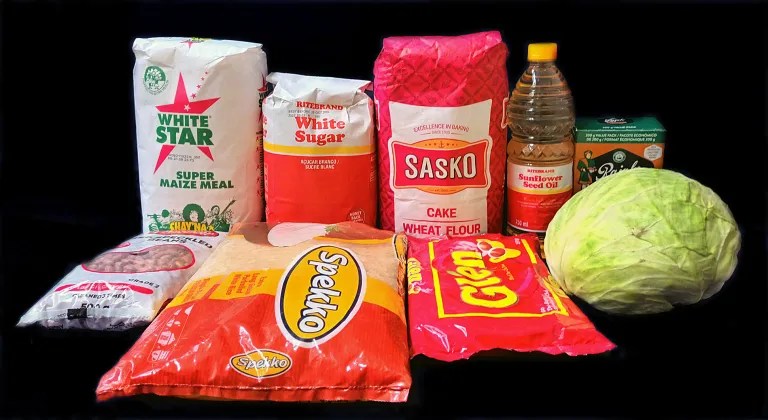
 Daily Maverick has been tracking the prices of 14 basic food items a person can buy with the R370 Social Relief of Distress grant. (Photo: Naledi Sikhakhane)
 There is a growing gap between what low-income families can afford and what they need for proper nutrition.
Maverick Citizen has been tracking the prices of 14 basic food items that a person can buy using the R370 Social Relief of Distress (SRD) grant. The food basket hovers above R400, making it unaffordable for those who rely on the grant as their only source of income.
The cost of our basket – owing to price increases for products such as flour, rice and bread – now sits at R412.
/file/attachments/orphans/Food-prices-Dec-Jan-2026_343860.jpg "(Graphic: Rudi Louw)")
The Pietermaritzburg Economic Justice and Dignity’s Household Affordability Index tells a similar story – their basket of 44 items jumped by R67,99 from December 2025 to January 2026 from R5,333.45 in December 2025 to R5,401.44.
“In January 2026 the difference in cost between the foods which families living on low incomes try to buy each month (the household food basket) and the foods which families would like to buy and should buy to meet basic nutrition (a basic nutritional food basket) was R1,100.66 (R5,401.44 vs R6,502.10). It means that in January 2026, families living on low incomes may underspend on basic nutritional food by a minimum of 17% (R1,100.66),” the index reads.
“Households living on low incomes change their purchasing patterns in response to changes in affordability conditions. On low incomes, women buy the core staple foods first so that their families do not go hungry and basic meals can be prepared. Where the money remaining is short, women have no choice but to drop foods from their trolleys or reduce the volumes of nutritionally rich foods in their trolleys.
“This has negative consequences for health, wellbeing and nutrition. As financial and economic circumstances worsen, so too does household health and nutrition. The gap between what women can buy and what they need to buy for proper nutrition widens. The Basic Nutritional Food Basket is an attempt to track the cost of foods required for balanced nutrition, viz. the foods and the cost of these foods for families to ensure their health and nutrition and for children to grow and develop properly.”
This pressure on low-income households is reflected in the broader economic data, particularly the latest Food Inflation Brief by the Bureau for Food and Agricultural Policy (BFAP), which offers a near-term outlook on food prices. The latest brief forecasts that consumers may experience some price relief as grain, oilseed and fuel prices continue to ease, but meat prices are likely to remain high in the near term because of ongoing biosecurity risks.
“Many regions remain affected by movement restriction and recent detections of foot-and-mouth disease at a commercial piggery in the Free State, new ASF cases in Gauteng (December 2025), and RVF outbreaks in sheep (November 2025) underscore the persistent disease pressures that will continue shaping supply conditions and livestock price formation,” the brief reads.
/file/attachments/orphans/Chart_03-768x4111_207091.jpg "(Source: StatsSA Consumer Price Index)")
Despite the concerns over ASF and avian influenza the brief says these diseases were less prevalent in 2025 compared with recent years. It claims that this brought some relief for the poultry and pork industries, although the threat remains and continued vigilance is required.
Read more: SA consumer inflation averages 3.2% in 2025, well inside Sarb’s new target range
“In the fresh produce market, vegetable prices are expected to recover gradually as supply levels decline seasonally. However, domestic volumes may increase slightly following Botswana’s reinstatement of its import ban (December 2025), which is likely to redirect additional produce into South Africa’s market. Meanwhile, the high rainfall received across summer rainfall production regions is expected to influence the supply, quality and price patterns of both fruits and vegetables over the coming months, potentially resulting in short‑term variability in market availability and price movements,” the brief reads.
The annual rate for food and non-alcoholic beverages was stable at 4.4% in December.
The Statistics SA Consumer Price Index echoes the trends in meat inflation continuing its upward trajectory, rising to 12.6% in December from 12.2% in November.
“Beef inflation remains at high levels. Beef steak, for example, recorded an annual price change of 28.4% in November, and rose to 29.4% in December. Other notable red meat products that registered higher rates include sausages (from 18.5% in November to 19.4% in December), boerewors (17.2% to 18.2%), mutton (13.7% to 15.0%) and pork (9.4% to 11.5%).”
Read more: Cost-of-braaing crisis: You will fork out more for meat this festive season
/file/attachments/orphans/Chart_02-768x518_227924.jpg "(Source: Stats SA Consumer Price Index)")
Inflation for cereal products rose, along with several key items experiencing faster price increases, including brown bread, white bread and spaghetti.
The milk, other dairy products and eggs category continues to decline, led by cheaper milk products. The annual rate for fresh full-cream milk, for example, declined to -1.5% from -1.2% in November.
Poverty line
The increase in food prices has been factored into the latest adjustments to the national poverty lines.
Stats SA released them in late January, explaining that these were constructed using the Cost of Basic Needs approach which links welfare to the consumption of goods and services including spending patterns on both food and non-food items.
- Food poverty line – R855 (in May 2025 prices) per person per month. This refers to the amount an individual will need to afford the minimum required daily energy intake. This is commonly referred to as the “extreme” poverty line;
- Lower-bound poverty line – R1,415 (in May 2025 prices) per person per month. This refers to the food poverty line plus the average amount derived from non-food items of households whose total expenditure is equal (or near) to the food poverty line. It marks the threshold for those who can afford essential food items but not all non-food items ; and
- Upper-bound poverty line – R2,846 (in May 2025 prices) per person per month. This refers to the food poverty line plus the average amount derived from non-food items of households whose food expenditure is equal (or near) to the food poverty line.
The report states that while food is undeniably a fundamental necessity, finding a consumption threshold is important to try to measure whether an individual is experiencing food deprivation.
“A baseline of 2,100 kilocalories (kcal) per day to meet the energy requirements of an average adult engaged in light physical activity was adopted. This threshold of 2,100kcal mirrors the standard used. To determine the food poverty line, the cost of acquiring 2,100kcal per person per day was estimated utilising the reference food basket,” it reads.
Although food inflation has stayed between 3% to 5% in the past two years, a number of factors seem to keep food prices high. This has left millions of South Africans who live on grants leaving food items at the till and not reaching basic nutritional needs. DM