



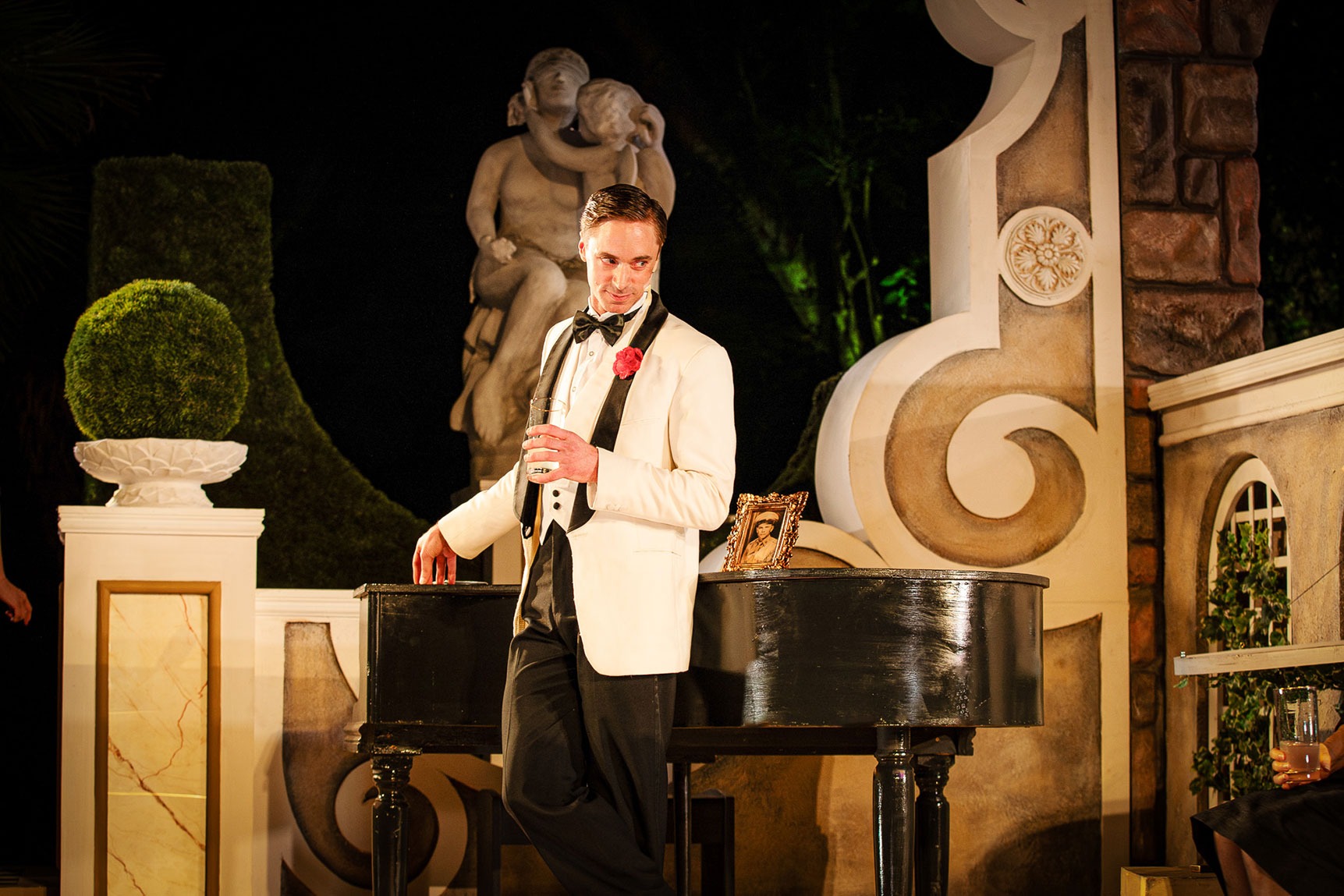
 David Viviers (Feste) at the piano in Twelfth Night. (Photo: Claude Bernardo / Maynardville)
 In 2020, Bad Bunny, the Puerto Rican rapper and singer who over the weekend took the Grammy for Best Album, said in an interview that, “at the moment I am heterosexual and I like women”, adding that his sexuality “does not define me”.
“At the end of the day, I don’t know if in 20 years I will like a man,” he said. “One never knows in life.”
Such very contemporary ideas about sexual fluidity are, of course, not new, nor are they necessarily born out of some sort of woke cultural moment. They are in fact at the heart of Shakespeare’s hysteria-inducing comedy, Twelfth Night, which has just opened in a fresh, side-splittingly funny iteration at Maynardville in Cape Town.
What had changed during the 425-year gap between Shakespeare’s penning of the play and cultural icons like Bad Bunny being free to express such ideas is that, in 1601, no international superstar – not even London’s most popular playwright – would have dared speak openly about anything akin to sexual fluidity.
Shakespeare was compelled to embed such ideas within an elaborate and convoluted plot involving twins and lost brothers and men falling in love with women disguised as men and vice versa. In the process he produced drama that enabled audiences to not only witness but experience an idea that to this day feels revolutionary: that we humans fall in love with people, rather than with people of a specific gender.
The play in many ways suggests that society’s assumptions about gender, class, wealth and status are imposed by convention – that they are ideological restraints more than anything.
/file/attachments/orphans/William-Young-Sebastian-in-Tweflth-Night_Claude-Barnardo_Maynardville_627665.jpg "William Young (Sebastian) in Twelfth Night. (Photo: Claude Bernardo / Maynardville)")
Although Twelfth Night is likely to have had its origins in existing works (there’s both a 1531 Italian play, Gl’ Ingannati/The Deceived Ones and a 1581 story by Barnabe Riche about Apolonius and Silla that are possible influences), the play is also a conjuring into dramatic action of the theme of the Catholic calendar’s one night of the year which was dedicated to “legal disorder”. Known as “Twelfth Night”, this was a day of revelry when servants could dress as their masters, women dress as men, and so on.
The play certainly delivers its fair share of characters acting out against the prevailing social order. And Shakespeare certainly milked the possibilities within the ensuing chaos and disorder to examine some rather poignant ideas about human nature.
Director Steven Stead has managed with this production to create what feels like a love letter to Shakespeare – it is not only enormously funny and almost quixotically clever, but has tremendous soul, with great affection for the aliveness that the Bard brings to the English language and the possibilities of theatrical dramatisation. It is a crisp staging, knows how it wants to make the audience feel, and certainly takes no prisoners in the handling of its humour.
The trick, if you can call it that, is to have assembled a genuinely exceptional cast, their performances a treat, whether they’re playing at being sassy, side-splitting or simply fall-down drunk.
You know it’s going to a be a rock ’n’ roll comedy the moment you first set eyes upon Jock Kleynhans, posing like some sort of self-adoring Disney prince, full of swagger and poetry and sporting a barrelling chest he can’t help but show off to the whole world, all the while having barely a lightbulb between his ears.
He makes magnificent use of his bouncy, flouncy, flowing head of hair, preening and waving the locks out of the way as though he is always about to do something important, but quite frankly does very little besides fawn over a woman who doesn’t love him and, since love is such a fickle thing, is in fact more than half-heartedly in love with his manservant – who is, of course, a woman. Not that he knows that – Bad Bunny would be proud.
/file/attachments/orphans/David-Viviers-Feste-Jock-Kleynhans-Orsino-and-Emily-Child-Cesario-in-Twelfth-Night_Claude-Barnardo_Maynardville_525988.jpg "David Viviers (Feste), Jock Kleynhans (Orsino) and Emily Child (Cesario) in Twelfth Night. (Photo: Claude Bernardo / Maynardville)")
And there is David Viviers as Feste, the fool, transformed in this Fellini-inspired production from a jester-in-tights into a Noël Coward-like scallywag, the sharp wit and witticisms and back-to-front logic simply barrelling out of him.
Unlike the fool currently occupying the White House, Shakespeare had the good sense to use the fools in his plays to not only show us a good time, but also to share meaningful lessons-in-life with us. Feste’s role, aside from being witness to the convoluted foibles of the people around him, includes delivering regular reminders of life’s topsy-turvy nature and embodying the notion that hilarity and heartache frequently co-habit.
And, between observing what’s unfolding around him and dropping bits of inside-out philosophy, this Feste has songs to sing, too, moments of collaboration between Shakespeare, the lyricist, and Wessel Odendaal, the Cape Town composer.
These jazzy refrains are not only a chance for Feste to ruminate over the nature of love, but help to momentarily bring a sobering atmosphere to a play that is buoyed by insanely funny performances, a good dose of slapstick and plenty of suspended disbelief.
On the night I saw it, the purity of the comedy absolutely held the audience transfixed. Perhaps it’s a response to the moment, the great sadnesses that seem to have been dredged up over the past year finding their antidote in a representation of humanity’s opposite: our ability to smile and laugh and make light where tremendous darkness exists.
For it is a mirth-filled production built on the foundations of great pain. Olivia is in mourning for her lost brother, while the twins, Viola and Sebastian, both believe the other has drowned in a shipwreck. Feste, meanwhile, harbours some terrible secret loss that’s entirely unspoken, but is felt throughout the play, permeating from deep within.
Such sadness is not what you’d imagine as the starting point for one of the greatest comedies ever written, and yet there are still other unhappy souls, too, each of them with some sort of yearning in their hearts.
/file/attachments/orphans/Graham-Hopkins-Malvolio-in-Twelfth-Night_Claude-Barnardo_Maynardville_488427.jpg "Graham Hopkins (Malvolio) in Twelfth Night. (Photo: Claude Bernardo / Maynardville)")
Played by the formidable Graham Hopkins, there’s the foolishly lovestruck (and evidently very horny) Malvolio, household servant to Olivia, who has it in his head that his mistress desires him – and might enjoy having him chase her around the house in his boxers and a pair of cross-gartered yellow socks. His misgivings, however, land him not in Olivia’s bed, but in prison – fairly light punishment for opening his robe and thrusting his groin in the boss’s face.
Also a bit lost are the pair of rollicking drinking buddies – the drowning-in-booze Sir Toby Belch (a magnificent Michael Richard, who plays him so alcohol-addled you can almost hear the drink sloshing around in him as he pads across the stage) and his vaguely demented companion Sir Andrew Aguecheek (Aidan Scott, seemingly recently escaped from an lunatic asylum) – whose persistent screwball drunkenness is hugely hilarious, but also kind of sad.
And there’s Count Orsino, played here by the aforementioned Jock Kleynhans, who is not only drop-dead handsome, but has wealth, influence, ridiculous self-confidence and, naturally, that full head of hair. And yet, he cannot seem to get that thing he desires most: Olivia.
Olivia, of course, is too deep in mourning for the loss of her brother to even imagine accepting Orsino’s missives of love.
But, then again, she’s also terribly fickle.
Jenny Stead, who plays Olivia, soon reveals herself as a bit of an emotional roller coaster, one moment burdened by grief, and then – in real-time – does a kind of lovestruck-teenager backflip when she sets eyes upon Orsino’s manservant, who is in fact Viola, thinly disguised as a man. What ensues is an alarmingly funny portrayal of unbridled desire, a huntress with her prey firmly in her sights. Growl!
/file/attachments/orphans/Emily-Child-Viola-in-Twelfth-Night_Claude-Barnardo_Maynardville_330935.jpg "Emily Child (Viola) in Twelfth Night. (Photo: Claude Bernardo / Maynardville)")
Ever-gracious Emily Child’s gender-swapped Viola, meanwhile, so grim and downhearted from losing her beloved twin to a shipwreck, manages to find herself – as a man – falling under the spell of Orsino’s puppy-dog affections. A heated true bromance ensues, and manages to spill over into something else.
These muddles of mixed emotion, observations about the fickleness of desire and love, and the obvious part played by lust in mediating both, are the stuff that Shakespeare transforms so magically into drama – and comedy. The play is in many ways a big fat middle finger to the entire institution of courtly romance. Observe how the twisted strands of fate and dramatic plotting finally bring the various couples together by the end of the play and you realise that the author was the whole time scheming to demonstrate the instability – and ridiculousness – of romantic attraction. Never mind the perceived noble cause of “true love”.
No matter how confusing and chaotic the plot may seem, Shakespeare knew how to tie it all together so that it ends up being far more than the sum of its parts. While it has all the trappings of a typical rom-com, it also unapologetically makes a bit of a mockery of the grand gestures and rituals that tend to accompany romance. In so doing it flips love on its head, sneakily examines its underbelly and reminds us that good comedy is often a container for tragedy, a way of processing all kinds of pain. DM
Twelfth Night is playing at the Maynardville Open-Air Festival in Cape Town until 7 March. Read about the behind-the-scenes of Twelfth Night here.