




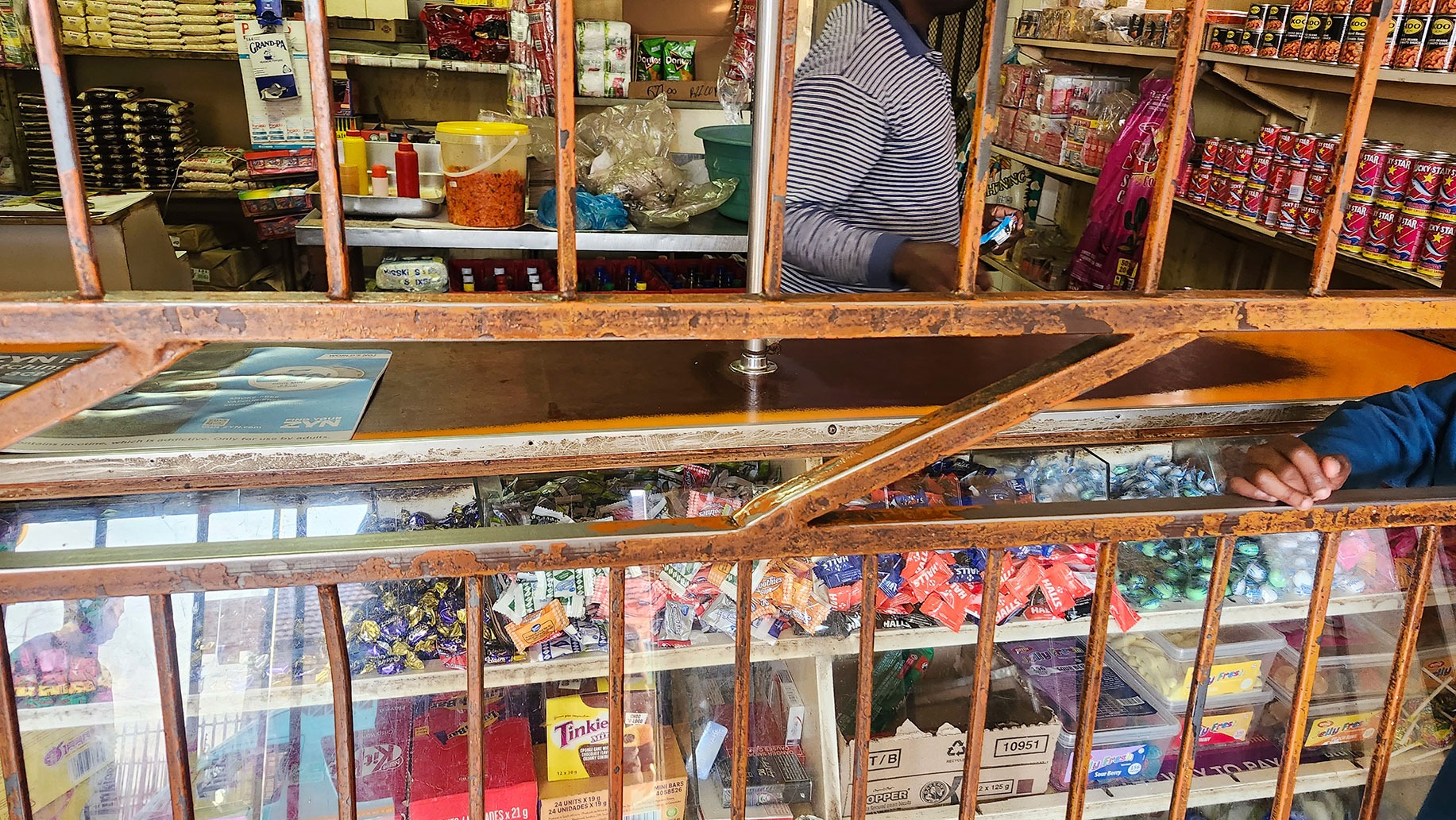
 A young girl waits for her order inside a spaza shop in Naledi, Soweto. (Photo: Naomi Campbell)
Survival items are densely stocked on the shelves of spaza shops in Soweto. The shelves contain the basic necessities of life – food and water. For black South Africans, spaza shops are places of convenience when compared with larger supermarkets, which are often inaccessible. Yet, the legacy of apartheid creates a struggle for black people who are fighting for both accessible products and economic empowerment.
In 2024, in the township of Naledi, Soweto, convenience became an issue of compliance due to food-borne deaths caused by terbufos, an illegal chemical pesticide allegedly found in purchased snacks that claimed the lives of six children who attended the same school. They were Zinhle Ida Maama (7), Isago Mabote (8), Njabulo Msimanga (7), Katlego Olifant (7), Karabo Rampou (9) and Monica Sebetwana (6). The previous year two children, Neo Kgang (4) and Leon Jele (6), also lost their lives in a similar spaza shop incident.
Karabo’s mother Refloe Rampou described her son as serious, but loving. She remembers that fateful Sunday every day.
“I just remembered his face. His face keeps reminiscing in my mind. I try to be strong every day, but there are some things I can’t erase,” said Rampou.
Ototleng Msimango, the mother of the seven-year-old Njabulo, remembers her son as a “charmer”. On the day Njabulo died, Msimango questioned her tragic reality.
“I was asking myself ‘Why? Why did this have to happen to me? What did I do wrong to lose my son?’” she said.
Isago’s mother, Nthabiseng Mabote, shared similar sentiments. The seven-year-old’s name means “future” in Tswana. His mother shared her struggle to live in a future without her son.
‘My son died in my hands’
“My son died in my hands. It has been the toughest nine months ever. It doesn’t feel real to me, it’s still not real. I can’t believe it is about to approach a year without him,” said Mabote.
Lebo Masimela, the stepmother of Zinhle Ida Maama, treated her like her own.
“I saw her growing up and we were close, like mother and daughter,” said Masimela.
She was in the kitchen preparing a meal for Zinhle who was playing outside with classmate Monica Sebetwana, the youngest victim. When Zinhle returned, she complained of strange symptoms. Zinhle told Masimela that she felt dizzy and began to vomit a black substance.
“It was so painful to see my child like that, helpless, lifeless,” said Masimela.
The sixth victim, Katlego Olifant, was the families’ and community’s last hope for potential answers to the mystery deaths, but he died too.
“We were praying that he survived so that he can tell the story because they were playing together. Maybe he was going to tell us who gave them what,” said Masimela.
Almost a year later, the victims’ families haven’t received closure.
“I personally want closure and justice for whoever did whatever, or gave our children that snack,” said Rampou.
Xenophobic tensions have increased as a result of the deaths, which caused community outrage. Organisations like Operation Dudula, an anti-immigrant group focused on driving African immigrants out of Soweto. The organisation helped cause the closure of at least two foreign-owned spaza shops in Naledi. After the death of her son, Msimango’s attitude towards immigrants has changed.
“I wish that all of the immigrants would leave, the number one reason being some of them don’t have compliance documents. They are not even supposed to own local businesses,” said Msimango.
Despite xenophobic attitudes from grieving and frustrated residents, community leaders share diverse perspectives. Chef, entrepreneur and food expert Miles Kubheka founded a new type of spaza shop called “Gcwalisa”, meaning “to fill” in isiZulu. The reimagined spaza shops operate on a fill-and-reuse retail model in Alexandra. Kubheka believes asking residents and spaza shop owners what their needs are is a key step towards successful spaza shop operations and regulations.
/file/dailymaverick/wp-content/uploads/2024/11/ED_469840.jpg "Rebopane Enterprise spaza shop in Naledi, Soweto. (Photo: Gallo Images / Fani Mahuntsi)")
Assumptions
“The biggest problem is that no one ever asks the people they are trying to help what they need – people just make assumptions. ‘Let’s do this for those people,’ but no one has ever asked those people what they actually want. I think we make massive assumptions on behalf of the people we are trying to help because we think we know better,” said Kubheka.
Entrepreneur York Zucchi, head of The Startup Tribe, an initiative set up to assist entrepreneurs, offers courses for aspiring and current spaza shop owners to build their businesses while creating relationships in the community to guard against xenophobia.
“We have a course on how spaza shops can integrate themselves better in the communities they serve, so that you are not us and them irrespective of your nationality, but your spaza shop is such a part of the community,” said Zucchi.
Laboratory administrator Jade Whiteman suggests private and wholesale sponsors can help address the issue of compliance and regulation through annual reviews of items that are to be sold on the market.
“Sponsor five or 10 spaza shops, and sponsor their testing for a year. The answer is not to fight each other, but to collaborate with each other,” said Whiteman.
/file/dailymaverick/wp-content/uploads/2025/01/11089554.jpg "Minister of Agriculture John Steenhuisen has announced his intention to implement a complete ban on Terbufos. (Photo: EPA-EFE / Nic Bothma)")
Government mandates
Despite government mandates for all spaza shops to register in their respective municipalities and the spaza shop grant that was created to help spaza shop development, regulation is still an issue. Since February 2025, rising incidents of food poisoning have been reported and linked to spaza shops not just in Soweto, but also in North West province.
Msimango says regulation shouldn’t be optional.
“Let it be the norm for our country, to stop this type of unexpected death. I think they should make sure that all local businesses comply with the legislation,” she said.
In January this year, Minister of Agriculture John Steenhuisen announced his intention to introduce a complete ban on the use and sale of Terbufos. The intention is for the ban to be enforced from 28 February. DM
Reporting for this story was supported by the Pulitzer Center