




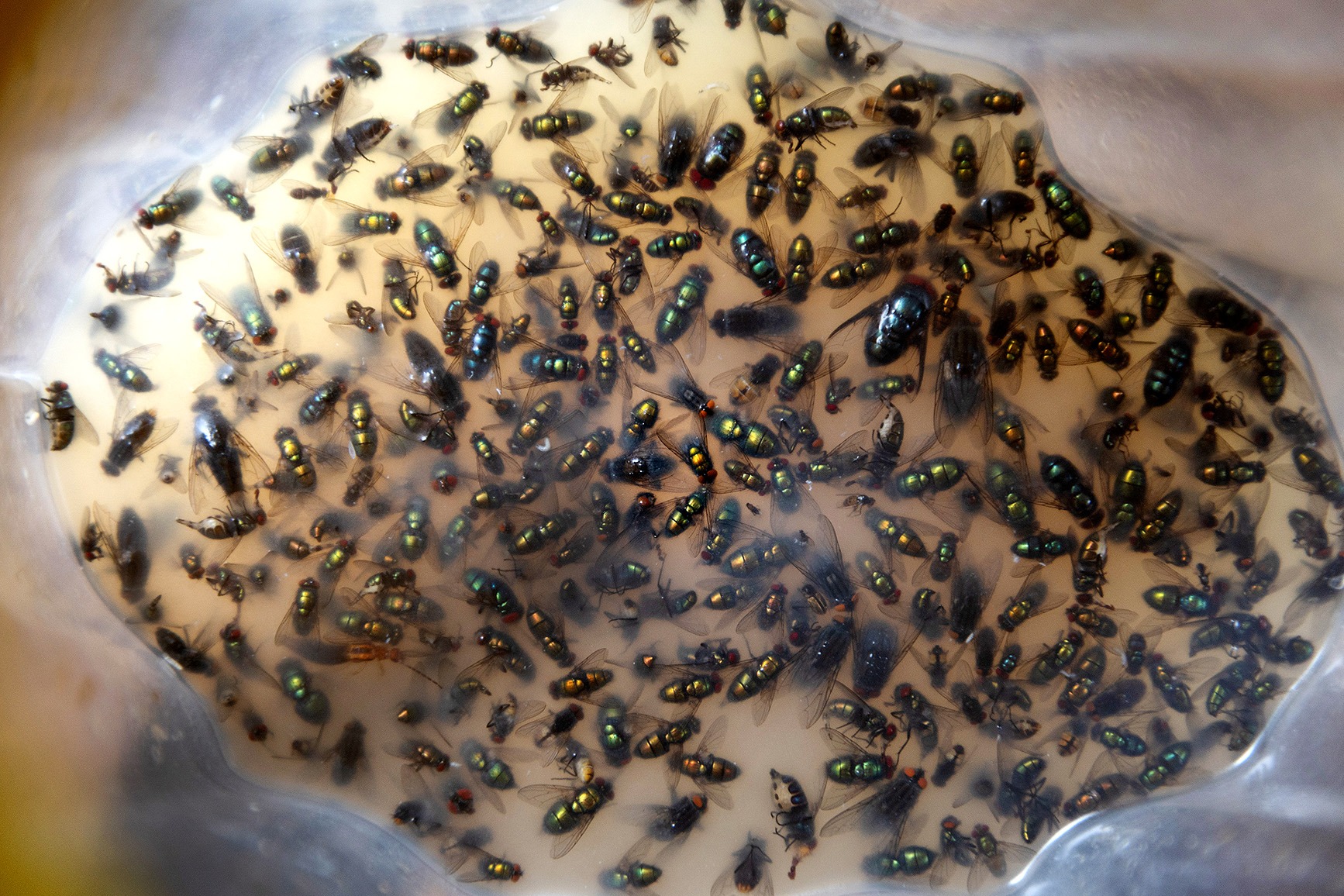
 The contents of a fly trap. Why are flies bugging Johannesburg residents even more than usual? (Photo: Our City News / James Oatway)
 Johannesburg residents and business owners have been battling a noticeable increase in flies, with restaurants, homes and public spaces reporting swarms that are becoming harder to control.
According to Dr Nina Parry, a fly and waste bioconversion specialist who recently completed her PhD, the city is experiencing a surge in two main species – the house fly (Musca domestica) and the green bottle fly (Lucilia sericata), both of which thrive in warm, wet and dirty environments.
“These flies breed wherever there is warm, moist organic matter, which includes rotting food, compost, open drains, animal manure and poorly managed waste,” said Parry.
Her doctoral research focused on black soldier fly larvae, insects known for their ability to break down large amounts of organic waste such as food scraps and manure. Her work was about figuring out the best way to use fly larvae to turn organic waste into animal feed and fertiliser, in a way that can work at factory scale, not just in a lab.
/file/attachments/orphans/Flies_14a_302991.jpg "Flies breed wherever there is warm, moist organic matter, which includes rotting food, compost, open drains, animal manure and poorly managed waste. (Photo: Our City News / James Oatway)")
Why is it getting worse?
Johannesburg’s summer weather creates perfect breeding conditions. In warm and wet conditions, it takes as little as three to four days and only half a teaspoon of organic matter for a fly egg to develop into a maggot. Within days, that maggot crawls away to a dark, dry place and becomes a fly ready to lay hundreds more eggs.
“The warmer it is, the faster they multiply,” said Parry, adding that this was why summer was the peak season for flies, and why March was usually the worst month.
A single fly can live for up to two months, continuously breeding throughout that time. The more food waste, open drains and animal waste exist, the more opportunities flies have to reproduce.
/file/attachments/orphans/Flies_11a_285401.jpg "The warmer it is, the faster flies multiply. (Photo: Our City News / James Oatway)")
House flies feed on almost anything organic, from fruit scraps and food waste to open drains and compost. Green bottle flies, which are slightly less common, prefer protein-rich waste, especially meat and animal matter.
Flies pick up bacteria from the waste and organic matter they feed on, and can transfer it to human food. However, Parry said they were more irritating than dangerous.
“They actually clean themselves a lot, so they don’t carry as much bacteria as people think,” said Parry.
Winter naturally reduces fly populations because cooler temperatures slow down their breeding cycle and cause many flies to die. But once warmer weather returns, so does the infestation.
What the City can do
According to Parry, the fly problem in Johannesburg is largely linked to waste management and infrastructure.
“The City can reduce flies by improving rubbish collection, closing open drains, fixing sewer leaks and encouraging residents to separate waste properly,” she said.
Organic waste, especially food scraps, should be placed in small airtight bags to limit the amount of exposed material in which flies could breed.
According to Dr Parry, household insecticide sprays could quickly reduce fly numbers, but offered only short-term relief. She noted that these products were often non-specific, meaning they may also kill beneficial insects that naturally controlled pests. She added that the chemical build-up in the environment could have negative ecological consequences.
Parry said that when flies gathered in large numbers indoors, particularly around ceilings and light fittings, targeted use of household insecticide sprays could help deal with the immediate problem. However, she added that prevention was far more effective than repeatedly killing adult flies.
“Preventive measures are much more effective because they remove the things that attract flies and provide breeding space,” she said.
/file/attachments/orphans/OCN_Flies_02copy_993393.jpg "The ‘helicopter’ is one method used by restaurants to keep flies off food. (Photo: Our City News / James Oatway)")
She advised residents to keep kitchens and eating areas clean by washing dishes promptly after use and ensuring food particles were not left exposed. Food waste should be sealed in a separate bag and disposed of outside the home as soon as possible.
Moisture control was also important. Drying sinks and basins and fixing leaks could help reduce insect activity, especially during hot, dry weather. Pet waste should be removed daily, as it could attract flies.
For additional control, she suggested the use of hanging sticky traps indoors, red-top fly traps near refuse bins, and insect-zapper lights placed outdoors. These tools could help reduce fly numbers in specific areas.
Parry said tackling the fly infestation would require both better city management and responsible household and business behaviour. DM
This story is produced by Our City News, a non-profit newsroom that serves the people of Johannesburg.
/file/attachments/2985/WhatsAppImage2025-11-21at1946001_346702_1cea9e715c05dc0a538fc79753ac3401.jpeg)