




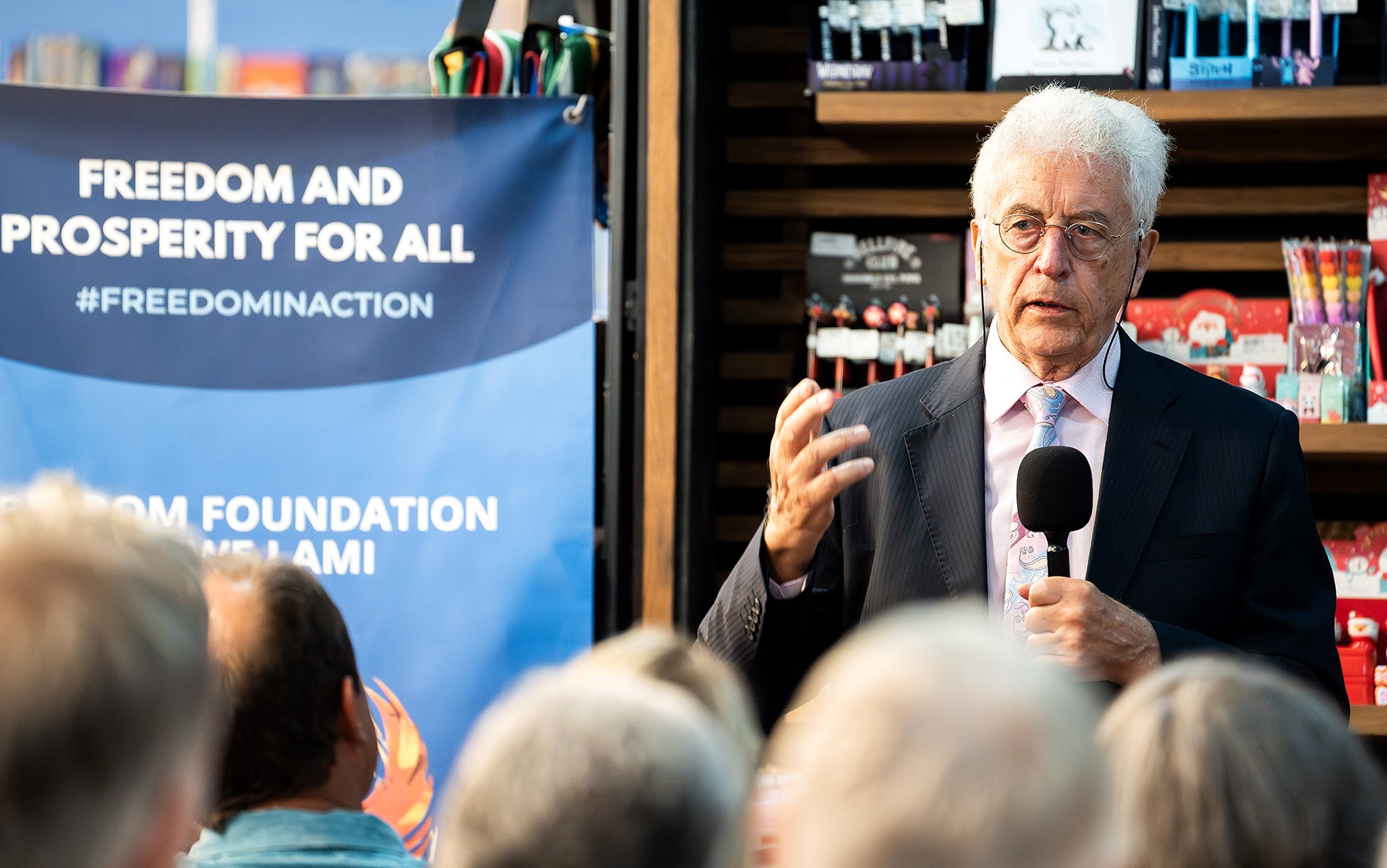
 Author and economic advisor Leon Louw sharing insights as to how local enterprises can help shape policies and the future of the metro. He also launched his book Leon Louw: A Legacy of Solution. (Photo: Dirk Moggee)
Nelson Mandela Bay (NMB) could become one of South Africa’s (SA’s) economic powerhouses – if organised business becomes more autonomous and less reliant on government regulation.
In fact, the more responsibilities are taken out of government hands, the more efficient cities, provinces and even the country could become.
This was one of a multitude of sentiments shared by policy and economic advisor, author Leon Louw during a meeting with the Nelson Mandela Bay Business Chamber on a recent visit to the city.
‘You learn by looking. Look at the growing economies of the world and copy them. Look at the winners and do what they do. Stop looking at the losers’ — Louw
The founder and CEO of the Freedom Foundation was invited to speak with chamber members on Tuesday morning, following the Gqeberha launch of Leon Louw: A Legacy of Solutions. It’s a biographical account of Louw’s solution-driven work over the past few decades that has helped shape government policy and business success.
The book, written by respected financial journalist and former Business Maverick editor Tim Cohen, is published by Maverick 451.
/file/attachments/orphans/LeonLouw2_317776.jpeg "The launch of Leon Louw: A Legacy of Solutions made its way to Nelson Mandela Bay on Monday where the author, former Business Maverick Editor Tim Cohen, and Louw shared insights from the book. (Photo: Dirk Moggee)")
Read more: Leon Louw: A Legacy of Solutions – ideas too clear to ignore, too powerful to forget
“When doctors ask me if I have any allergies my answer is always the same: only politicians,” Louw said, as the collection of business leaders gathered around the Business Chambers boardroom laughed in response.
“I make a point of engaging with leaders from various political parties in the hopes of finding some solutions. I don’t care which party you represent. All I am interested in is establishing good policies.”
Bottom third of the list
Taking a quick look back, Louw said SA ranked in the top third of world economies at the start of the post-apartheid era. That position has gradually weakened, and SA has slipped to the bottom third today.
He said this position could easily be remedied by looking at what some of the biggest global economies are doing and copying their models and policies.
With specific reference to the Coega Special Economic Zone (SEZ), Louw said it was a misnomer as there was nothing really setting it apart as “special”.
He referred to similar SEZs in China where government economic regulations do not play a role, allowing imports, exports and operations to flow freely without exchange controls. Products are only regulated once they cross from the SEZ into the rest of the country.
He said in other parts of the world, businesses establishing themselves in SEZs are given a 10-year tax exemption, with the option of an additional five years, to help them develop and grow when they start out.
“If Coega can manage to implement similar policies it will run out of land. It will have to start showing investors away.
“You learn by looking. Look at the growing economies of the world and copy them. Look at the winners and do what they do. Stop looking at the losers,” said Louw.
Once again referencing China, Louw said it has a population of 1.4 billion but operates about six core SEZs. SA, on the other hand, has a population of 63 million and 12 SEZs. In Louw’s opinion, SA should earmark two main SEZs, manage them with growth-driven policies, and watch as economic investment flows back into the country.
As an example of how current policy and laws can be developed (or even scrapped) to bring about real change and a mindshift in SA, Louw referred to building regulations in some of the poorest townships.
“A poor person stays in a shack in a shanty town. The moment he wants to improve his standard of living by building a brick structure, local government officials show up and demolish his house because he does not have approved building plans. Progress is being criminalised.
“When the very structure that you call home is a crime, you develop a mindset that the law is bad. These people are living in crime, they cannot afford to follow the law and regulations. Crime becomes a part of life.”
‘Active role’ of organised business
Business Chamber president Kelvin Naidoo, a manufacturing and technical executive at industrial battery manufacturer Auto X, echoed Louw’s sentiments, drawing from the experiences of his own employees that are being extorted on a daily basis by criminal elements in the poorer communities where they live.
He said engagements with Louw proved insightful and presented several “silver linings” that could assist organised business to play an active role in growing international interest in NMB and to develop its economy.
He said employees constantly complain about having to pay so-called protection fees to public transport operators so that they have permission to use their own cars for their daily commute.
Naidoo also made the point that SA is in the process of alienating itself from other countries, to the detriment of its economy, through its unwarranted involvement in global politics.
“South Africa is losing its position as a gateway into Africa. Nigeria has a bigger economy, while countries like our neighbours, Namibia and Botswana, are fast growing into serious competitors.”
Business Chamber members raised the issue of instability in NMB specifically, and how business owners were more focused on survival than on economic growth.
More money was being spent on becoming energy- and water-resilient – two basic services that should be managed by government.
Yet Louw is of the belief that South African citizens should become less reliant on government, and more services should be outsourced to private entities if we want them to operate efficiently.
“In the private sector, a busy day is a good day. But if you ask a government employee, they will in all likelihood say a busy day is a bad day.
“If you had a system where the person doing the job’s self-interest aligned with good service delivery, everything would run more smoothly.”
He conceded that this would be open to corruption, where tasks could be done poorly to create a need for services. However, through a system of proper evaluation, ranking service providers and providing incentives and rewarding good work, service delivery by a collection of private enterprises could provide a viable solution.
Business Chamber CEO Denise van Huyssteen said they are looking forward to further engagements with Louw on how organised business can play a decisive role in the way forward for the Bay.
“I think the timing is unique and it just happens to be an opportune moment for these discussions to take place. Policies need to be put in place that will stimulate growth regardless of who the government structure in charge is,” she said. DM