





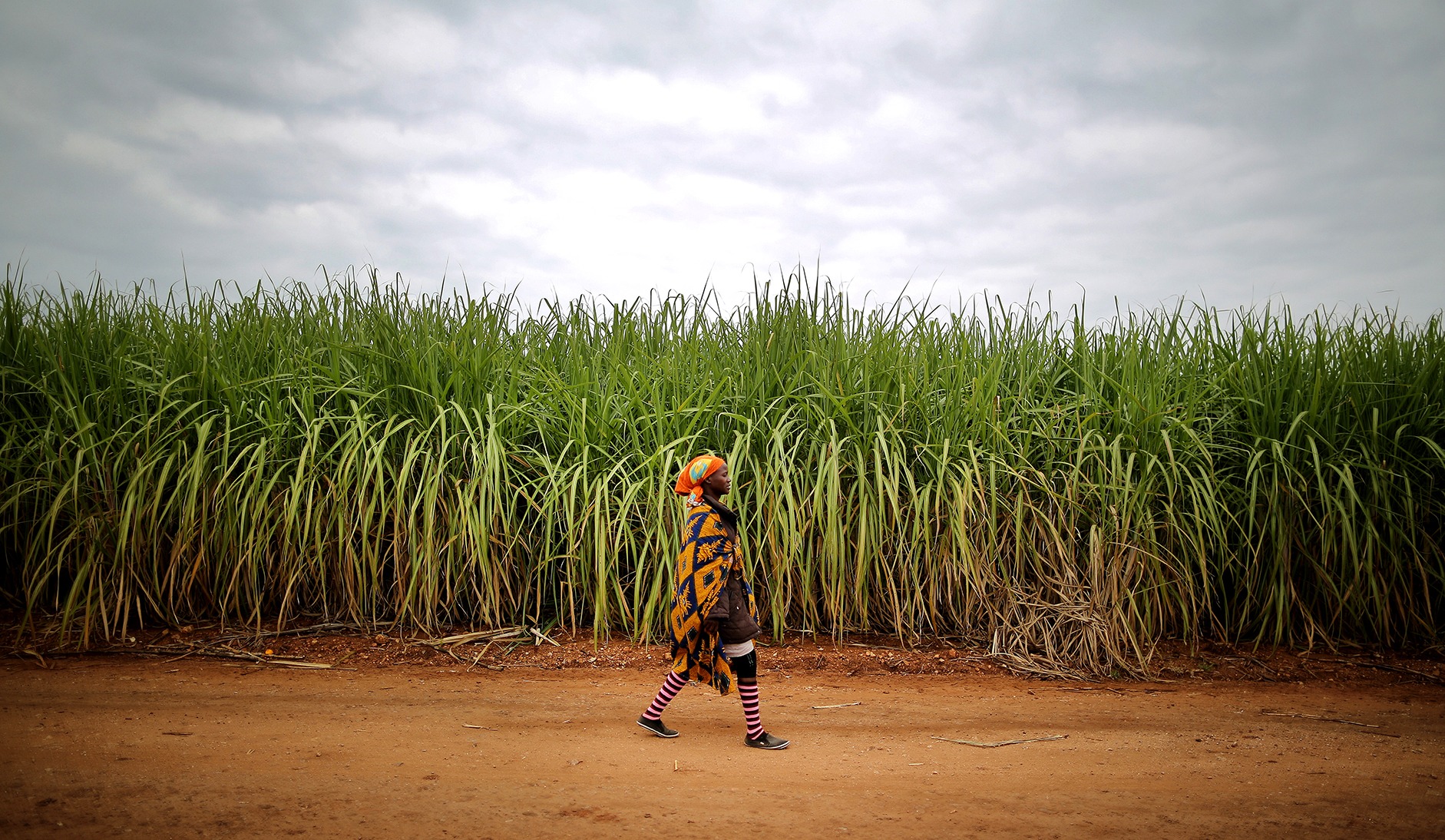
 A woman arrives for work in a sugarcane field in Komatipoort, South Africa. The sugar industry has highlighted job losses in its campaign against the sugar tax. (Photo: Dan Kitwood / Getty Images)
 SA Canegrowers is urging the government to end the health promotion levy, citing a “surge in subsidised imports of sugar and job losses”.
So what do subsidised imports and the health promotion levy have to do with each other?
The Health Promotion Levy (HPL), popularly known as the sugar tax, was implemented in April 2018, taxes only sugar-sweetened beverages with sugar exceeding 4g per 100ml of drink. The tax rate is set at 2.1 cents per gram of sugar content, after the first 4g of the drink.
/file/dailymaverick/wp-content/uploads/2025/09/MC-ChildrenAdvertising-Obesity-1.jpg "Sugary drinks like sodas are taxed under the Health Promotion Levy, but not table sugar. The levy has not increased since its implementation in 2018, despite health advocates and academics arguing for a higher tax to increase health benefits. (Photo: hsph.harvard.edu / Wikipedia)")
It applies only to sodas, flavoured waters and energy drinks — not to the sugar bought in packets used for baking and cooking or beverages made at home, such as tea and coffee, and not to the sugar used for preservation of foods such as jams, canned fruit and jellies, or sweets.
The HPL was introduced to lessen the consumption of sugar-sweetened beverages, which contribute to the rising tide of diabetes and obesity in South Africa. Evidence showed that the tax initially worked in lessening consumption in poorer households.
Despite planned increases in the tax, lobbying from the industry and sugar producers’ interest groups led the government to halt tax increases until at least 2026.
The economic issues
Economist Xhanti Payi explained to Daily Maverick that subsidised imports meant other countries financially incentivised production and introduced products into another market at lower prices.
Payi said that while the HPL was designed to curb consumption of sugary drinks, poor people who might rely on sodas for a cheap, immediate energy boost due to less access to healthier diets may turn to cheaper or illicit products. This means the tax increases state income, but does not necessarily change consumer behaviour or address the underlying income disparity problem, he explained.
He argued that the problem of sugar consumption could be addressed through efforts to increase people’s incomes via employment and economic growth, suggesting that relying solely on the tax might be a short-term, less effective approach
“We want healthier people; we understand that income is a critical part of a healthy population,” Payi said.
Payi said that as a primary market, the agricultural sector’s health was important for the secondary and tertiary sectors, and a reduction in demand could cause supply distortions affecting the entire value chain.
He used the example of an indirect effect, like increasing transport costs for other goods delivered by the same truck that would deliver sugar as well.
“We must take the tax as government and use that tax to actually support an industry that can allow that truck driver to have another customer to fill in the gap that has been left by the sugar customer.”
Payi emphasised that the money should be used to support other industries to create jobs that offset the job losses, and that it would be imperative for the tax revenue to be earmarked and ringfenced, to fill the gap and prevent a net negative on the economy.
The Healthy Living Alliance (Heala) told Daily Maverick that, as tariff disputes and import pressures dominated sugar industry news, tariffs and the HPL should not be conflated. Tariffs were trade instruments designed to stabilise industries. The HPL was a public health instrument designed to save lives, Heala said in a press release.
“We cannot allow tariff debates to derail a health tax that works,” said Nzama Mbalati, CEO of Heala. “Just as we use tobacco and alcohol taxes to protect South Africans from harm, the HPL is a critical part of our national health tax framework. Strengthening it is a public health necessity, not an industry target.”
A study commissioned by the National Economic Development and Labour Council (Nedlac) and frequently cited by the SA Canegrowers Association estimated that the sugar tax led to 16,000 job losses in the sugar and beverage industries during its first year of implementation.
However, research conducted by Priceless SA, based at the University of the Witwatersrand, an independent research group, found no significant evidence that the sugar tax led to job losses in the sector.
The health issues
“Every amputation, every blindness diagnosis, every child who loses a parent to diabetes is a reminder that we have waited too long,” said Mbalati. “The HPL is not a standalone experiment; it is a proven health tax. Government has used health taxes successfully for decades. Strengthening the HPL simply extends that legacy to protect South Africans from excessive sugar consumption.”
Modelling from Priceless SA indicates that increasing the HPL to 20% could, over 25 years, prevent 619,000 new diabetes cases, save about 72,000 lives, prevent 85,000 strokes and save South Africa R23.9-billion in healthcare costs.
“We treat people every day for conditions that should never have progressed this far. The HPL is not just a tax, it is a protective shield for millions of South Africans,” says medical doctor and health advocate Dr Darren Green, featured in Heala’s upcoming campaign.
“Strengthening it means fewer amputations, fewer patients on dialysis and fewer children growing up without parents. Very few interventions deliver such measurable health benefits, especially for communities already carrying the heaviest burden.” DM