




Logic dictates that to make more, you need more – more machines, operators, and shifts. When demand rises, expansion feels like progress. But in practice, this approach often leads to inefficiency, unnecessary complexity, and wasted capital. Most factories already possess untapped capacity. The challenge lies in finding and unlocking it.
The scaling trap
Traditionally, decisions on scaling production rely on senior managers’ gut feel and experience. But educated guesses can end up being costly on a number of fronts:
- Machines: If you simply add equipment without understanding the root causes of your current inefficiencies, it only amplifies existing problems.
- People: When you hire new people to operate those machines without standardising your processes or providing time-consuming training, it introduces inconsistency and risk into your assembly process.
- Data: When these decisions are not based on reliable data, the result is a busier, not necessarily more productive, factory.
This is what many in the industry now call the scaling trap: the false belief that growth must come from expansion. What actually drives sustainable growth is knowing where and how to expand, guided by data, not assumptions.
Finding hidden capacity
Studies across hundreds of assembly lines worldwide consistently reveal the same truth: between 20% and 40% of potential output is quietly lost to small inefficiencies. Variable operator performance, paper-based processes, and disconnected systems all chip away at productivity and output.
Because data is often scattered across systems or trapped on bits of paper, managers can’t see the trends and home in on areas where time, materials, or effort is being wasted. The key to scaling smarter is data visibility. You can’t improve what you can’t measure.
The data-driven difference
The most progressive manufacturers have started approaching scaling as a data-driven discipline. Rather than asking, “What do we need to buy?”, they ask, “What can we unlock with what we already have?”
This approach follows five basic principles:
- See clearly: Find your hidden capacity by reviewing real performance data.
- Standardise performance: Train every operator to perform like your best one.
- Digitise the process: Replace paper and guesswork with real-time traceability.
- Optimise continuously: Use insights to eliminate bottlenecks and stabilise takt time.
- Scale with precision: Expand only when and where the data confirms it’s needed.
Instead of throwing more resources at the problem, let the data lead and show you where to act – and where not to.
The cost of disconnection
Disconnected systems are another invisible drag on efficiency. Every manufacturer pays a ‘fragmentation tax’ – the lost time, integration headaches, and extra costs that come from juggling multiple tools and vendors that don’t ‘talk’ to one another.
Unifying people, processes, and machines on a single data backbone simplifies management and magnifies performance. When configuration, execution, and validation happen in one digital environment, the consolidated real-time insights allow change to happen faster.
Turning data into action
Once manufacturers capture reliable data, they can start to see the hidden story behind the line, including:
- Ghost bottlenecks – unstable processes that quietly throttle throughput – emerge.
- Operator dashboards highlight performance trends and training opportunities.
- Live analytics show process variation in real time, predicting quality issues before they occur.
These insights allow decision-makers to target their investments precisely. When a new machine or operator is added, it is at the point where data proves it will deliver the greatest return, which means you can invest and scale with confidence.
The human dividend
Investing in an operator guidance system is one of the expenses that requires due consideration – and it can cut training and other labour-related costs.
When operators receive clear, dynamic guidance, their stress levels drop, confidence rises, and quality improves. As a result, senior staff can also be freed from repetitive training to focus on innovation and problem-solving.
Globally, a shortage of skilled labour means that empowering and retaining your existing workforce is as important as optimising your machines. The best-performing factories don’t just focus on equipment efficiencies – they’re also inclusive, and people-centred.
Building a culture of continuous improvement
Smart scaling is a continuous cycle: digitise, diagnose, optimise, and scale. Each cycle compounds the results, so that everyday operations become an improvement-driven routine. This is what moves your manufacturing from reactive mode to resilience.
The next level of manufacturing growth won’t be achieved by those who add the most machines or operators, but by those who extract the most value from the ones they already have.
By combining real-time visibility, process standardisation, and empowered people, manufacturers can scale production intelligently – achieving higher output, stronger quality, and better margins without adding a single headcount or square metre of floor space.
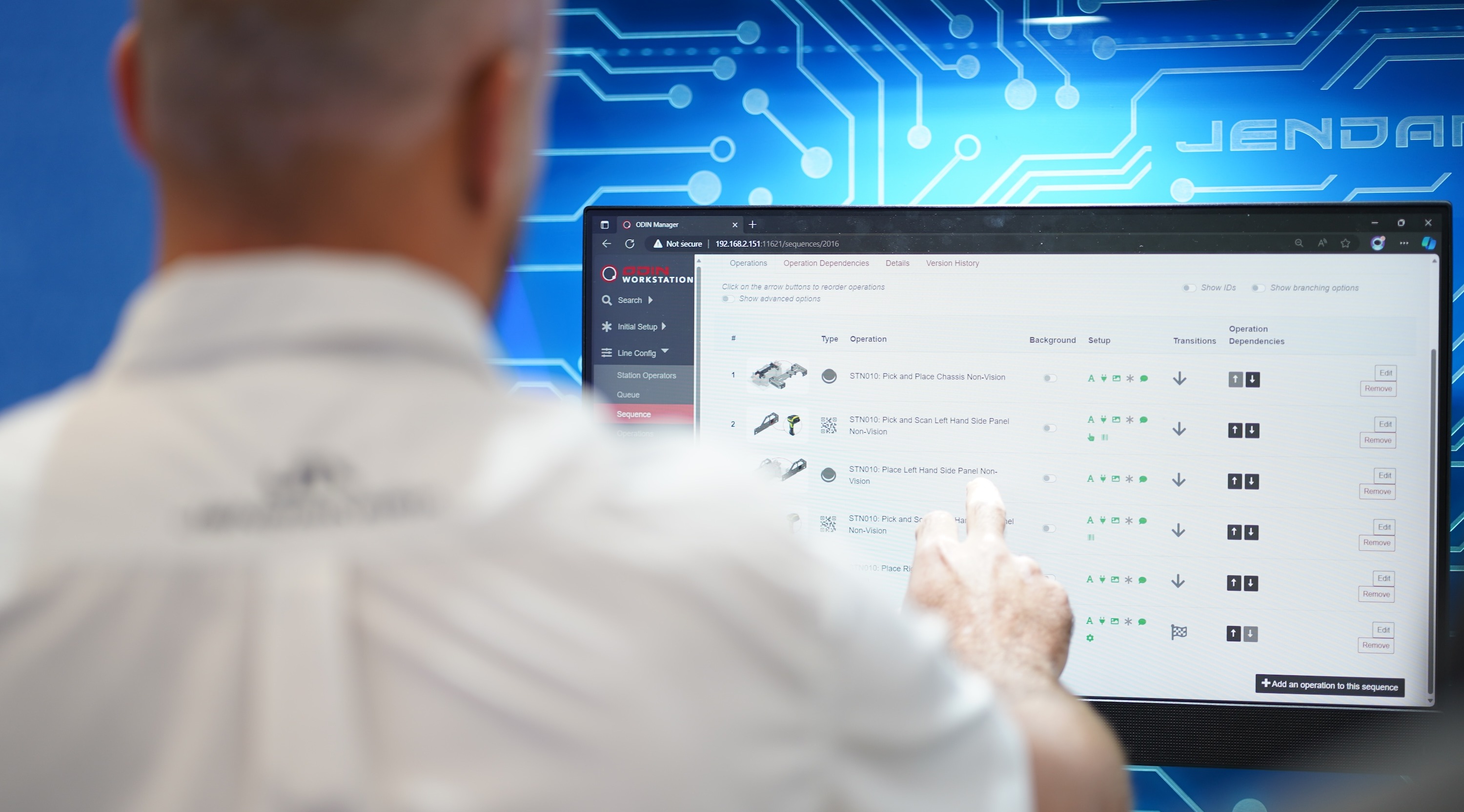
To learn more about this, download the Smart Scaling Playbook – and see how data-driven assembly lines use an assembly line operating system, like ODIN Workstation, to increase output, reduce training time, and make informed decisions that protect profitability. DM
Theuns Greyvenstein holds a B.Eng. degree in mechatronics, robotics and automation engineering, and is a solutions engineer at Jendamark Automation.