
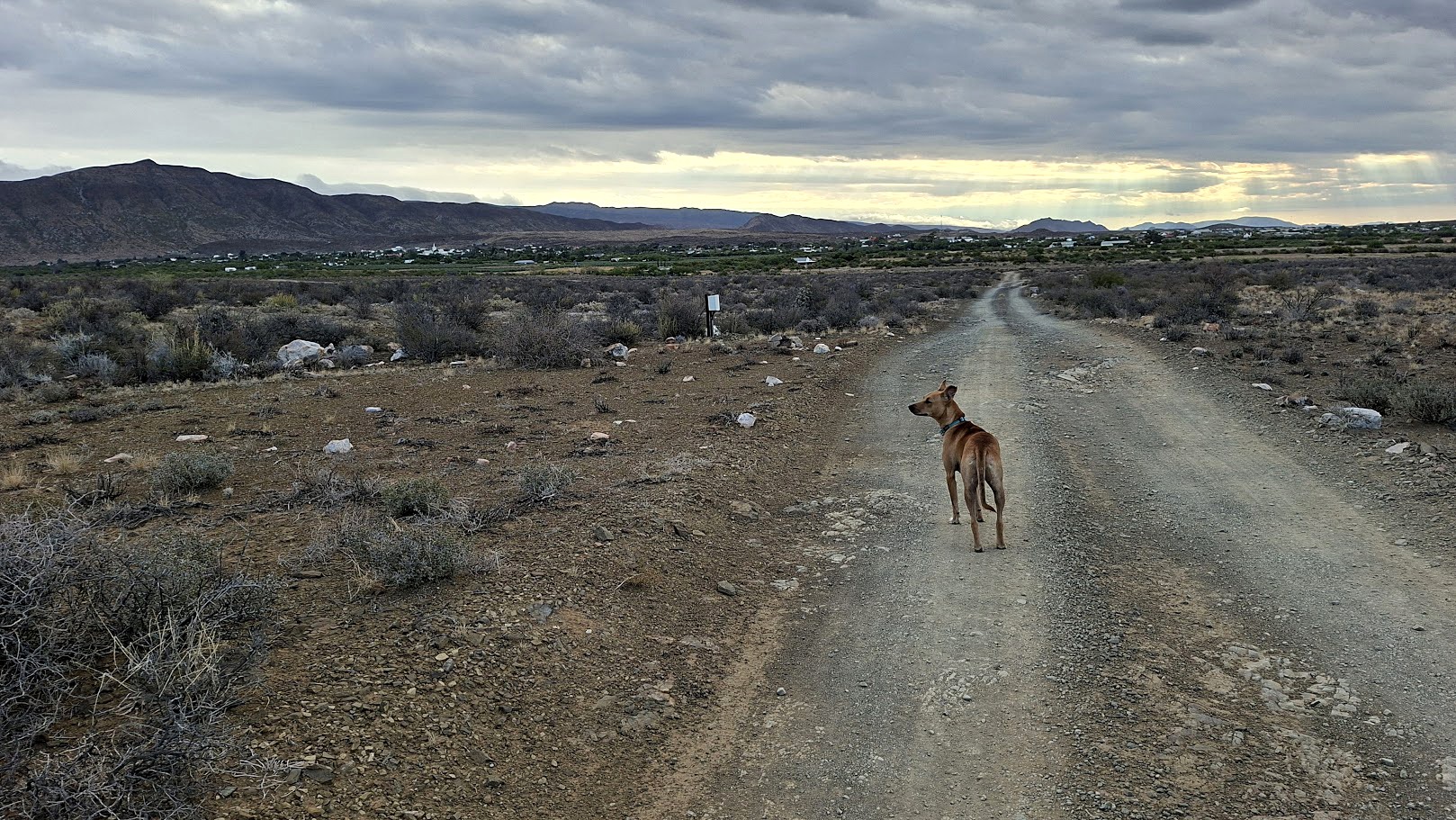
 My dog Rosa on the outskirts of Prince Albert in January 2026. (Photo: Steven Robins)
 /file/dailymaverick/wp-content/uploads/2025/10/label-Op-Ed.jpg)
Upon arriving at my guesthouse in drought-prone Prince Albert I could not help but notice the sprinklers spraying water on a green lawn surrounded by dry and dusty veld. The guesthouse owner told me she was fighting a losing battle, with temperatures in the late thirties. Lawns are probably not a good idea in an arid zone, even if they satisfy the suburban aesthetics of wealthy tourists. I learnt that 120 guesthouses in the town draw on the town’s water supply to wash the towels and linen of the thousands of visitors who pass through the town.
On our first morning in Prince Albert I woke up at 5.30am and decided to go for a run. I stepped outside onto the stoep overlooking a parched landscape of dead shrubs and bushes. On the guesthouse lawn were four Cape hares grazing the lush green grass. This quiet and serene moment ended when my dog Rosa burst onto the scene, provoking the hares to dart off into the desiccated veld. Although I had been critical of the guesthouse owner’s water-guzzling lawn, the hares clearly regarded the grass as helpful for surviving this latest deadly drought.
The local ecologist Dr Sue Milton-Dean told me that she had tried to persuade residents and guesthouse owners to plant their lawns with drought-resistant, diverse indigenous plants. In an article in the Prince Albert Friend, she advised residents to “plant diverse indigenous gardens – the more diverse and ‘unmanaged’ the garden, the more the food and nooks and crannies there are for insects and birds that eat them… Roses and lawns support little diversity and need much attention [and water]”.
/file/attachments/orphans/SueMilton_1Feb2025atWolwekraalspeakingtoSUstudents_451350.jpg "Dr Sue Milton-Dean speaks to Stellenbosch University students at Wolwekraal Nature Reserve in Prince Albert in February 2025. (Photo: Steven Robins)")
In 2005, together with her late husband, the ecologist Dr Richard Dean, Sue established the 114-hectare Wolwekraal Nature Reserve with the aim of promoting veld restoration and biodiversity. The reserve, which is 3km outside Prince Albert, has a high diversity of vulnerable and endemic plants from the Succulent Karoo Biome. It is widely recognised as a global biodiversity hotspot, and was declared a Western Cape Protected Area in 2011.
Sue leads walks through the reserve to create awareness among tourists and young people about ecological sustainability, biodiversity and the challenges of veld restoration in the badly damaged Karoo landscape. In 2008, with her husband, Sue established the Renu-Karoo Veld Restoration project in Prince Albert. In addition to supplying plants for landscaping and gardens, Renu-Karoo does contract growing of Karoo plants for the medicinal and aromatic plant industries and for special projects. This involves providing plants, seeds and consulting services to companies and individuals engaged in efforts to restore damaged Karoo veld.
When I met Sue on a previous field trip with my students, she told us that the area was becoming a desert and that it should probably no longer be used for agriculture. In January 2026, the town was once again in the midst of a serious drought, and Sue told us that duikers and other animals were dying in the veld and commercial agriculture was struggling. Sue recalled that when she first arrived in the town in the late 1980s, she was able to buy locally produced vegetables and fruit. Now she has to buy everything from the local supermarket. Even the once-successful olive and wine production businesses were closing down due to water problems. In the place of agriculture are upmarket residential estates and guesthouses. Once-functioning food-producing farms were being subdivided into real estate for the wealthy.
/file/attachments/orphans/WatercrisissignPrinceAlbert_20250415_179641.jpg "The main road of Prince Albert in January 2026. (Photo: Steven Robins)")
Since the start of the 20th century, Prince Albert has had three serious drought episodes – in the 1930s, 1960s and from 2015 to 2022. The most recent drought cycle was followed by two years of relatively good rainfall for this arid zone. It is now feared that the town is entering yet another drought cycle.
Water scarcity in a town that has averaged 170mm of rain annually over the past 120 years has contributed to a sharp decline in agriculture. Prince Albert’s tourism boom with its many upmarket restaurants, art galleries, coffee shops, guesthouses, jazz, art and cultural festivals has exacerbated water scarcity in the town. Tourism is literally sucking the town dry and killing agriculture. Yet, paradoxically, tourism also drives the local economy and is a major employer.
The Witwatersrand University geographer Stefan Grab recently noted that historical droughts in the Karoo have been highly variable in severity. For instance, in 1897, certain areas in the Karoo experienced severe drought while other parts received near normal rainfall. Using long-term historical rainfall records, Grab shows how 19th century droughts over parts of the interior of southern Africa were spatially and temporally complex and at times resulted in widespread drought across the entire region, whereas at other times it was confined to only one sub-region. Grab has also found that multiyear and severe droughts in the Karoo have decreased in frequency and amplitude (rainfall deficit) during the past two centuries.
/file/attachments/orphans/PrinceAlbertguesthousewateredlawnnexttodryveld_20260114_260163.jpg "A Prince Albert guesthouse with its watered green lawn next to drought-stricken veld on the outskirts of Prince Albert in January 2026. (Photo: Steven Robins)")
/file/attachments/orphans/HousewatertanksolarpanelsinthePrinceAlbertveld20260116_453281.jpg "A house surrounded by veld with off-grid water tanks and solar panels on a farm on the outskirts of Prince Albert in January 2026. (Photo: Steven Robins)")
Grab’s findings also suggest that the El Niño-linked “global drought” of 1877-78 was the most hydrologically severe two-year drought in some, but not all, parts of the Karoo. This long-term perspective suggests spatial variability is likely to continue to characterise the rainfall patterns of the Karoo. Similarly, climate scientists believe that the western part of the Karoo is likely to become drier while the eastern part will probably experience higher rainfall. Unpredictable climatic and rain patterns will no doubt continue well into the future in these drylands.
Milton-Dean notes that Grab was not able to include temperature in his drought assessments because there is no long-term temperature database. Increasing temperatures cause drought conditions even when rainfall remains the same. The South African Weather Service’s bleak prediction for Prince Albert for March to May 2026 suggests that there is likely to be 40% less-than-normal rain, and 50% above normal temperature. The consequences of this for rainfall and water supply are alarming.
Sue’s report calls for a drastic reduction in the consumption of water for laundry, showers, car washing, recreation and gardens, and advocates for sewage water reuse systems, planting locally indigenous, removing lawns and explaining water shortages to tourists. She writes in the Prince Albert Friend: “The nomadic birds have left, and resident birds such as Karoo chat, Rufous-eared warbler, Spike-heeled lark and Karoo korhaan have dwindled. No sign of Bat-eared foxes and suricates and hares are few and far between.” The report ends with a grim conclusion: “I have no advice on how not to be depressed about the condition of the veld, the declining production, the suffering of the plant and animals, the river that has run dry.” Clearly, Prince Albert is going through the hardships of yet another “Day Zero”.
Water and rainfall have always been at the very centre of everything in Prince Albert, a small Karoo town that was named in 1846 in honour of Queen Victoria’s consort. The settlement, originally the Kweekvallei (Queeckvalleij) loan farm, was established by Zacharias and Dina de Beer in 1762. It was settled precisely because of the streams that flowed down from the Swartberg Mountains. Robert Gordon’s 1778 painting of Kweekvallei shows neatly demarcated agricultural fields watered by the river, floodplain and extensive leiwater canals. The painting also depicts a few traditional “matjieshuise” of Khoi and San people, who by then had been thoroughly displaced by colonial violence and transformed into subjugated farm labourers.
As the settlement expanded, 50 landowners were granted access to the leiwater. This water, which continues to flow through the town, has made agriculture possible in this drylands area. Although the water continues to flow, and sheep and goat farming and olive production persists, the future of agriculture looks far less secure than it did when Zacharias de Beer began farming there in 1762.
The relatively recently expanded olive production estates in Prince Albert are up for sale following the recent discovery that the groundwater has become increasingly saline due to drought and overextraction. Commercial fruit, vegetable and wine production have long vanished, as has Merino wool farming. While there are still some farms with Dorper and Meatmaster sheep for meat and Angora goats for mohair, poor rainfall and unfavourable global markets have contributed to making livestock production increasingly precarious. This has been exacerbated by rising costs of lucerne production and the need to buy large quantities of stock feed.
Whereas sheep and goat farming once created permanent jobs for the “Coloured” residents of this town, these jobs have all but vanished. This has contributed to deepening poverty and exacerbating sociospatial segregation between the affluent (mostly white) town residents and those living in North End township. Even the unequal and paternalistic relationships between white farmers and Black farmworkers have become something of the past. Instead, the indigenous residents of North End now have to survive on social grants, temporary work or migrate elsewhere in the country. The majority of young pupils complete their schooling without prospects of employment in the town.
/file/attachments/orphans/SueMiltontalkingtoagroupofSUstudentsatWolwekraal_1Feb2025_672745.jpg "Dr Sue Milton-Dean points out to Stellenbosch University students the hand-dug hollows she uses as mini-catchments to concentrate water in patches to facilitate seed germination and seedling survival in the Wolwekraal Nature Reserve, February 2025. (Photo: Steven Robins)")
One of the few encouraging possibilities for local jobs is the explosion of renewable energy projects throughout the Karoo, where 65% of wind and solar farms are located. Sue told us that her nursery sells large quantities of indigenous plant seeds to renewable energy companies that are required by the state to rehabilitate the land they use by planting indigenous vegetation. Sue’s nursery and nature reserve employ 10 permanent local residents and she hires temporary seed collectors when she gets contracts from companies. She also does veld restoration field studies on the livestock-degraded landscape of Wolwekraal Nature Reserve, and young interns come from all over the country and abroad to work with her on these nature conservation projects.
Although there is a likelihood of sharp increases in the frequency and intensity of drought as a result of climate change, the Karoo has a patchy landscape where rain may fall on one farm but not on another immediately adjacent to it. Grab’s long-term Karoo rainfall records confirm this variability. It is highly likely that farmers, flora and fauna in the Karoo drylands will continue to adapt to this uncertainty and patchiness as we enter a world increasingly characterised by climatic instability.
Amid the ruins of these degraded and drought-stricken landscapes there are farmers and those, like Sue and her fieldworkers and interns, who have not yet given up on the Southern Karoo drylands. During my visit to Prince Albert’s North End, it also became clear that the indigenous survivors of the devastation of colonialism and apartheid are also having to find new ways to live in a precarious world in which even exploitative farm labour is declining as commercial agriculture gives way to upmarket tourism.
These days a variation of the saying “‘n boer maak ‘n plan” could be applied to hares that survive off the lush green lawns of Prince Albert’s guesthouses and upmarket residential estates. Smart improvisation will increasingly be required from all human and more-than-human inhabitants of the Karoo drylands. DM
Professor Steven Robins is DSI/NRF SARChI project leader in the Sociology of Land, Environment and Sustainable Development Research Programme, Department of Sociology and Social Anthropology, Stellenbosch University.