




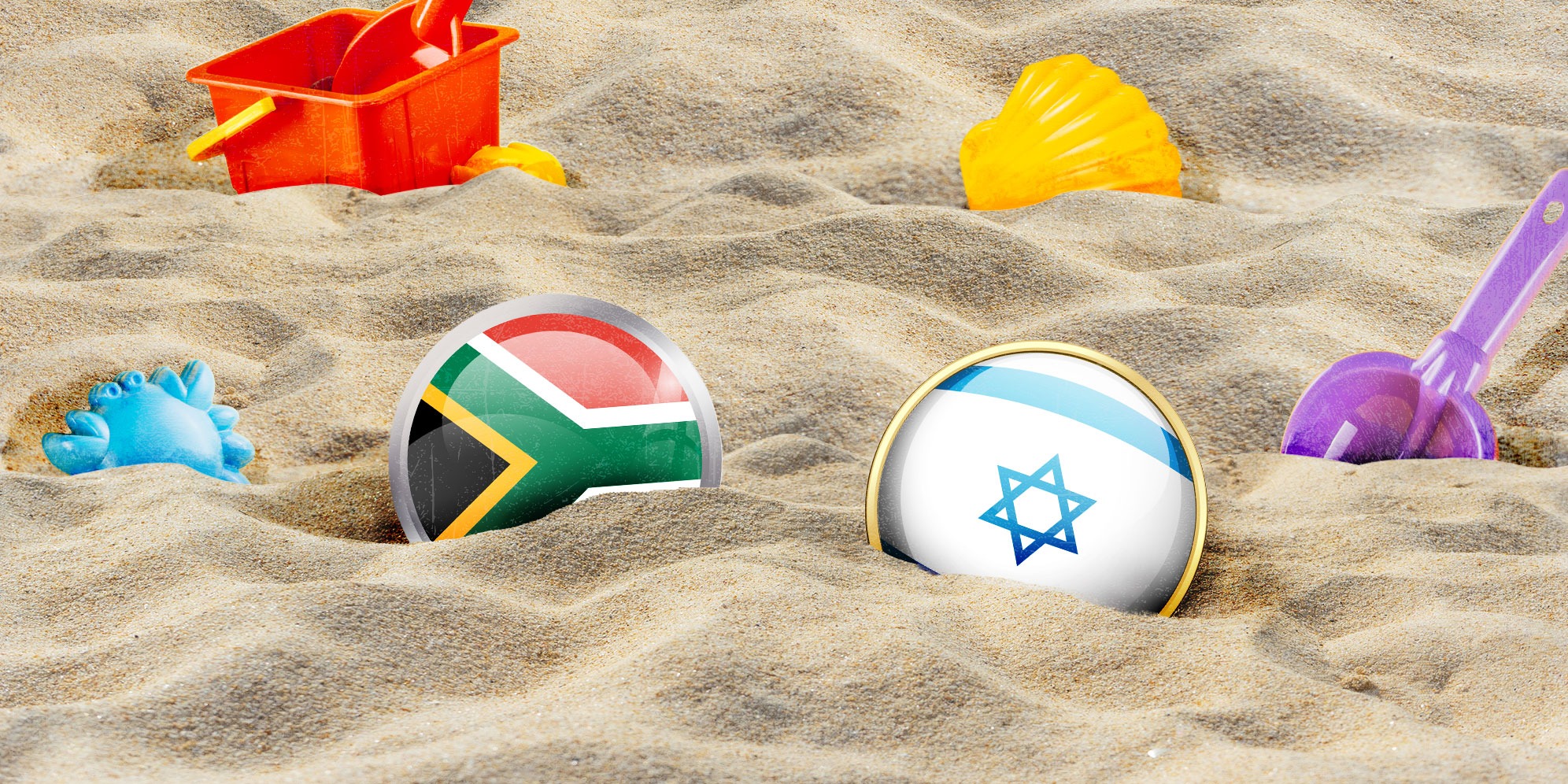
 Illustrative image: Sandbox. (Photo: iStock) | Sand toys. (Photo: Freepik) | South African flag badge. (Image: iStock) | Israeli flag badge. (Image: Freepik) | (By Daniella Lee Ming Yesca)
 Tit-for-tat declarations of persona non grata reveal the depth of the collapse of relations between Israel and South Africa. But, until more fundamental issues are resolved, these expulsions are the symptom of a deeper divide, not its cause.
The phrase “persona non grata” has been a headline in South Africa. What does the phrase mean, and why does it matter here and now?
/file/attachments/orphans/584893906_1869040310712565_2585651074875013019_n_283743.jpg "Persona non grata: Ariel Seidman, Chargé d’Affaires of the Israeli Embassy in South Africa. (Photo: Ariel Seidman Dcm / Facebook)")
Have the tit-for-tat expulsions of two diplomats become a problem in South African-Israeli relations or, rather, is it actually symptomatic of a much larger malaise? The answer, of course, is the latter. In medical terms, it might be something like an acute fever indicating a serious, deeper, underlying condition.
What exactly does it mean for a diplomat’s continuing presence in a country to become “persona non grata”, and how does it fit into the range of tools in diplomatic relations?
The phrase persona non grata is Latin, meaning an “unwelcome person.” In diplomatic practice, it refers to a foreign official, an ambassador or any other staff member deemed unacceptable by a host country and thus prohibited from entering or staying in his or her assigned host nation.
Grave rebuke
It is the most serious censure a host nation can apply to an actual diplomat, requiring that diplomat’s immediate departure from their assignment.
Article 9 of the 1961 Vienna Convention on Diplomatic Relations says a receiving state can declare a diplomat to be a persona non grata with no explanation whatsoever. Once that decision is made, the diplomat has to be recalled as their diplomatic immunity and privileges are terminated.
The common fictional portrayal is of a diplomat becoming persona non grata in a world of clandestine meetings, secret drop boxes for illegally obtained classified information, and all the staples of spy novels.
But the declaration of a diplomat becoming persona non grata can happen when, for example, a foreign diplomat is caught illicitly selling duty-free liquor or tobacco obtained under their diplomatic privileges, or the trafficking in illegal drugs, or even, perhaps, engaging in trafficking in persons, as in bringing in domestic staff under false pretences. Such things do happen.
According to the (private, non-government) Washington International Diplomatic Academy, “Although spying is a valid and often-used reason for slapping the ‘PNG’ label on someone who is no longer welcome in the country, sometimes the reason behind it is a tit-for-tat game, an expression of ideology, or the whim of a dictator…”
Read more: How SA can avoid stepping on diplomatic toes while dancing the Rasool rumba
Espionage and tit-for-tat expulsions
In the case of espionage, the statement would usually accuse the diplomat of having engaged in activities incompatible with diplomatic norms.
For a comparative context, the Washington International Diplomatic Academy adds, “More Russian officials than any others have been expelled for spying in recent years — from more than 20 countries [although, rare, some American diplomats have been expelled from foreign countries as well, besides tit-for-tat reciprocal expulsions].
One of the latest rounds took place four days after Russia invaded Ukraine in February 2022, when the United States PNGed 12 Russian “intelligence operatives” posted to Moscow’s mission to the United Nations in New York. The State Department said they had “abused their privileges of residency in the United States by engaging in espionage activities that are adverse to our national security”.
In doing this, the State Department added that this was a further step in Western efforts to isolate Russia diplomatically for its aggression against Ukraine. The Americans’ concern, though, was that once such a group expulsion happened, the Russians would expel the same number of American diplomats from among the embassy staff cohort in Moscow or American consulates in Russia, already understaffed due to previous tit-for-tat PNG rounds.
The Washington International Diplomatic Academy also noted, “Such reciprocal actions are standard practice. Sometimes declaring someone accredited as a diplomat a PNG resembles a chess move — to make a point or advance a certain policy — but more often it’s a game of checkers, or a way to show displeasure or anger for a perceived wrong.”
Policy disagreements
Thus, declaring a diplomat a persona non grata is a tool for demonstrating displeasure in the problems in a bilateral relationship, besides issuing sharp statements from the State Department over disagreements about policy issues.
In fact, one of my former colleagues was caught up in just that exercise. He was a student of Russian literature and public social and political life (and was someone I would turn to for insights about Russian cultural and intellectual life). His duties had been to manage the increasingly limited set of bilateral exchange programmes still in operation, as well as to engage with academics and independent Russian journalists on behalf of the embassy. Important but standard stuff.
Still, because he was deeply knowledgeable about Russia, he was the kind of diplomat Russia’s increasingly authoritarian government almost certainly wanted to remove from Moscow. That round of tit-for-tat expulsions noted above became an opportunity to send packing a knowledgeable diplomat like my friend.
In less angry bilateral circumstances, when a host government believes a foreign diplomat has gone beyond the usual bounds in bluntness or public criticism of a host country’s policy, standard practice would be to summon the head of that mission to the foreign ministry for a very stern conversation or, perhaps, more formally, the host country government might issue a diplomatic note, a “demarche,” describing the offence and putting the embassy and its staff on notice that they must sin no more, or else it will be the naughty corner — or worse. Declaring a diplomat to be persona non grata over his or her remarks, even some critical ones, becomes a significant raising of the stakes.
Ebrahim Rasool
/file/dailymaverick/wp-content/uploads/2025/03/ED_274031.jpg "Former ambassador to the US Ebrahim Rasool. (Photo: Gallo Images / Brenton Geach)")
When South Africa’s now-former ambassador to the United States, Ebrahim Rasool, participated in a webinar in South Africa (but listened to by international audiences, including people in the US), in which he described the new US president, Donald Trump, as someone pursuing a white supremacist agenda, that became a sufficient excuse for the US Administration to act, given the growing antipathy towards the South African government.
The Trump Administration — already embracing a truculent agenda vis-à-vis South Africa, complete with those false charges of a genocide against white South African farmers — quickly declared the South African ambassador to be persona non grata.
There was virtually no discussion about the purported sin, and there was never an effort to discuss things with the South African envoy, let alone attempt to elicit any apology over the ruffled feathers. But this PNG decision was just one more demonstration of an increasingly acrimonious government-to-government relationship.
SA-Israel ideological battle
In the current local circumstances, the decision to declare the Israeli chargé d’affaires persona non grata, and then Israel’s reciprocal declaration of a South African diplomat assigned to its embassy in Tel Aviv, but responsible for relations with Palestinians, was not an isolated occurrence, but, rather, the symptom of a larger issue.
As Steven Gruzd, head of the SA Institute of International Affairs’ African Governance and Diplomacy Programme, described the challenge, “The relationship between Israel and South Africa is in tatters. It has been deteriorating, especially over the last three years.
“The mutual expulsion of diplomats has not happened in isolation. It’s the latest blow in an ideological war of attrition.”
By this point, beyond two officers assigned to the Ramallah beat, the South African Embassy is virtually without staffing. Similarly, the Israeli Embassy in Pretoria is down to bare bones. Neither country has had an ambassador assigned to the other for some time, and it increasingly seems very unlikely that will change any time soon.
For Israelis, their grievance, obviously, is with the strong pro-Palestinian stance taken by South Africa’s Department of International Relations and Cooperation and the African National Congress, and most especially in South Africa’s pursuit of charges of genocide at the International Court of Justice, stemming from the massive Israeli military assault on Gaza. (Of course, the Israelis vociferously deny such charges and point to the 7 October attack by Hamas in southern Israel as the trigger for the Gaza attack. The antagonisms and conflicts between Israelis and their neighbours stretch back through decades, even if, now, a so-called pathway to peace and a potential reconstruction of Gaza is limping forward.)
/file/attachments/orphans/WhatsApp-Image-2025-12-31-at-1528_184284.jpg "South African President Cyril Ramaphosa. (Photo: GCIS / Baba JJiyane)")
In announcing their decision that the Israeli chargé d’affaires had been declared persona non grata, South Africa pointed to his critical remarks on a podcast about the South African President, but also that Israeli officials had visited South Africa without notifications of those visits, and that the Israelis had curated a relationship with the king of the amaTembu in offering water treatment equipment in his province, but absent coordination with the national or provincial government.
Window-dressing
But those complaints should be read more as window-dressing irritations than serious diplomatic blunders.
Many embassies around the world have visitors from their respective home offices without seeking formal host nation agreement, unless the visitors are high-level ones who require protocol treatment or will have appointments with host country officials.
Similarly, absent a state-to-state agreement on assistance, many embassies can carry out aid projects with local governments and independent bodies, including in South Africa.
However, such activities usually take place between countries that already have good relations, something clearly not in place between Israel and South Africa. (As just one example of programmes outside of the host government, back during the madness over the provision of anti-retroviral Aids drugs, in the years before the Pepfar programme, the US government worked with nongovernment entities to provide support in dealing with the HIV/Aids epidemic, all without major fisticuffs with the government in South Africa. Nobody was expelled over such things.)
But with the virtual disappearance of respective embassy capabilities by the two nations, and no pathway for relations to improve, there may be collateral damage to travellers of various religious persuasions as they seek to travel in territory under the control of Israel.
It will be difficult to gain appropriate visas or emergency assistance if needed. The current imbroglio will also make South Africa’s Jewish population increasingly nervous about their circumstances.
Moreover, it is entirely possible the Americans will see this latest decision as yet one more thing to hold against the South Africans in the stressed US-South African official relationship.
One former senior diplomat with much experience in the Middle East and Africa likened the current circumstances between South Africa and Israel to a squabble between two kids in a sandbox, but without an adult nearby to settle things.
So far, the weather forecast must be increasing the chances of heavy weather for any Israel/South Africa connection until the more basic issues reach a resolution. DM