




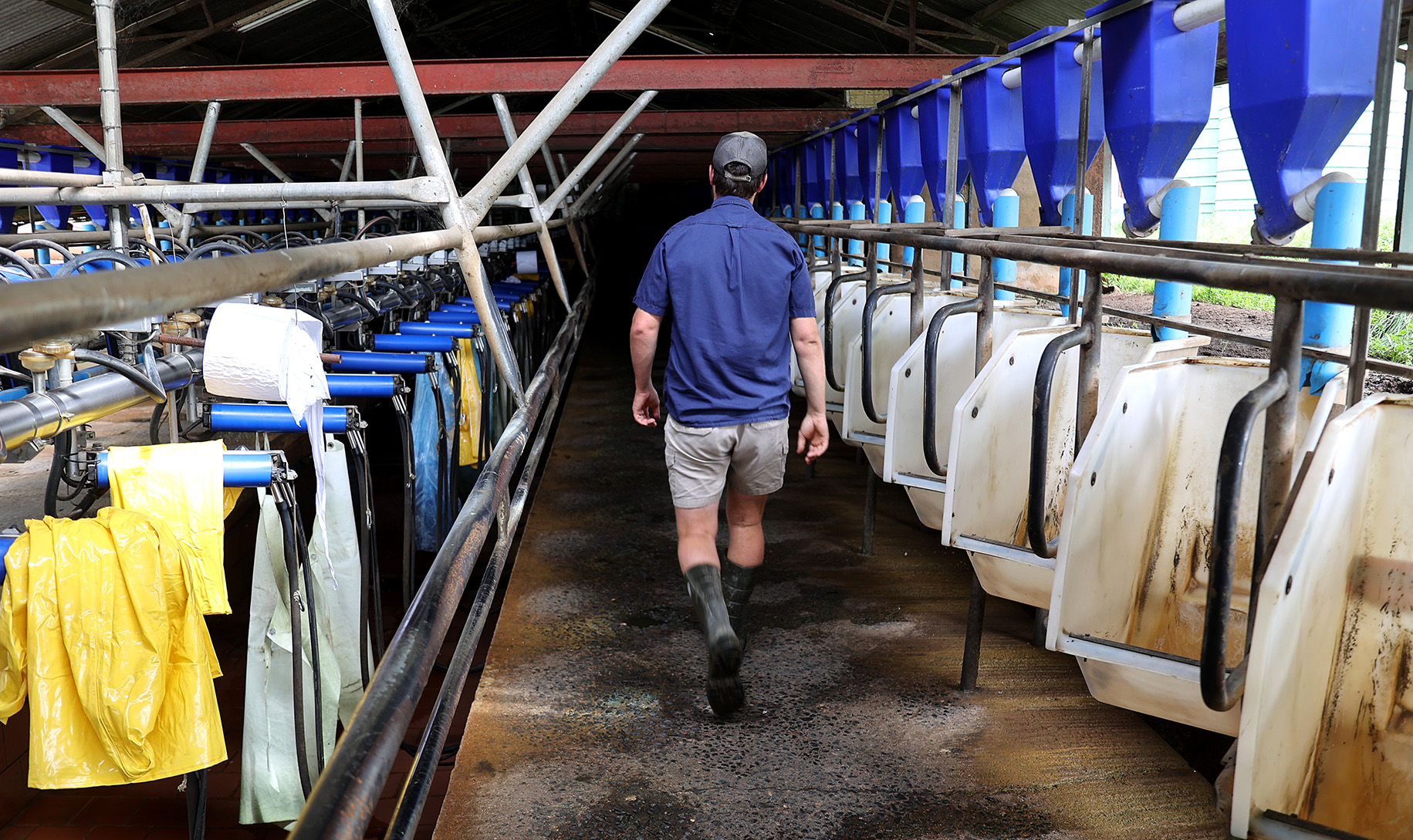
 South African dairy farmers have been hard-hit by the latest outbreak of foot-and-mouth disease. (Photo: Leano Larona)
 Attorneys representing Sakeliga, the Southern African Agri Initiative (Saai), Free State Agriculture and several farmers have sent a letter of demand to the minister of agriculture and other officials, calling on the government to allow private administration of foot-and-mouth (FMD) disease vaccines.
The letter asserts that there is no legal barrier preventing livestock owners from procuring and administering vaccines.
Citing the Animal Diseases Act, it emphasises the obligation of livestock owners to prevent disease and administer the necessary treatments, suggesting that private vaccination is both rational and lawful, and highlighting the urgent need for action against the rapidly spreading FMD.
The minister of agriculture, DA leader John Steenhuisen, has unveiled a national vaccination strategy, but there is a lack of clarity regarding implementation and access to vaccines for farmers.
/file/attachments/orphans/ED_587095_203943.jpg "Agriculture Minister John Steenhuisen. (Photo: Sharon Seretlo / Gallo Images)<br>")
The current government policy restricts vaccine procurement and administration to state entities, which the writers of the letter argue could exacerbate the crisis.
The attorneys’ clients demand a written confirmation by 30 January, allowing the private sector to be involved in vaccine administration. If the government disagrees, it must provide a detailed explanation of any legal impediments, or the attorneys’ clients will seek court intervention to protect the livestock industry.
In response, Steenhuisen released a statement on Tuesday, 27 January, urging unity rather than litigation.
He said the Animal Diseases Act governed the controlled vaccination process.
“The threatened court action could well derail the purchasing and rollout of vaccines while the Saai/Sakeliga/Free State Agriculture case moves through the court process and the department waits to obtain a clear directive from the court in this matter,” said Steenhuisen.
“Technical responses required by officials and veterinarians within the department to answer such court challenges will divert critical veterinary and departmental resources away from the frontline fight against FMD.
“In addition, financial resources that could go towards vaccine purchase or personnel recruitment will have to be diverted to answer the court challenge.”
/file/attachments/2987/Screenshot2026-01-29at234118_940869.png)
Shocking
Francois Rossouw, the CEO of Saai, said the minister’s assertions were shocking.
“Farmers are left in misery and despair amidst the biggest crisis ever to have hit the livestock industry. It’s a crisis which could have been prevented if the Department of Agriculture and the agricultural enterprises had done what the law demands from them, or if there were consequences for ineptitude or reckless neglect by government officials,” said Rossouw.
“Minister John Steenhuisen’s reaction to the letter of demand sent to him by Saai, Sakeliga and Free State Agriculture has shocked the farming fraternity to the core. Not only does it reflect the petty politics in which he got entangled, but it also shows how shallow his understanding of the essence and the extent of this crisis is.”
Steenhuisen said, “Claims proposing a vaccine-free-for-all are short-sighted and reckless and fly in the face of established international and local precedence for disease control. We have already seen the disastrous effects of unfettered access to vaccines that have been illegally imported into KwaZulu-Natal by certain farmers and the serious risk this has posed.”
/file/attachments/orphans/Frame-94_579926.jpg "(Graphic by Daniella Lee Ming Yesca)")
He urged the farming community to be wary of promises by lobby groups, claiming this was an attempt to “profit from the hardships farmers are currently enduring. These actions threaten a scientific framework designed to ensure the country wins the war against FMD once and for all.”
Roussow refuted this and said the organisations were simply representing their members.
“The accusation that these mass-based membership-driven organisations are engaging him [Steenhuisen] through this letter of demand to profit from it and to drive membership recruitment is misplaced. Having farmers’ constituencies who are severely affected by his department’s massive failure to meet its most basic responsibilities, these organisations can’t do better recruitment than the minister and the department are doing for them,” said Roussow.
He stated that the department's actions contradicted its statements, resulting in a lack of trust among farmers regarding the state’s ability to effectively vaccinate the herd and maintain the country’s FMD-free status.
He criticised Steenhuisen and the department for a “heavy-handed, secretive, centrally controlled blanket vaccination approach to foot‑and‑mouth disease”, saying the department had underestimated the crisis, overestimated farmers’ patience, and failed to be transparent about costs and the scientific framework.
/file/attachments/2987/Screenshot2026-01-29at235734_348039.png)
(Source: RMIS)
Pig farmers
While the beef and milk industries have suffered the most from FMD, the pork industry is bracing for a big outbreak, with seven highly suspicious and confirmed FMD cases at the moment — a number that is expected to increase in the near future.
The South African Pork Producers’ Organisation (Sappo) is finalising pig-specific contingency measures to address FMD, focusing on disease clearance timelines and market access, while designating abattoirs for affected pigs to support operational continuity.
Impact
While plans are being put in place to access vaccines, farmers are reeling from the impact of the disease.
KZN dairy farmer Freddy Bondesio lost 40% of his profits when more than 2,000 of his herd were affected late last year.
“We are a four-part dairy farm employing 165 people. This disease hit us incredibly hard. Three of our dairies were affected, and more than 2,000 cows showed clinical signs. The financial impact was brutal; production dropped by about 40% of our total production. This has been driven by severe mastitis, reduced production, foot problems and cow deaths,” said Bondesio.
“We saw milk quality fall, our medical bills go up almost threefold, electricity costs rise by roughly 30% due to longer milking hours, and labour costs increase by 20 to 30% because the work became so much heavier. Years of work and progress disappeared in just a few months. It has been devastating for our animals, our staff and our business.”
/file/attachments/orphans/FMD28_521809.jpg "Disinfection stations on the highways around Ixopo and at the entrances of farms in a bid to stop the spread of FMD. (Photo: Leano Larona)")
When asked what he would need to protect his animals from re-infection, he said, “We’ve seen that early vaccination can reduce severity, but it does not stop all cases. So we’re cautiously optimistic and ready to support the government because our livelihoods and the rural economy around us depend on getting this right.
“We implemented strong biosecurity the moment we heard about FMD in KZN — spraying vehicles, disinfecting footwear and dipping staff before entering the farms. But in our area, five farms showed symptoms on the same day, and with pasture-based dairies, birds, wildlife and movement from surrounding communities, it’s nearly impossible to stop this virus through biosecurity alone.
“We suspect airborne or widespread environmental spread. The only realistic tool to prevent re-infection is early (preventative) vaccination. We are encouraged by the minister’s vaccination plan and hope it can be implemented as soon as possible.” DM
The Ministry of Agriculture’s key containment strategies include:
Proactive Vaccination: Moving towards “mass preventive campaigns” in high-risk districts, aiming for 80% coverage of targeted cattle populations.
Zoning and Movement Control: A progressive zoning framework will be implemented, featuring digital, QR-coded movement permits integrated with vaccination records and the Livestock Identification and Traceability System.
Rapid Diagnostic Network: Strengthening the laboratory network to ensure initial results are delivered within 72 hours, with vaccine matching completed in four to seven days to ensure the treatment is effective against specific strains.
Legislative Emergency Powers: Proposed amendments to the Animal Diseases Act will create explicit emergency powers to authorise rapid ring vaccination and fast-track procurement during crises. DM