
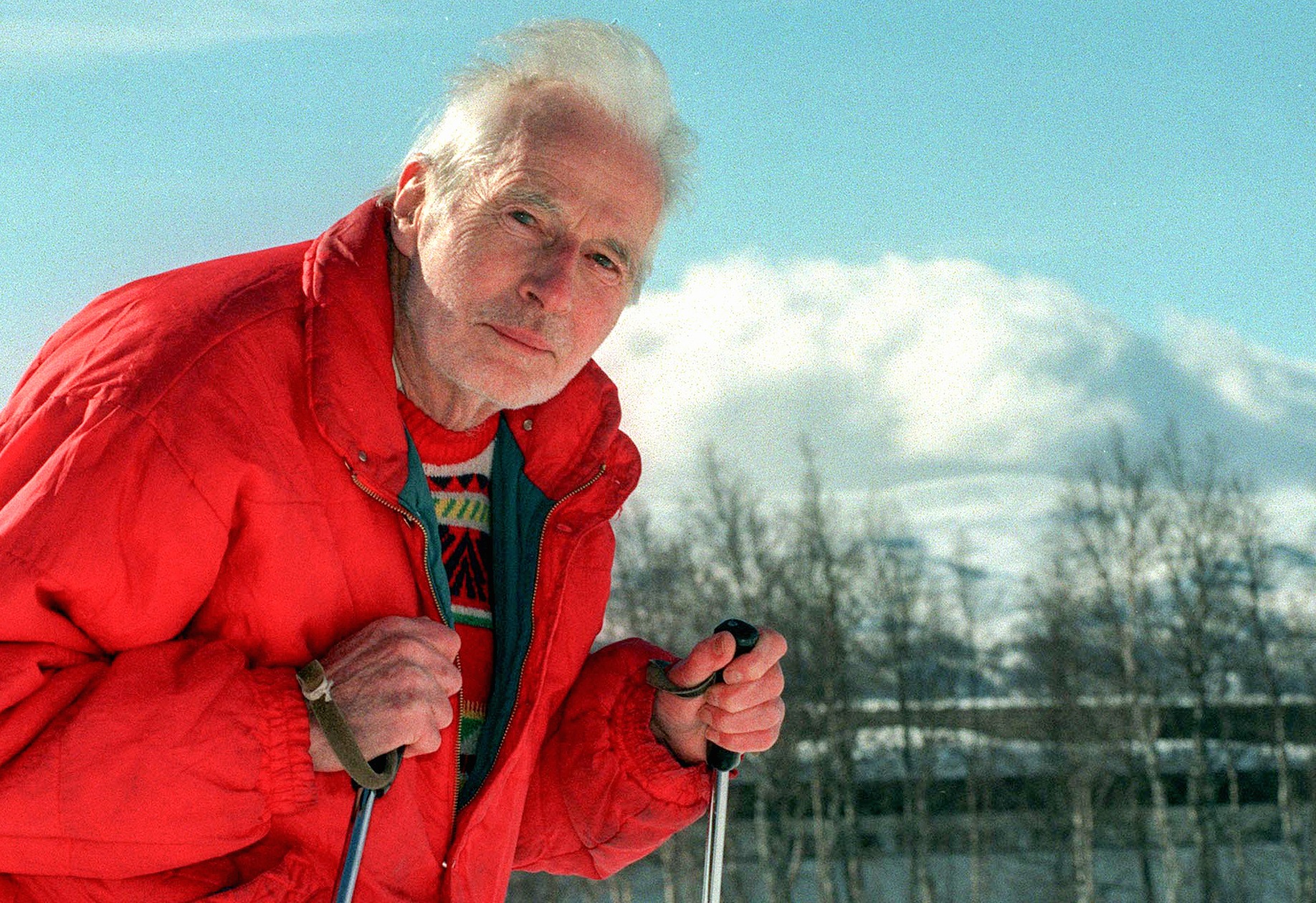
 Father of 'deep ecology' Professor Arne Naess photographed while out skiing, in 1998. (Photo: Per Lochen / NTB via AFP)
 /file/attachments/2987/NOtesfromasmallfinal_916700.jpg)
Imagine a Norwegian philosopher perched high on a mountain ledge, squinting into the wind, not in conflict with it’s icy bite but in conversation with it. This is Arne Næss, father of deep ecology, mountaineer, thinker and occasional wordsmith.
He wasn’t the kind of philosopher who dusted his sleeves in ivory towers. Rather, he rappelled down rock faces, paused mid-climb to ponder the rights of moss, and then descended to write about the moral significance of rivers. His philosophy was not only written on paper but tested against stone and silence.
Deep ecology, as he coined it, insists the world is not merely a warehouse for human use. Every entity – be it a frog, a fungus or a fjord – has intrinsic value, independent of its usefulness to Homo sapiens.
That sounds lofty, perhaps austere, but in Næss’ telling it often came with a twinkle in the eye. He was not in the business of ecological gloom; he loved play, humour and paradox, even as he urged a radical rethinking of our place in the natural world.
From ‘shallow’ to ‘deep’
In 1973, Næss distinguished between ‘shallow’ and ‘deep’ ecology. The shallow kind is anthropocentric: protect forests because they provide lumber or clean air, protect whales because tourists like them.
Deep ecology, on the other hand, insists nature deserves protection because it exists. A river’s dignity doesn’t hinge on our thirst; the owl isn’t just a rodent-control device. Each being is an end in itself.
This distinction was radical. Environmental movements in the 1970s were mostly about pollution, recreation or resource management. Næss came along like a friendly philosopher-elf, saying: “That’s nice, but it’s not enough. You’ve got to go deeper.”
A personal philosophy of nature
Næss coined ‘ecosophy’ (ecological wisdom) for his personal guiding philosophy. His ecosophy, sometimes called Ecosophy T (after his mountain hut, Tvergastein), was his attempt to live in accordance with ecological principles. He grew vegetables, built his cabin high in the mountains and pared his life down to essentials. His ecosophy said:
- Diversity is better than monoculture.
- Simplicity of lifestyle is liberating.
- Self-realisation comes from widening your sense of self until it includes plants, animals and landscapes.
That last point was perhaps his most playful. For Næss, the “ecological self” is expansive. You don’t just identify with your own skin and bones, but with ecosystems. Hurt a river and you are, in some sense, hurting yourself.
Mischievous wisdom
With George Sessions, Næss distilled deep ecology into eight principles:
- All life has intrinsic value.
- Diversity contributes to this value.
- Humans have no right to reduce this richness except for vital needs.
- Human flourishing depends on nonhuman flourishing.
- Excessive interference is disastrous.
- Population should be reduced for the good of all species.
- Policy must change at structural levels.
- Those who accept these must act.
The genius lies in how they blend moral seriousness with Scandinavian pragmatism. They’re not commandments but provocations, designed to make us rethink.
Næss’ environmental understandings weren’t confined to lecture halls. He was famous for holding seminars on mountain slopes, arguing that philosophy should be felt in one’s lungs and calves.
When you debate “intrinsic value” while looking down a thousand-foot cliff, your sense of urgency sharpens.
Næss himself embodied this. An accomplished climber, he claimed philosophy and climbing were not separate pursuits. Both required clarity, humility and respect for limits.
/file/attachments/orphans/1547317_634377.jpg "Norwegian philosopher Arne Naess in Oslo, Norway, in May 2004. Naess died on 12 January 2009 at the age of 96. (Photo: EPA / Aas / Erlend)")
Against anthropocentric arrogance
Playful though he was, Næss’ critique of human-centred thinking was sharp. He saw anthropocentrism as arrogance that blinds us to the world’s fullness. He mocked the idea that humans are the pinnacle of evolution, suggesting instead that our task is to find our proper niche.
This didn’t mean disapproval: Næss loved people and insisted deep ecology was not anti-human. It was pro-context. Humans thrive best when embedded in healthy ecosystems. When we strip away forests and poison rivers, we diminish not only other species but ourselves.
Unlike doom-laden environmentalists, Næss radiated a kind of joyful austerity. He practiced voluntary simplicity, not as punishment but as liberation.
More things, he argued, don’t equal more happiness. A life pared down to essentials – books, skis, gardens, friends – was richer. He once said: “The smaller the ecological footprint, the bigger the possibility for genuine joy.”
This remains one of his most appealing legacies: presenting environmentalism not as guilt, but as a path to freedom.
Influence and critique
Næss’ deep ecology inspired eco-activists, spiritual movements and green politics worldwide. Earth First! borrowed its uncompromising defence of wilderness. Ecofeminists, bioregionalists and Buddhists found resonances in its rejection of human domination.
But critics called it vague, mystical, or inattentive to social justice. Who decides what counts as “vital needs”? How do we balance human rights with ecosystem rights? And does identifying with rivers solve the structural power of corporations?
Næss welcomed such critiques. For him, philosophy was dialogue, not dogma. The “deep” in deep ecology wasn’t about final answers but about asking deeper questions. Answers to such questions are today central to the work of the Rights of Nature movement.
A playful legacy
Arne Næss died in 2009, but his presence lingers in environmental thought like alpine air. He left us more than a philosophy, he left us an attitude: seriousness without solemnity, critique without despair, laughter echoing through mountain valleys even while facing ecological collapse.
If today’s climate debates often feel grim, Næss offers another tone: playful seriousness. Protect the Earth not because you must, but because you are the Earth, and because doing so can be joyful.
To read Arne Næss is to be reminded that philosophy can be both mischievous and transformative. His deep ecology challenges us to recognise the intrinsic value of all beings, to expand our sense of self and to embrace simplicity as joy.
But perhaps his greatest gift is tone: the reminder that caring for the Earth is not just duty, but delight. DM
Books by Naess
Ecology, Community and Lifestyle
Life’s Philosophy
The Ecology of Wisdom