




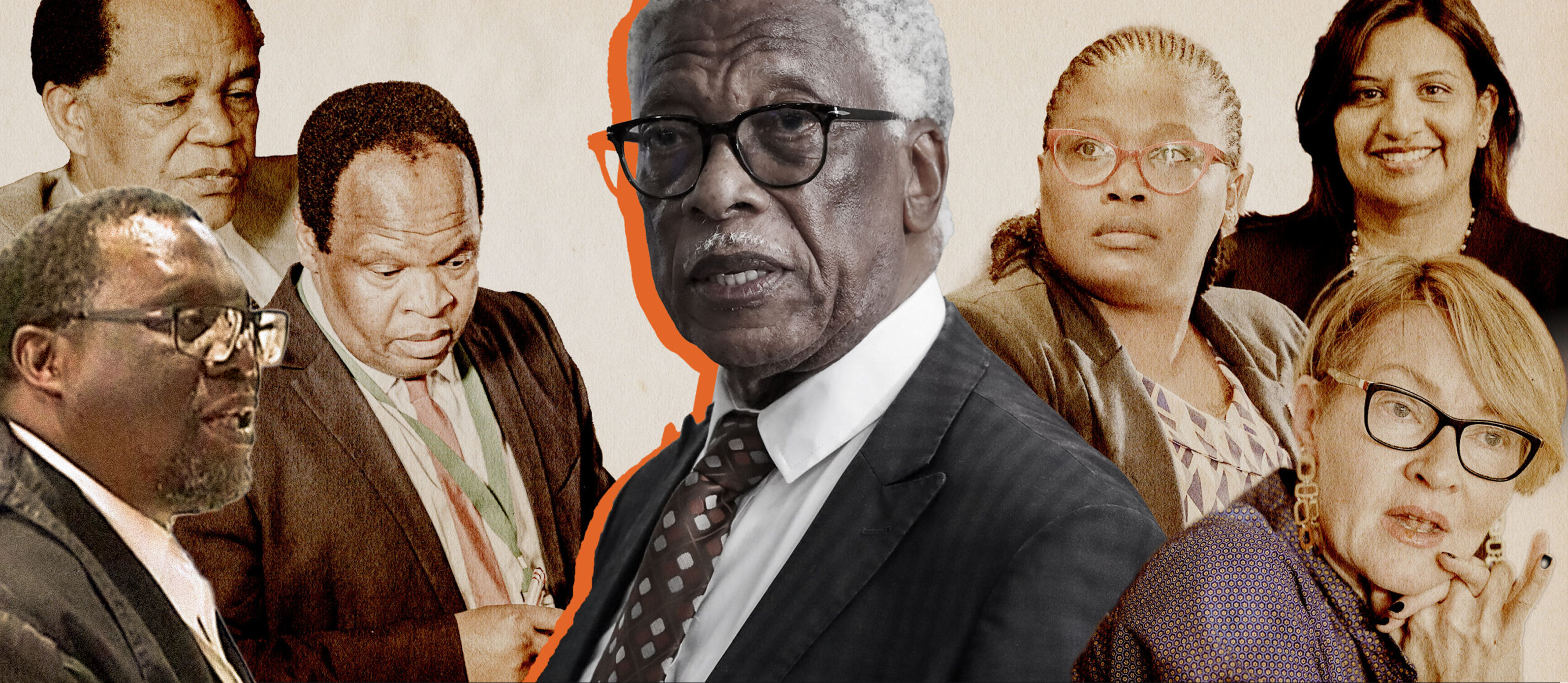
 Illustrative image: Judge Bernard Ngoepe. (Photo: Gallo Images / Sunday World / Mabuti Kali) | Griffiths Madonsela SC. (Photo: X) | Advocate Muzi Sikhakhane. (Photo: Gallo Images / Sharon Seretlo) | Eastern Cape Judge President Selby Mbenenge. (Photo: Gallo Images / Luba Lesolle) | Andiswa Mengo. (Photo: Gallo Images / Luba Lesolle) | Lisa Vetten. (Photo: Chris Collingridge) | Advocate Nasreen Rajab-Budlender. (Photo: LinkedIn)
 /file/dailymaverick/wp-content/uploads/2025/10/label-analysis-2.jpg)
While Eastern Cape Judge President Selby Mbenenge has been found not guilty of gross misconduct, he was found by a Judicial Conduct Tribunal to have fallen short of standards expected of a member of the judiciary.
At the weekend, the tribunal, chaired by retired judge Bernard Ngoepe, released its 169-page findings stating that Mbenenge’s conduct with regard to court secretary, Andiswa Mengo, “fell short of the standards expected of a judicial officer”.
Mbenenge was found guilty of contravening Article 5.1 of the Code of Judicial Conduct, which mandates that a judge should always act “honourably and in a manner befitting judicial office”.
The fact that Mbenenge had initiated and conducted a “flirtatious relationship” with Mengo at her place of work and during work hours was also dishonourable, the tribunal found.
/file/dailymaverick/wp-content/uploads/2025/06/ED_556131.jpg "Complainant Andiswa Mengo at the Judicial Conduct Tribunal at the Capital Hotel in Sandton on 5 May 2025. (Photo: Gallo Images / Luba Lesolle)")
Process not yet over
Meanwhile, the Women’s Legal Centre, which represented Mengo at the tribunal, issued a statement noting that “we are currently supporting our client”, who needed time to process “both the outcome and the deeply disappointing language used in parts of the report”.
The centre was awaiting instruction from Mengo and noted that she reserved her right to consider further legal recourse, “including the possibility of taking the tribunal’s findings on review”.
It was “important” that the tribunal had found Mbenenge guilty of misconduct or inappropriate conduct, the centre noted.
“This finding affirms that the conduct complained of was unacceptable and improper, and that Ms Mengo’s complaint was not without merit”.
The process was not yet concluded, added the centre, as the report now proceeded to the Judicial Service Commission, mandated to consider it in order to make a final determination.
“There remains scope for further submissions to the [Judicial Service Commission]”, the statement concluded.
On the state dime
The tribunal found that the Judge President’s work-related interactions, asking personal questions that included inquiring about Mengo’s relationship status, were intended by Mbenenge to lay the “foundations for a flirtatious relationship”, which had been an abuse of the state’s time.
While some of the communication between the two – including sexually suggestive emojis – had taken place after hours, many messages had been exchanged during working hours, the panel found.
This behaviour was deemed by the tribunal to be “detrimental to the business of the court”.
While the tribunal acknowledged the professional hierarchy of the environment – Mbenenge as Judge President and Mengo as court secretary – it found this power imbalance did not “automatically equate to coercion or sexual harassment”.
Mengo, the tribunal found, had “actively participated” and had “crafted and sent many flirtatious and salacious messages” to Mbenenge, which were “inconsistent with the behaviour of someone being coerced”.
Mengo’s argument – that she had only responded to Mbenenge to “appease” him – was rejected.
The tribunal found that there had been “no evidence of overt or covert coercion or abuse of power” deployed to coerce Mengo’s participation. The issue, rather, was whether “a reasonable person” could have viewed her “active and salacious responses” as a sign of consent.
/file/dailymaverick/wp-content/uploads/2025/08/Z63_3015.jpg "Gender-based violence researcher Lisa Vetten. (Photo: David Harrison)")
Abuse of power
The tribunal also rejected Dr Lisa Vetten’s expert testimony that the power imbalance between Mbenenge and Mengo created “coercive circumstances” which had made it difficult for a junior employee to say “no”.
Vetten had analysed the WhatsApps between the two parties and had told the tribunal that Mengo had on numerous occasions said “no” to Mbenenge. Mbenenge, who is also a pastor, was not deterred by a Bible verse, Psalm 1, Verse 1, sent to him by Mengo after he had suggested they physically meet.
Vetten set out how, before this, Mbenenge had bombarded her with requests for photographs and had asked her 14 times to discuss her favourite sexual position, to which she did not respond.
The tribunal, however, found that “the most significant evidence mitigating the idea of relentless advances” was an incident in East London involving a request for sexual intimacy. This was when Mengo sent the Bible text.
Boundaries
When Mbenenge had suggested they have sex, the tribunal noted, Mengo had “politely rebuffed him, quoting a Bible verse and stating it was impossible”. Mbenenge, noted the tribunal, had “immediately accepted this rebuff”.
This behaviour had indicated that the Judge President had not harassed Mengo as he had “respected the boundary once it was clearly established”.
An abuse of power could not be simply “assumed” when one person was senior to another, and “in a democratic society the law could not prohibit associations – including flirtatious ones – across lines of seniority and wealth”.
Ngoepe said he agreed with Mbenenge’s counsel, advocate Muzi Sikhakhane, who had argued that “it would be absurd to suggest that judges could only associate with other judges, or clerks with other clerks”.
The finding of Misconduct Simpliciter instead of Gross Misconduct, an impeachable offence, was based then on Mbenenge’s violation of the Code of Judicial Conduct relating to his professional behaviour in the workplace he led.
/file/dailymaverick/wp-content/uploads/2025/05/GroundUp-Mbenenge-sex-emojis.jpeg "Dr Zakeera Docrat gives evidence at the Judicial Conduct Tribunal in May 2025. (Photo: Office of the Chief Justice)")
The meaning of emojis
Dr Zakeera Docrat, a forensic and legal linguistic expert, was called by the tribunal to testify on how the many emojis between Mbenenge and Mengo should be interpreted.
The panel found that emojis did not have “a universal definition” and that “their meaning depends entirely on the common understanding between the specific people using them”.
An eggplant, in other words, might symbolise a night out at a Greek restaurant to some, the tribunal seemed to suggest.
“If both parties understand what an emoji represents in their conversation, an expert cannot override that meaning to create a different narrative,” the tribunal found.
In other words, the knowledge of experts was not required, and that subjective understanding is what counted.
Mengo had argued that the use of statements like “hayini” (no way) had constituted a rebuff. However, the tribunal noted that “she often followed these words with laughing emojis, which indicated she was using the term as an exclamation of playfulness rather than a genuine ‘no’ ”. DM