




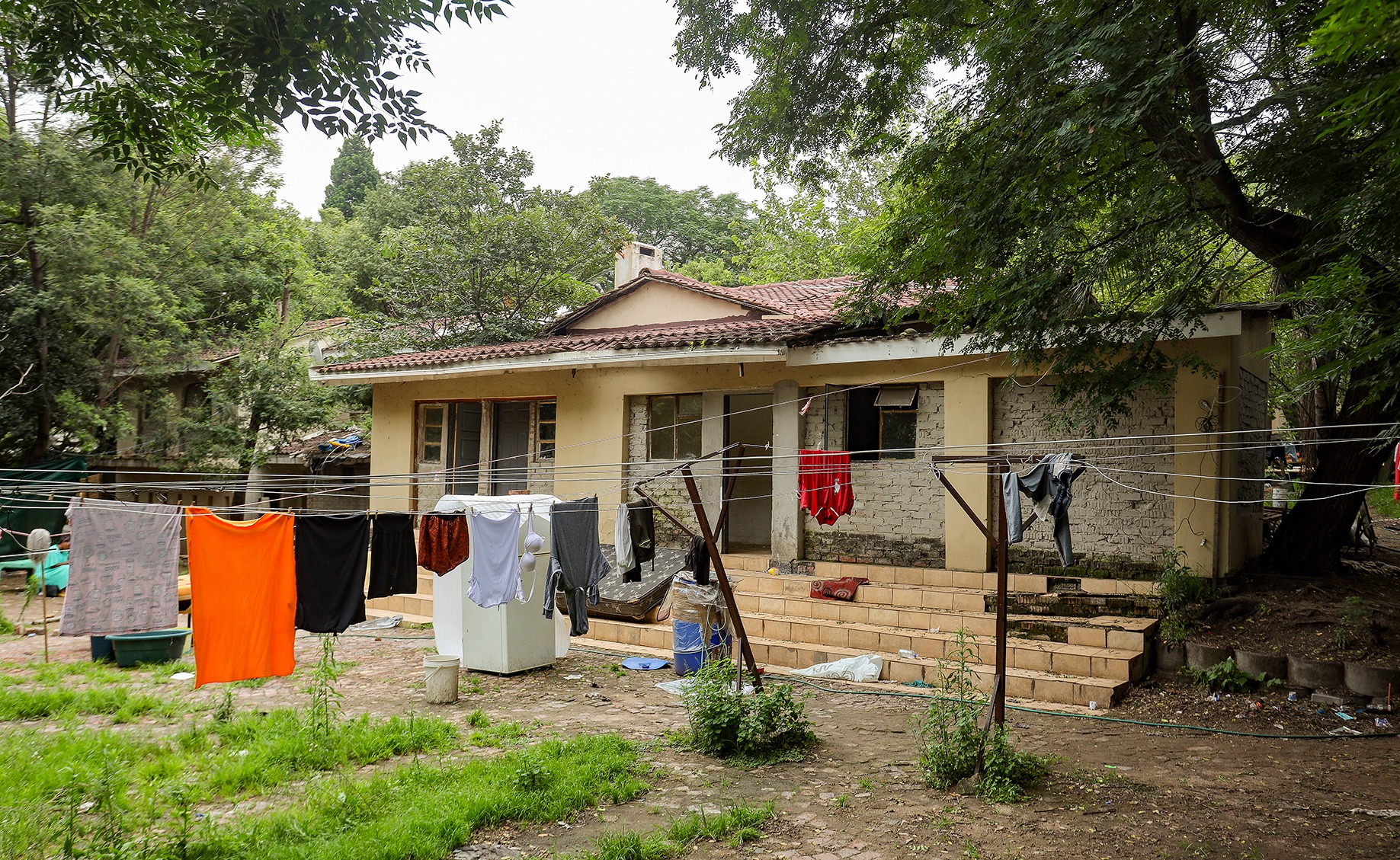
 A multidisciplinary operation by the City ofJohannesburg raided a number of hijacked houses in Bryanston on 8 January 2026. While building hijacking is common in the Johannesburg CBD, syndicates have now moved to the northern suburbs. (Photo: Fani Mahuntsi / Gallo Images)
 Earlier this month, City of Johannesburg officials raided a hijacked residential property in the leafy, affluent suburb of Bryanston that had been turned into a makeshift village illegally housing more than 70 families.
Days later, on 12 January, a second hijacked Bryanston property, valued at R5.5-million, was raided by officials, underscoring that a problem that was once thought to be confined to Johannesburg’s CBD has spread into its suburbs.
The operations were led by the City manager, Dr Floyd Brink, who confirmed that at least 17 residential properties in the area were being investigated for similar infringements. A suspect, Lawrence Ramalwa, was arrested on 8 January in connection with both raided properties. He has since been released on bail and is due to appear in court on 27 February.
/file/attachments/orphans/ED_592118_163462.jpg "A neglected pool at one of the hijacked houses in Bryanston targeted during a multidisciplinary operation on 8 January 2026. (Photo: Fani Mahuntsi / Gallo Images)")
According to media reports, the R5.5-million property was hijacked in 2020 and illegally reconnected to utilities after it had been disconnected by the owner. It is alleged Ramalwa retrofitted the house with makeshift structures, collecting more than R164,000 a month in rent from the tenants. The property racked up more than R1.1-million in municipal arrears, long after the owners flagged that it had been hijacked.
“These interventions form part of an ongoing, multi-departmental strategy to reclaim hijacked buildings, enforce by-laws, protect communities, and hold perpetrators accountable,” Brink said on 12 January. “No individual or group is above the law.”
So how does one hijack a house? And what options do homeowners have once they find themselves in this position?
House hijackers’ tactics
Andre Snyman, head of eBlockwatch, a local community watch group, told Daily Maverick that house hijacking is a growing problem in Bryanston and is organised by criminal syndicates that have been operating in the area for years unnoticed by neighbours and the City.
He explained that house hijackers use two methods. With the first, they pose as legitimate renters to landlords under the pretext that they are interested in renting to buy. They often lack legitimate documents but manage to persuade landlords by offering large sums of money upfront as deposits and promising to cover maintenance costs themselves.
“[The hijacker] signs [a] contract with the owner with an offer to buy, to purchase, but first rental. […] He pays maybe the first month, but he says, if you want me to buy this property, the swimming pool needs to be redone, or the geyser’s not working; he starts small […].
“And then he says, I’ll fix it up and I’ll deduct it off my rent. And of course, the owner’s keen,” Snyman said. “So then that is the first mistake that the guys make because he now can deduct stuff off the rent.”
Soon, the hijacker stops paying rent altogether and refuses to leave the property, forcing the landlords to go through the courts to obtain a legal eviction order. The hijackers use the money they’ve already spent on the house as ammunition in court and then employ a number of tricks to drag out the process over several years.
/file/attachments/orphans/ED_592108_806710.jpg "Inside the dilapidated kitchen in one of the hijacked houses in Bryanston targeted during a multidisciplinary operation by the City of Johannesburg on 8 January. (Photo: Fani Mahuntsi / Gallo Images)")
The second tactic is for hijackers to target and occupy properties that have been left vacant by owners who are either living abroad or away on vacation. Once the property has been occupied, they are able to erect makeshift accommodations, move tenants in and rack up municipal fees under the legal owners’ names.
This was the case for one Bryanston property owner who, according to a 17 January News24 report, had been living in Zambia when he discovered that he had been declared dead and his house had been hijacked.
Snyman said that any attempt by the property owners to take matters into their own hands can make matters worse as the hijackers will be able to obtain an interdict against the owners.
“You can’t go along there even to intimidate them. Because if you go and for example, people have often said you put a swarm of bees there, or you drop sewage in there, or you put stones at the front door. That’s intimidation. So the law is very much in favour of these guys,” he said.
‘Don’t leave the house empty’
Once hijackers are in, it’s an uphill battle to get them out. Mike Bolhuis is a senior specialist security provider who has worked on the issue of hijacked properties for 20 years. He told Daily Maverick that residential property hijacking has been an ongoing problem in rural and low-income areas for years. He said hijackers rely on abusing existing legislation such as the Prevention of Illegal Eviction from and Unlawful Occupation of Land Act (1998), also known as the PIE Act, which requires landlords to obtain a court order for a legal eviction.
“The law is a slow process through courts to get a person evicted, because they can play many cards – they’re then sick, or they don’t have legal representation, or they fired their previous legal representation; there’s so many tricks they pull,” Bolhuis said. “In the meantime while they’re doing this, they obviously score – they don’t pay the huge rent, they use those properties to commit other crimes, [and] they run a business from there.”
/file/attachments/orphans/ED_592102_319788.jpg "This unkempt house was also included in the multidisciplinary operation targeting hijacked houses in Bryanston on 8 January. (Photo: Fani Mahuntsi / Gallo Images)")
Property owners’ next steps
So what can property owners do to protect themselves? The first thing Snyman advised is that prevention is easier, and he encouraged property owners to use legitimate estate agents and property managers, as they will perform the necessary checks on prospective tenants.
“Number two, if you’ve got an empty stand, don’t leave the house empty because people will move in. And once they move in, you will never get them out,” he said. “If you don’t live in the area, get a security company to go to your premises once a week or once, twice a week or whatever, and send a WhatsApp location when they’re there to you, with a photograph to say your property is empty, it’s all okay. And if they see somebody there, they must immediately inform you so that they can remove these guys immediately because they’re trespassing.”
If hijackers have already moved in, Bolhuis said that the best thing for property owners to do is to act quickly and refuse to accept further stories about delayed payments.
“Get the maximum information, keep your enemy closer than your best friend, and once you have everything, open up a proper police case, [you] or your trustworthy lawyer, and get a case on an urgent basis through the high court,” he said. “If you can afford it, [go] through court with the correct people and police in place and get them evicted, otherwise it’s going to take too long.” DM