




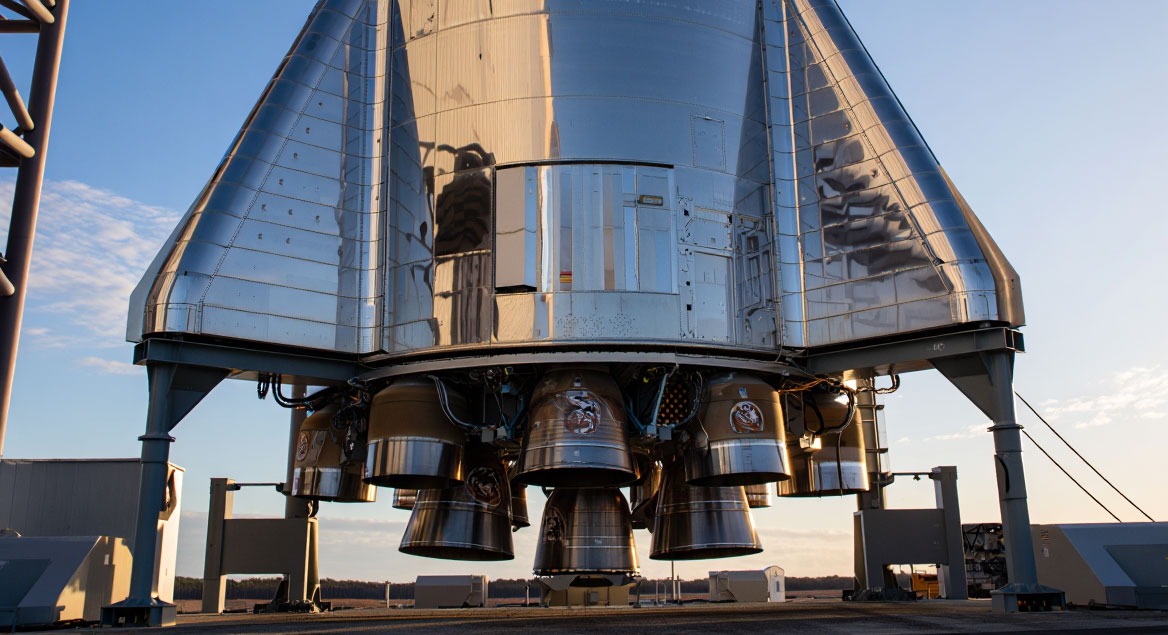
 Amid rumours Elon Musk is taking SpaceX public, the company’s valuation has been pegged at about $1.5-trillion. (Image: Reve.art)
 A few statistics came across my screen this week that made me blink and re-read. SpaceX launched 165 rockets in 2025. That is nearly one every two days. And if you think that’s astonishing, consider this. Musk’s new rocket, Starship, will cost customers somewhere around $100–$150 (R1,600–R2,500) per kilogram to launch payloads into Earth’s orbit. That is 10 times cheaper than SpaceX’s current much re-used rocket Falcon. And about 50 times cheaper than the French-made Arianne. And 200 times cheaper than Nasa’s SLS.
In just two decades, SpaceX has managed to edge out former aerospace heavyweights Boeing, Lockheed and Northrop Grumman to gain 800-pound gorilla status over rocket launches in the United States. But market share alone understates the structural nature of this dominance. SpaceX launched more rockets in 2025 than the rest of the world combined, put up 75% of everything that went into space and operates a satellite constellation almost 10 times larger than any competitor. Perhaps most significantly, SpaceX remains the only way to get Nasa astronauts into space.
Musk owns the space industry. No one else is even close, nor is there any indication that serious competition is coming, although there are some distant aspirants like Jeff Bezos’ Blue Origin (which has managed exactly one launch) and the Chinese government, which must be apoplectic with envy. And because of SpaceX’s mastery of re-usable rockets, no one can get close to is customer pricing and no one else has ever built a re-usable rocket.
SpaceX is so far ahead that the word monopoly does not even apply.
SpaceX whispers
The reason these stats are suddenly buzzing around the airwaves hark back to a tweet on 11 December from a guy by the name of Eric Berger, the senior space editor at Ars Technica and a long-time “SpaceX whisperer”. He published an article titled Here’s why I think SpaceX is going public soon. Elon Musk replied directly to Berger’s post, stating simply: “As usual, Eric is accurate.”
Things got hot immediately. Musk had been consistent – SpaceX would never go public. And here he was, confirming it. Cellphones buzzed. Analysts spreadsheeted. Commentators hypothesised. Investors hyperventilated.
How much? What is this company worth? And how much did it want to raise? When the figures emerged, there was a beat of stunned silence followed by the cacophony of frenzied conversation.
The company would be valued at $1.5-trillion (R25-trillion) from which the company would be raising north of $30- billion (R450-billion). That valuation sits between the GDPs of the Netherlands and Australia.
It is difficult to put this number in perspective.
There has only been one listing of a company which is valued higher, and that was Saudi Aramco in 2019, valued at $1.7 trillion ($30 trillion). It owns most of the world’s oil, while SpaceX owns a couple of rockets and some communications satellites. SpaceX has negligible revenue and profits compared to the giant old oil company. In what world could this be rational?
In the cold hard light of the future of everything, it is.
Starship opens new frontiers
Let’s return to SpaceX’s spanking new and successfully tested monster rocket Starship, and consider this: Starship is designed to carry 100 to 150 metric tonnes to orbit. To put that in perspective, the Space Shuttle – the pinnacle of 20th-century engineering – carried about 25 tonnes. Starship has the internal volume of a small cathedral.
More importantly, internal SpaceX chatter suggests the marginal cost (the cost to do one more launch) could eventually drop to a paltry $2-million (R30-million). Even if it charges customers $20-million per launch to recoup R&D, it is still undercutting the closest Old Space competitor by roughly 99%.
When analysts look at that $1.5-trillion valuation, they aren’t looking at “rocket sales”. They are looking at the fact that SpaceX has built a shipping container for the stars. If Starship truly reaches $100/kg, it makes it cheaper to launch a satellite than it currently is to ship a heavy crate of high-end machinery across the ocean.
It isn’t only external payloads that SpaceX will have completely captive. It is SpaceX’s wholly owned company Starlink, its communications satellites and connectivity play. Starlink has become the flywheel: demand generator, cash engine and strategic moat all in one. As of December 2025, Starlink said it had more than 9 million active customers across 155 markets, growing at a pace Business Insider described as roughly 20,000 new users a day.
On the supply side, the Verge reported that by October 2025 SpaceX had launched its 10,000th Starlink satellite – an industrial scale that begins to resemble Earth-bound telecom infrastructure. Rumours are that Musk wants 70,000 Starlink satellites in place in two years, and having just bought a whack of cellphone spectrum from Echostar, he is clearly positioning the company to become the largest global telecommunication provider within a few years.
Commentator Joseph Orifice provides this context: “Starlink is the largest satellite broadband network on the planet. Millions of homes in rural and underserved areas now rely on Starlink as their primary internet connection. Airlines use it for in-flight Wi-Fi. Shipping fleets use it in the middle of the ocean. Governments and militaries use secure versions for communications and surveillance. Starlink has transformed SpaceX from a launch company into a recurring-revenue infrastructure business.”
Lowest-price third-party payload launcher, telecoms giant, builder of data centres in space, deployer of space-based military ordnance and surveillance kit.
In short, emperor and arbiter of the last industrial frontier – space.
Is all of that worth a valuation of $1.5-trillion? Some analysts who have done the numbers have argued that it is a bit rich, but if you add the “Elon Musk premium” it’s a steal. I looked at the valuation metrics, but once they get into orders of magnitude times revenue (never mind profit) my brain just shuts down. But one has to keep in mind – SpaceX currently entirely owns almost all space infrastructure. And traditionally, any monopoly on infrastructure (rails, roads, ports) is where the trillions lie.
There are two final matters. Firstly, for those who dislike Elon the man and wish for his comeuppance, this has got to hurt. There were audible cheers across the world across a certain demographic when he damaged his Tesla brand with his chainsaw politics, but this time is different. And to add insult to injury he is rumoured to be considering awarding Tesla shareholders early access to SpaceX shares, which will cause a tsunami of new investors into Tesla stock, spiking its price and increasing his swag pile further.
Finally there is the date of the IPO – early June 2026. According to, er, astrologers this is when Jupiter aligns with Venus and Earth. I have no idea whether this is important to the mercurial SpaceX boss, but as Bloomberg’s Matt Levine says in his MoneyStuff column – “if Elon Musk sometimes cares about astrology, then the market sometimes has to care about astrology too”. DM
Steven Boykey Sidley is a professor of practice at JBS, University of Johannesburg and a partner at Bridge Capital and a columnist-at-large at Daily Maverick. His new book It’s Mine: How the Crypto Industry is Redefining Ownership is published by Maverick451 in SA and Legend Times Group in UK/EU, available now.